
Olympus Mons
Olympus Mons is a vast shield volcano on Mars and the highest known mountain and volcano in the solar system, famed for its enormous size, low slopes, and layered summit caldera.
Overview
Olympus Mons is a colossal shield volcano on Mars. As the tallest known volcano and mountain in the solar system, it dominates the surrounding Tharsis region and is a frequent subject of planetary geology and exploration. Its broad, gently sloping profile, extensive lava flows and collapsed summit structures make it an archetype of large volcanic edifices formed by prolonged effusive eruptions. The feature is commonly described as a shield volcano and lies on the planet Mars.
Image gallery
10 Images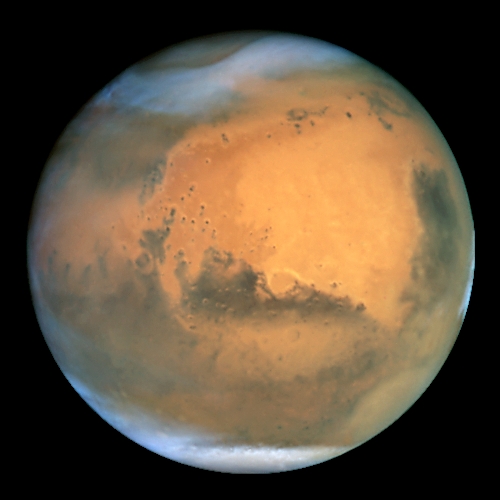





Physical characteristics
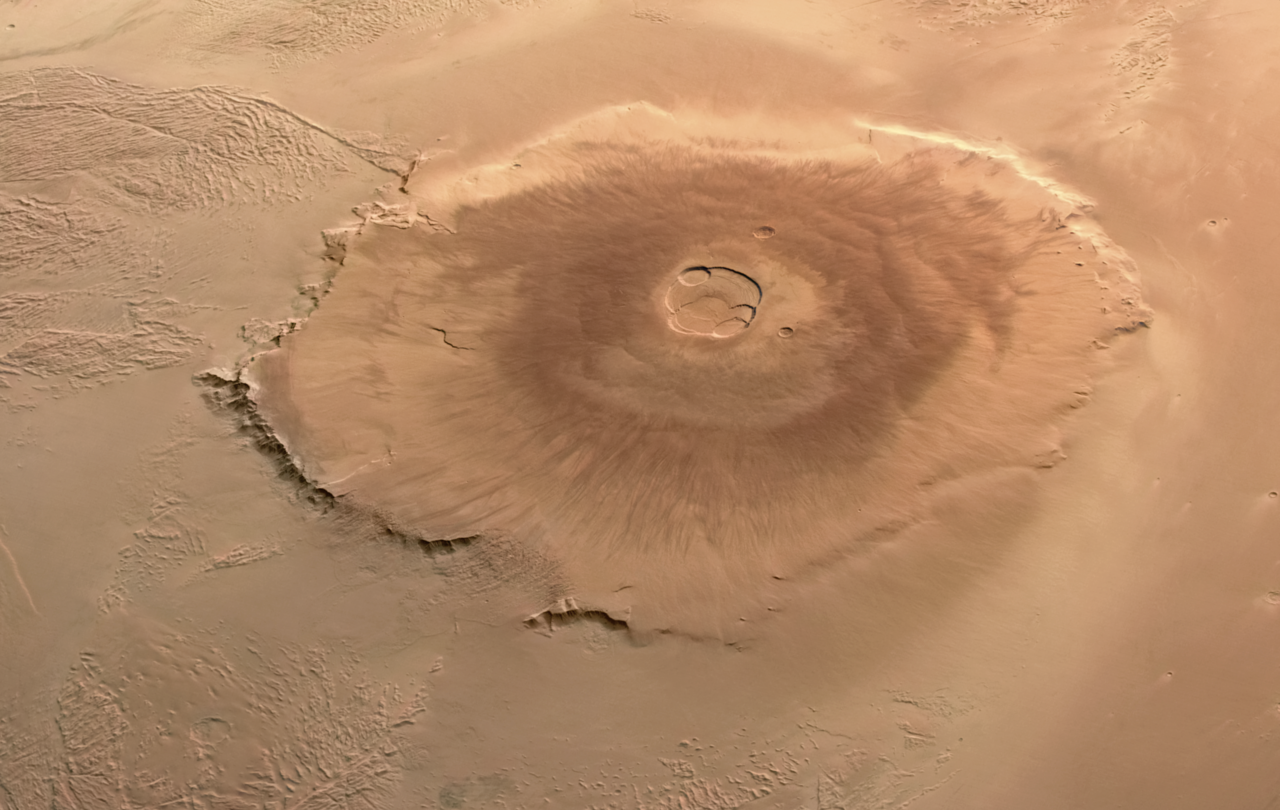
Olympus Mons rises far higher than any terrestrial peak and extends across a vast base. Its summit contains a complex of overlapping calderas surrounded by steep escarpments and a broad apron of debris. The volcano's flanks show numerous lava flows that spread out from the central edifice, producing the classic low-angle shield shape with gentle slopes over long distances.
Parts and structure
- Caldera complex: Multiple collapse pits mark the summit and record repeated eruptive cycles.
- Flanks: Extensive basaltic lava flows built the gently sloping sides.
- Basal escarpment and aureole: Surrounding cliffs and fragmented landslide deposits encircle much of the base.
Formation and geological context
Olympus Mons grew through many long-lived, effusive eruptions of low-viscosity lava. On Mars, the absence of active plate tectonics allowed a persistent volcanic source to remain over a single hot spot, enabling the accumulation of enormous volumes of lava in one location. Lower gravity and differences in crustal properties on Mars also contributed to the volcano’s unusually large size. Detailed topographic studies, including laser altimetry from orbiting spacecraft, have refined measurements of its height and shape.
History of observation and exploration
Large-scale views of Olympus Mons emerged from orbital imagery during the era of planetary probes. Early close-up mapping by orbiters provided the first detailed views of its calderas and lava flows, while later instruments measured elevation and surface textures. These missions transformed Olympus Mons from a telescopic curiosity into a well-characterized target in comparative planetology.
Importance and notable facts
Olympus Mons is notable not only for its record-setting dimensions but also for what it reveals about Martian volcanism, planetary heat flow, and crustal behavior. Scientists study it to understand volcanic processes without plate motion and to compare basaltic shield volcanism across planetary bodies. It is often cited when discussing the largest geological structures known in the solar system and is described in popular summaries as the tallest volcano and mountain (volcano, mountain) relative to counterparts on Earth.
Related articles
Author
AlegsaOnline.com Olympus Mons Leandro Alegsa
URL: https://en.alegsaonline.com/art/72470
Sources
- quest.arc.nasa.gov : "What are the highest and lowest points on the surface of Mars"