
Open star cluster
A loose grouping of stars born from the same molecular cloud. Open clusters are young, share composition and age, and are important tools for studying stellar evolution, distances and galactic structure.
Overview
An open star cluster, often called an open cluster or galactic cluster, is a relatively loose assembly of stars that formed together from the same giant molecular cloud. These aggregates typically contain anywhere from a few dozen to several thousand stars and therefore present a recognizable concentration of common-age stars in the plane of a galaxy. Members of an open cluster share similar ages and chemical composition because they condensed from the same parent cloud; young examples may still be partly embedded in their birth material. For a general reference to the concept of a group of stars and typical populations see descriptions of cluster sizes, and for the birth environment see giant molecular clouds.
Image gallery
10 Images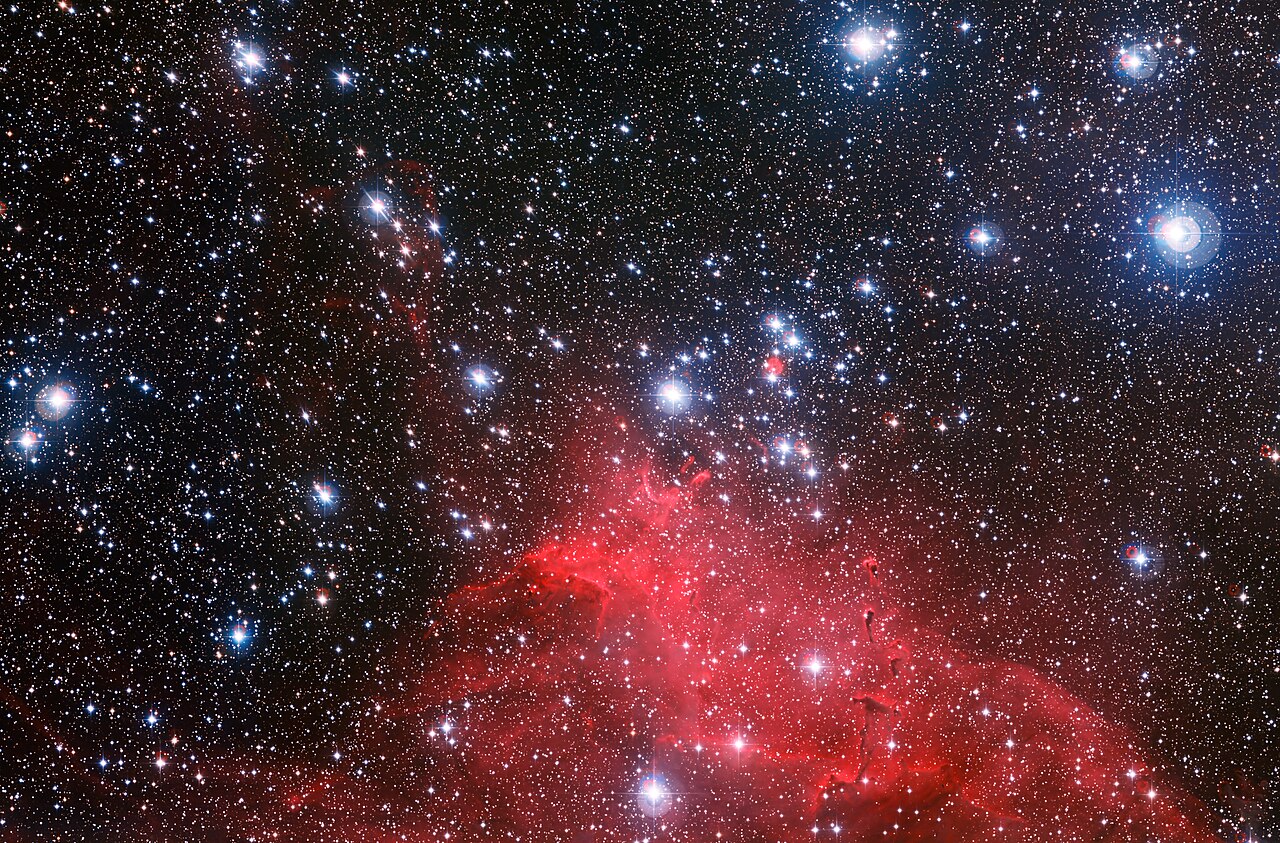




Characteristics and internal structure
Open clusters are only loosely bound by mutual gravity, so individual stars can be stripped away by external forces or gradual internal motions. Young clusters often contain hot, massive stars that ionize surrounding gas and create visible H II regions; radiation and stellar winds (radiation pressure) from those stars begin to disperse the natal cloud, a process discussed at radiation pressure. Cluster populations display mass segregation (massive stars toward the center) and a mix of single and multiple star systems. Because members formed together, an open cluster provides a coeval sample with similar chemical composition, which simplifies comparative studies of stellar properties and evolution (stellar evolution).
Formation, lifespan and disruption
Open clusters form in regions of active star formation, most commonly in the disks and spiral arms of galaxies; they are typically found in spiral and irregular galaxies rather than in elliptical systems. Many newly formed clusters are short-lived, dispersing as stars drift away or as tidal interactions with molecular clouds and the galactic disk heat and disrupt the system. Typical lifetimes vary: small clusters and associations often dissolve within tens to a few hundred million years, while the most massive open clusters can survive for a billion years or more. This contrasts with the denser, older globular clusters, which remain bound for much longer timescales.
Scientific importance and observation
Open clusters are indispensable tools in astrophysics. Because their stars have nearly the same age and distance, astronomers use color–magnitude diagrams and main-sequence fitting to determine cluster ages, distances and test stellar models. Observations across the electromagnetic spectrum — optical for unobscured clusters and infrared for embedded or dust-obscured examples — reveal formation histories and stellar demographics. Studies of open clusters help calibrate the initial mass function, binary fractions and chemical evolution of the galactic disk.
Examples and notable facts
More than a thousand open clusters have been cataloged within the Milky Way, and many more likely remain hidden in dusty regions. Some are bright enough to see without telescopes: the Pleiades, the Hyades, and the Alpha Persei Cluster are classical naked-eye examples familiar to observers. Practical distinctions between cluster types — for instance between open and globular clusters — hinge on mass, density, age and galactic distribution. For researchers and amateur observers alike, open star clusters remain accessible, informative laboratories for understanding how stars live and the larger structure of galaxies.
- Formation site: giant molecular clouds
- Typical study methods: color–magnitude diagrams
- Environmental context: spiral and irregular galaxies
- Contrast: globular clusters vs. open clusters
Questions and answers
Q: What is an open star cluster?
A: An open star cluster, also known as a galactic cluster, is a group of a few hundred or thousand stars that have roughly the same age and were formed from the same giant molecular cloud.
Q: How many open clusters have been discovered in the Milky Way Galaxy?
A: More than 1,100 open clusters have been discovered within the Milky Way Galaxy.
Q: How are open clusters held together?
A: Open clusters are loosely bound together by mutual gravitational attraction but can be disrupted by close encounters with other clusters and clouds of gas.
Q: How long do open clusters typically survive for?
A: Open clusters generally survive for a few hundred million years, with the most massive ones surviving for a few billion years.
Q: Are globular clusters more or less likely to survive than open clusters?
A: Globular clusters of stars exert a stronger gravitational attraction on their members so they can survive for longer than open clusters.
Q: In which types of galaxies are open star clusters found? A: Open star clusters have only been found in spiral and irregular galaxies where active star formation is occurring.
Q: What happens when young open star clusters form in molecular clouds? A: Young open star clusters light up the molecular cloud they form in and create an H II region. Over time, radiation pressure from the cluster will disperse the molecular cloud.
Related articles
Author
AlegsaOnline.com Open star cluster Leandro Alegsa
URL: https://en.alegsaonline.com/art/72770
Sources
- eso.org : "Young stars paint spectacular stellar landscape"
- adsabs.harvard.edu : adsabs.harvard.edu/abs/1979stcl.book.....P
- nightskyinfo.com : nightskyinfo.com/open_clusters/