
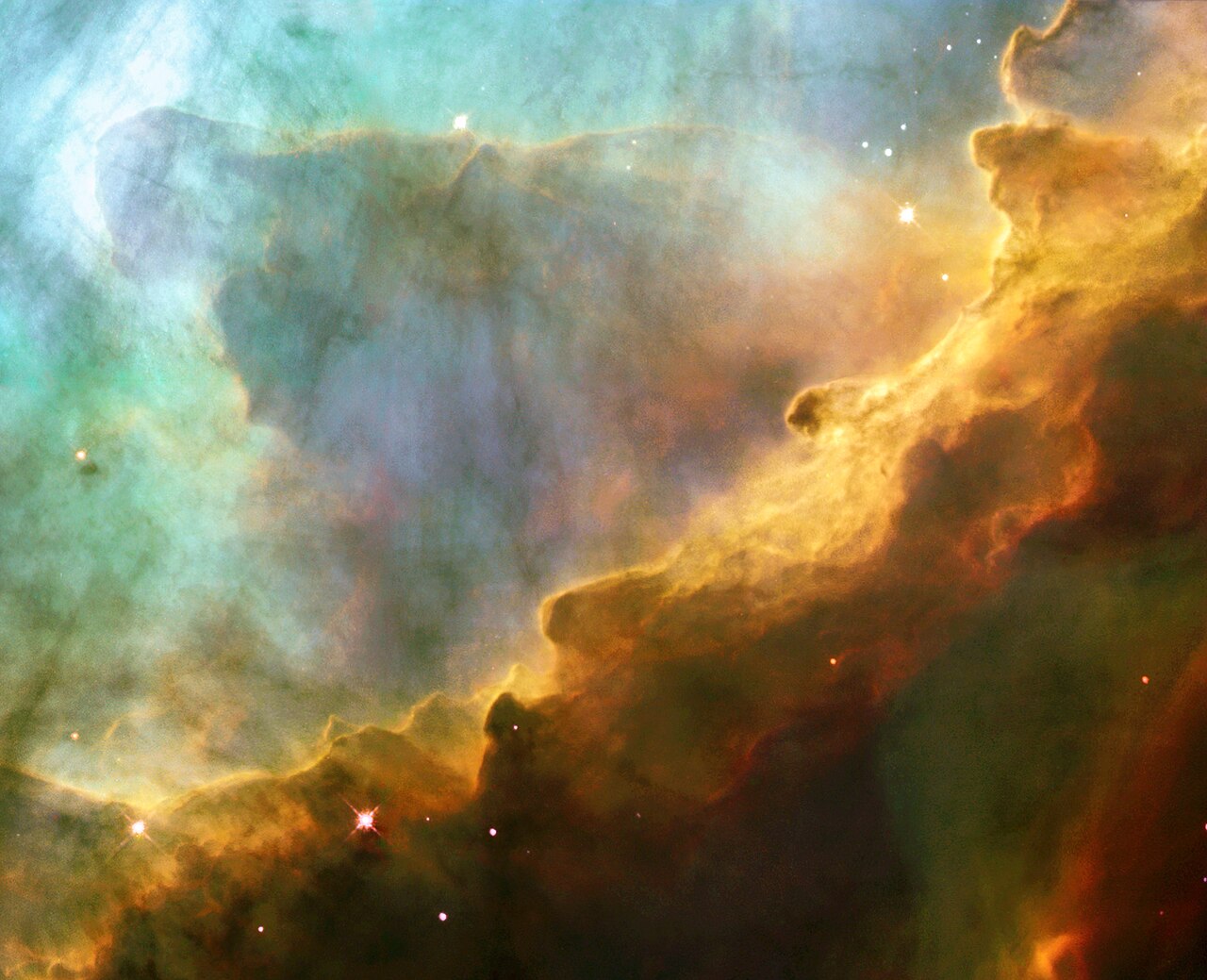
Omega Nebula (M17) — the Swan Nebula, a bright H II region
M17 (the Omega or Swan Nebula) is a luminous H II star-forming region in Sagittarius about 5,500 light-years away, home to the young cluster NGC 6618 and a frequent target for multiwavelength studies of star formation.
Overview
The Omega Nebula, cataloged as Messier 17 or M17 and commonly called the Swan Nebula, is a bright emission nebula and active star-forming region in the Milky Way. As an H II region, it shines because ultraviolet light from hot, young stars ionizes surrounding hydrogen gas, producing strong emission lines visible in optical light and bright infrared emission from heated dust. The nebula lies in the direction of the central Milky Way within the constellation Sagittarius and is commonly cited at a distance of roughly 5,500 light-years from Earth. It contains an embedded open cluster, broadly known as NGC 6618, whose high-mass members provide most of the energetic radiation.
Image gallery
10 Images





Structure and characteristics
M17 displays bright, filamentary clouds of ionized gas, dark dust lanes that carve shadows through the glowing material, and compact cores of molecular gas where new stars are forming. In visible light it shows a distinctive curved shape that observers have likened to an omega (Ω) or a swan in flight. Infrared and radio observations penetrate the dust to reveal protostars and dense clumps in the surrounding molecular cloud; X-ray imaging has also detected many young stellar objects. Spectroscopy of the region shows the hydrogen recombination lines and other emission features typical of ionized nebulae.
Star cluster and star formation
The bright stellar grouping at the heart of M17 (NGC 6618) is a young cluster containing massive O- and B-type stars that dominate the nebula's ionization. These massive stars drive winds and radiation that shape the surrounding gas, creating bright rims, cavities and outflow activity. The region is a laboratory for studying how massive stars influence subsequent star formation, how clusters assemble, and how dust and gas evolve in compact H II environments.
History and cataloguing
Observers first recorded the nebula in the mid-18th century; it was noted by Philippe Loys de Chéseaux and later added by Charles Messier to his catalog as M17 on 3 June 1764. Since those early telescopic views, M17 has been imaged and analyzed across wavelengths—from optical photographs to infrared surveys and radio mapping—making it one of the better-studied compact H II regions in our galaxy.
Observing tips
M17 is bright enough to be seen with binoculars under dark skies and becomes an appealing target in small amateur telescopes, where its overall curved shape and some dust lanes are visible. It is best observed during the northern summer when the constellation that hosts it is high in the sky. Narrowband filters (H-alpha, O III) and infrared equipment reveal additional structure and embedded stars that are otherwise obscured by dust.
Scientific importance and multiwavelength study
Astronomers study M17 to learn about massive-star feedback, the interaction of ionizing radiation with molecular clouds, and cluster evolution. Radio and submillimetre observations trace cold molecular gas and cores, infrared surveys identify protostars and disks, and X-ray imaging reveals energetic young stars. Together these datasets help form a picture of how concentrated H II regions form and disperse their natal material.
Names and quick reference
Besides "Omega Nebula" and "Swan Nebula," M17 has accumulated informal names such as the Horseshoe, Checkmark, and Lobster nebulae, reflecting different impressions of its curved shape. It remains a popular target for both amateur and professional observers because of its brightness and richness.
- Designation: Messier 17 (M17), associated with NGC 6618
- Type: Emission nebula / H II region
- Constellation: Sagittarius (see constellation)
- Approximate distance: 5,500 light-years
- Catalog history: noted by Chéseaux; added to the Messier catalog
Related articles
Author
AlegsaOnline.com Omega Nebula (M17) — the Swan Nebula, a bright H II region Leandro Alegsa
URL: https://en.alegsaonline.com/art/72495