
Ophiuchus Supercluster Explosion: the largest known cosmic eruption
A vast energetic outburst in the Ophiuchus region produced cavities and shock features in intracluster gas, attributed to a powerful active galaxy nucleus; observed across X-ray, radio and optical bands.
The Ophiuchus explosion refers to an exceptionally energetic outburst discovered in the region of the Ophiuchus galaxy cluster (sometimes described in popular accounts as a supercluster). Observers identified enormous cavities and disturbances in the hot intracluster medium that point to a violent release of energy from the cluster core. The event attracted attention because it is among the most powerful single eruptions seen in the observable Universe and because of its implications for how galaxy clusters evolve and how energetic feedback from black holes affects their surroundings. For an overview from a major space agency see NASA and related coverage by other institutions here.
Image gallery
6 Images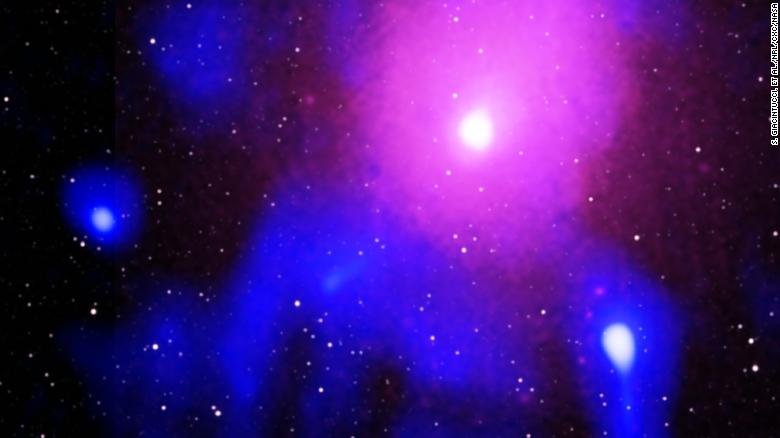





Characteristics and observations
- Scale: the disturbance occupies a very large fraction of the cluster's central region and appears as depressions (cavities) and ripples in the hot X-ray–emitting gas.
- Multiwavelength signature: the structure is visible in X-ray imaging and spectral maps, accompanied by radio emission consistent with jets or lobes inflated by an active galactic nucleus, and optical imaging of the central galaxy provides context for the host black hole. See descriptions of the Ophiuchus region here and the quoted distance estimate here.
- Energy and impact: the outburst injected an enormous amount of mechanical energy into the intracluster medium, producing shocks and buoyant bubbles that redistributed gas and heat on very large scales.
The leading interpretation is that a supermassive black hole in the brightest cluster galaxy underwent an intense episode of jet activity or accretion-driven feedback. Relativistic jets and lobes from the active nucleus inflated cavities and pushed aside the surrounding plasma, a process observed in many clusters but on a much larger scale in Ophiuchus. The central engine is believed to be a very massive black hole; introductory material on that mechanism is available here.
Discovery and instruments
Scientists reached the conclusion using coordinated observations from space- and ground-based facilities. X-ray telescopes that map hot cluster gas, radio arrays that reveal synchrotron emission from accelerated particles, and optical instruments that resolve the host galaxy all contributed. The Hubble Space Telescope and other observatories provided key optical context for the cluster core Hubble details. Combining datasets allowed researchers to link cavities in the X-ray band with radio-emitting structures and to estimate the age and evolution of the outburst.
Aside from the immediate interest in an extreme event, the Ophiuchus eruption informs broader questions: how active galactic nuclei regulate cooling in clusters, how energy is transported through tenuous plasma, and how such feedback influences star formation and galaxy growth. The Ophiuchus case is often cited as an extreme example of AGN feedback and is used to test models of cluster thermodynamics and cosmic energy budgets.
Notes and context: media summaries sometimes label the event "the biggest explosion since the Big Bang," a phrase that attracts attention but simplifies complex comparisons. In technical terms, it is an extraordinarily energetic AGN outburst observed within a nearby cluster, and it provides a concrete laboratory for studying the interaction between supermassive black holes and their large-scale environments.
Questions and answers
Q: What is the Ophiuchus Supercluster?
A: The Ophiuchus Supercluster is a supercluster located about 390 million light years from Earth.
Q: What caused the biggest explosion seen in the Universe?
A: The explosion was caused by a super massive black hole spraying out jets of extremely active particles.
Q: How was the observation of the explosion made?
A: The observation was made by various space-based and Earth-based observatories including the Hubble Space Telescope.
Q: Has such an explosion been seen before?
A: Yes, it is not the first time such an explosion has been seen.
Q: How powerful was the eruption in the Ophiuchus Supercluster?
A: The eruption was extremely powerful.
Q: What evidence has been published regarding the explosion?
A: NASA and others have published evidence for the biggest explosion seen in the Universe.
Q: What kind of particles were sprayed out by the super massive black hole?
A: The super massive black hole sprayed out jets of extremely active particles.
Related articles
Author
AlegsaOnline.com Ophiuchus Supercluster Explosion: the largest known cosmic eruption Leandro Alegsa
URL: https://en.alegsaonline.com/art/72841
Sources
- nasa.gov : "Ophiuchus Galaxy Cluster"
- chandra.harvard.edu : "Chandra Press Room :: Most Powerful Eruption in the Universe Discovered :: January 5, 2005"
- arxiv.org : "Discovery of a giant radio fossil in the Ophiuchus galaxy cluster"
- ui.adsabs.harvard.edu : "Deep Chandra study of the truncated cool core of the Ophiuchus cluster"
- doi.org : 10.1093/mnras/stw1171
- worldcat.org : 0035-8711
- theguardian.com : "Biggest cosmic explosion ever detected left huge dent in space"