
Nuvvuagittuq Greenstone Belt
A very old, metamorphosed sequence of volcanic and sedimentary rocks on the eastern shore of Hudson Bay, Canada; key to studies of early Earth's crust and debated evidence of ancient life.
Overview
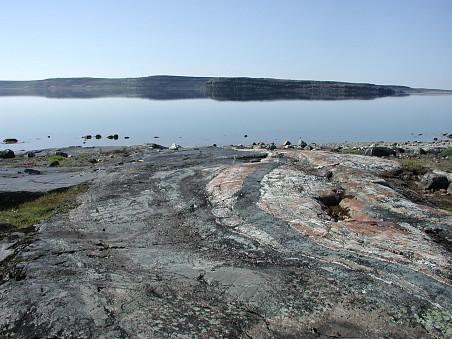
The Nuvvuagittuq Greenstone Belt (NGB) is a compact but scientifically important assemblage of ancient, highly metamorphosed rocks on the eastern shore of Hudson Bay in northern Canada. Researchers study the belt because it may preserve fragments of some of Earth's earliest crustal material. Because the rocks have been strongly altered by later events, interpreting their original character and age requires careful petrographic work and multiple radiometric techniques.
Image gallery
5 Images


Geological characteristics
The belt consists of metamorphosed volcanic and sedimentary sequences together with chemical sediments. Typical components include:
- mafic to ultramafic volcanic rocks transformed to amphibolite and related metamorphic lithologies;
- banded iron formations and iron-rich chemical sediments;
- metasedimentary layers and minor intrusive bodies that record multiple thermal events.
These rock types record processes that affected the early crust, such as submarine volcanism, seafloor alteration and early sedimentation, but their primary textures and original mineralogy have often been overprinted by metamorphism.
Age and scientific debate
Estimates for the age of the Nuvvuagittuq rocks vary. Some studies have reported very ancient isotopic ages suggesting portions of the belt could be as old as the Hadean–early Archean (claims have placed ages in excess of four billion years), while other analyses favor a younger Archean age of roughly 3.7–3.8 billion years. Differences arise from sampling of different minerals, interpretation of isotopic systems, and the effects of later thermal events. Readers can follow background material on the region's setting via regional descriptions and more specific locality references such as the coast of Hudson Bay.
Scientific importance and controversial findings
NGB attracts attention for two main reasons: its potential to preserve remnants of Earth’s earliest crust and reported signatures that some researchers have interpreted as traces of very early life. Claims of microstructures and isotopically light carbon in some Nuvvuagittuq samples have been advanced as possible biological indicators, but these interpretations remain contested because metamorphism can produce similar features abiologically. Summaries of the age claims and biogenicity debates appear in overviews of early Earth studies and specialized papers accessible through age-dating literature and methodological reviews at metamorphic geology resources.
Location, access and research challenges
The Nuvvuagittuq Greenstone Belt lies in a remote subarctic region, which limits field seasons and makes sampling logistically demanding. In addition, the heavy metamorphism and complex structural history complicate efforts to reconstruct original rock types and depositional settings. Continued progress depends on careful sampling, modern isotopic techniques and comparisons with other ancient terranes to build a robust picture of the belt's place in early Earth history.
Related articles
Author
AlegsaOnline.com Nuvvuagittuq Greenstone Belt Leandro Alegsa
URL: https://en.alegsaonline.com/art/71514
Sources
- zenodo.org : "Evidence for early life in Earth's oldest hydrothermal vent precipitates"
- doi.org : 10.1038/nature21377
- pubmed.ncbi.nlm.nih.gov : 28252057