
Obsidian
Obsidian is a natural volcanic glass formed by rapid cooling of silica-rich lava. It is a mineraloid valued for its glassy fracture, historical tools, decorative uses and occasional surgical applications.
Overview
Obsidian is a natural volcanic glass that forms when hot, silica-rich lava cools so quickly that crystals do not have time to grow. Because it lacks an ordered crystal lattice, obsidian is classified as a mineraloid rather than a true mineral. Its appearance is commonly dark and glassy, but a variety of colors and surface effects may occur depending on chemistry and tiny inclusions.
Image gallery
10 Images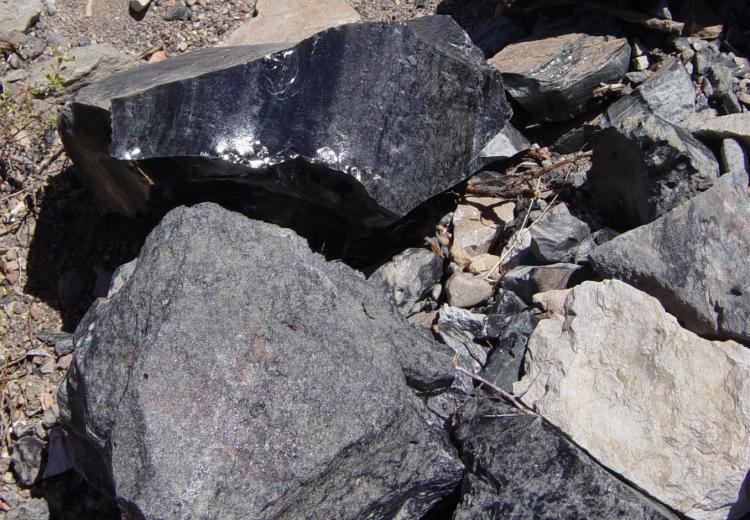


Formation and physical characteristics
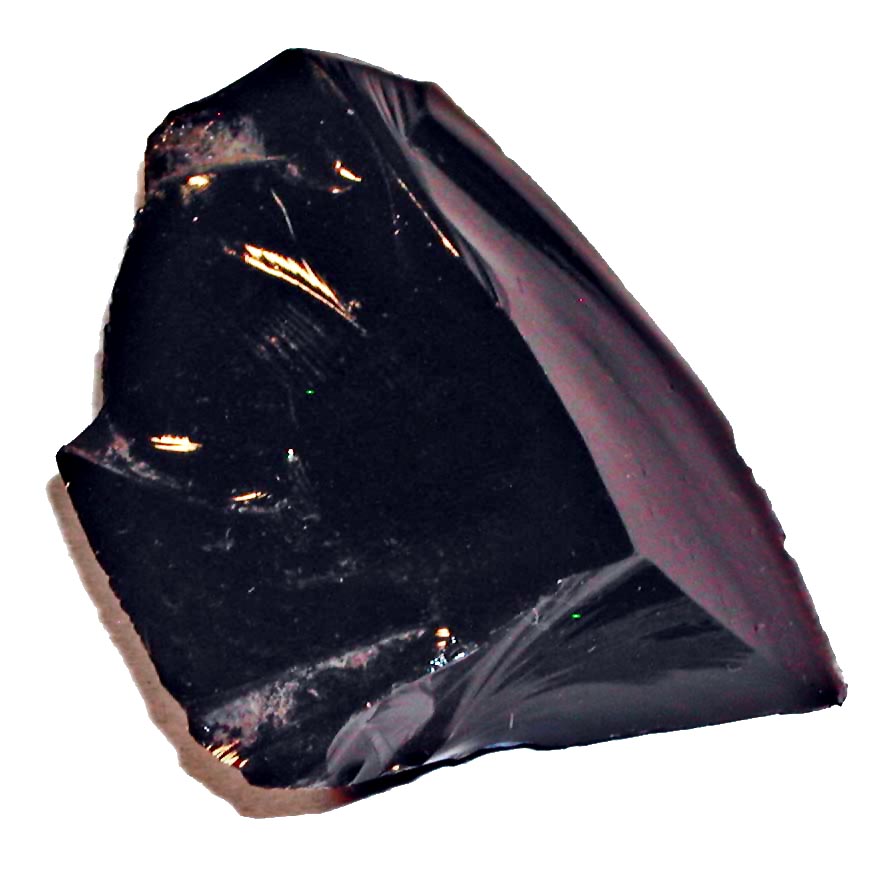
Obsidian originates from rapidly quenched felsic magma. When lava high in silica solidifies quickly, the melt becomes an amorphous solid. The glassy structure gives obsidian a distinctive set of physical properties:
- Conchoidal fracture producing very sharp edges — obsidian blade fragments can be extremely thin at the edge.
- Glassy luster and generally dark colors (black, brown, dark green), though variations may be red, gold, or iridescent.
- Absence of crystal faces or cleavage because it is an amorphous glass, not a crystalline solid.
- Brittleness: it can shatter into predictable curved fragments useful for flaking.
History, cultural importance, and archaeology
Human cultures worldwide exploited obsidian for millennia because its fracture produces reliably sharp edges. Flakes and points served as cutting tools and projectile tips — for example, finely worked arrowheads and knives found in archaeological sites. Because different volcanic sources have distinct chemical signatures, archaeologists use geochemical analysis to trace artifacts back to particular outcrops and to study ancient trade and exchange networks.
Modern uses and scientific interest
Today obsidian appears in jewelry, ornamental objects and museum collections. It also attracts scientific interest: petrologists study its formation to understand rapid cooling in volcanic systems, while conservation scientists and instrument makers experiment with its optical and surface properties. In some specialized medical contexts researchers and practitioners have explored the use of obsidian as a surgical tool because its edges can be exceptionally sharp; such blades are used only in select circumstances and under controlled conditions (surgical blades).
Varieties, distinctions and related materials
Notable forms include "snowflake" obsidian, with pale cristobalite spherulites produced by partial crystallization, and sheen or rainbow varieties caused by microscopic layering or inclusions. Obsidian differs from other volcanic glasses—such as tachylite or perlite—by composition and texture. Because it is amorphous, obsidian is properly described as a mineraloid rather than an igneous rock in the strict mineralogical sense, though it is commonly discussed within igneous petrology.
For further reading on identification, sourcing and uses see introductory resources and field guides (volcanic glass overview, material properties, igneous contexts, lava behavior, edge sharpness studies, archaeological reports and medical investigations).
Questions and answers
Q: What is obsidian?
A: Obsidian is a natural volcanic glass and a type of igneous rock.
Q: How is obsidian formed?
A: Obsidian is formed when lava high in silica cools rapidly and solidifies quickly.
Q: What is the unique feature of obsidian blade edges?
A: Obsidian blade edges can reach almost molecular thinness due to the lack of crystal structure.
Q: How were obsidian blades used in the past?
A: Obsidian blades were used as arrowheads in the past.
Q: What is the modern-day use of obsidian blades?
A: Obsidian blades may be used as surgical scalpel blades today.
Q: What is the main component of obsidian lava?
A: The main component of obsidian lava is silica, or SiO2.
Q: Is there a crystal structure in obsidian?
A: No, there is no crystal structure in obsidian.
Related articles
Author
AlegsaOnline.com Obsidian Leandro Alegsa
URL: https://en.alegsaonline.com/art/71804
Sources
- books.google.com : Primitive Technology: A Book of Earth Skills
- em.gov.bc.ca : "Perlite - Mineral Deposit Profiles, B.C. Geological Survey"
- ncbi.nlm.nih.gov : "A comparison of obsidian and surgical steel scalpe...[Plast Reconstr Surg. 1993] - PubMed Result"