
Nucleophilic substitution: mechanisms, factors, and applications
Nucleophilic substitution reactions involve replacement of a group on a molecule by a nucleophile. This article explains the main mechanisms (SN1, SN2), influencing factors, variants, history and common uses.
Nucleophilic substitution is a common class of chemical reactions in which an electron-rich species (a nucleophile) attacks an electron-poor center and replaces another group, called the leaving group. The general idea and context for this type of chemical change are summarized in many introductory sources — see a general description here and a note on substitution reactions here. The attacking reagent is the nucleophile (definition) and the atom bearing the substituent is the electrophilic center (more); the departing entity is commonly called the leaving group (leaving group).
Image gallery
4 Images

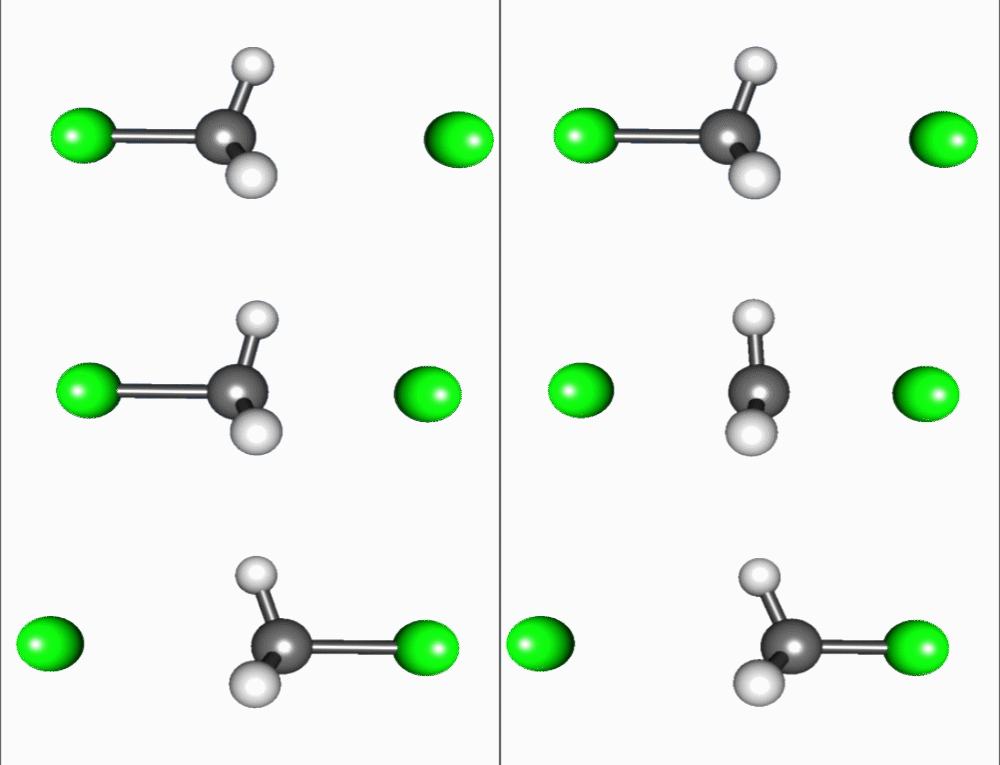
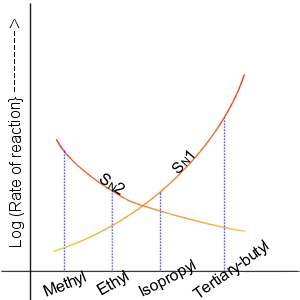
Main mechanisms: SN2 and SN1
There are two prototypical pathways for nucleophilic substitution in organic chemistry, conventionally called SN2 and SN1. The SN2 pathway (SN2) is a single-step, concerted process in which bond formation to the nucleophile and bond breaking to the leaving group occur simultaneously. Kinetically it follows second-order rate law — rate depends on both substrate and nucleophile concentrations — and it usually leads to stereochemical inversion at the reaction center (Walden inversion).
By contrast, the SN1 pathway (SN1) proceeds in at least two steps. First the leaving group departs to give a carbocation intermediate; then the nucleophile adds. SN1 reactions show first-order kinetics with the rate determined by the substrate ionization step, and they frequently give racemization at a stereogenic center because the planar carbocation can be attacked from either face.
Factors that determine the mechanism
- Substrate structure: Primary centers favor SN2, tertiary centers favor SN1; secondary centers can follow either path depending on other conditions.
- Nucleophile strength: Strong, negatively charged nucleophiles promote SN2; weak or neutral nucleophiles are consistent with SN1.
- Leaving group ability: Good leaving groups (halides, tosylates, triflates, water) accelerate both mechanisms by making bond cleavage easier.
- Solvent effects: Polar protic solvents stabilize ions and favor SN1; polar aprotic solvents leave nucleophiles more reactive and often favor SN2.
- Steric hindrance: Crowded centers slow SN2 attacks and thus shift balance toward SN1 when ionization is feasible.
These factors interact; prediction of mechanism for a particular substrate is based on weighing them together rather than a single rule.
Variants, examples, and applications
Several specialized forms of nucleophilic substitution exist. Nucleophilic aromatic substitution can proceed by addition–elimination on activated aromatic rings or by elimination–addition through a benzyne intermediate (a different sequence and set of conditions). Typical laboratory and industrial examples include halide substitution on alkyl halides, hydrolysis of esters under nucleophilic catalysis, and the Williamson ether synthesis (alkoxide attacking an alkyl halide). These reactions are central to synthesis of pharmaceuticals, agrochemicals and fine chemicals because they allow deliberate modification of molecular skeletons.
Mechanistic understanding guides practical choices such as protecting groups, selection of solvents and leaving groups, and design of selective displacement steps in multistep syntheses.
Historical notes and notable facts
The SN1/SN2 notation and much of the mechanistic framework were developed in the early-to-mid 20th century by physical organic chemists studying rates and stereochemistry. Practical relevance has only grown as methods for controlling reactivity and selectivity have evolved. For further reading on fundamentals and advanced topics see accessible resources on the nucleophile concept here, the role of the atom attacked here, and reviews of leaving groups and substitution types here and here. Introductory discussions of the two classic mechanisms are available at SN1 overview and SN2 overview.
Related articles
Author
AlegsaOnline.com Nucleophilic substitution: mechanisms, factors, and applications Leandro Alegsa
URL: https://en.alegsaonline.com/art/71386