
SN1 reaction — unimolecular nucleophilic substitution
SN1 is a two-step unimolecular nucleophilic substitution in which the substrate ionizes to a carbocation. This entry explains mechanism, kinetics, stereochemistry, factors influencing SN1, examples and contrasts with SN2.
Overview
The SN1 reaction is a fundamental class of nucleophilic substitution in organic chemistry. The designation "SN1" means substitution (S) by a nucleophile (N) with a rate-determining step that is unimolecular (1). In its simplest description the substrate first ionizes to give a carbocation and a leaving group; the carbocation is then trapped by a nucleophile. General background on substitution reactions and related topics is available in broader articles on nucleophilic substitution and introductory organic chemistry.
Image gallery
3 Images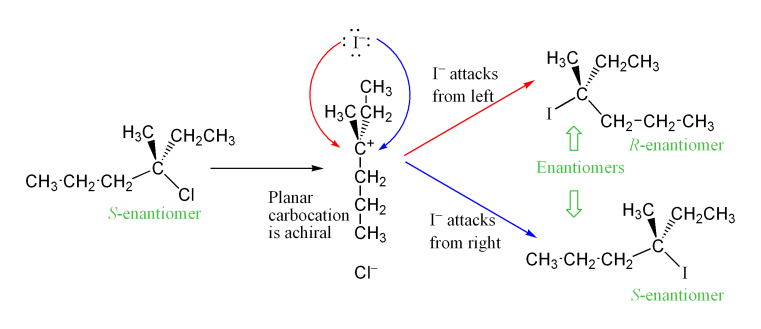

Mechanism and kinetics
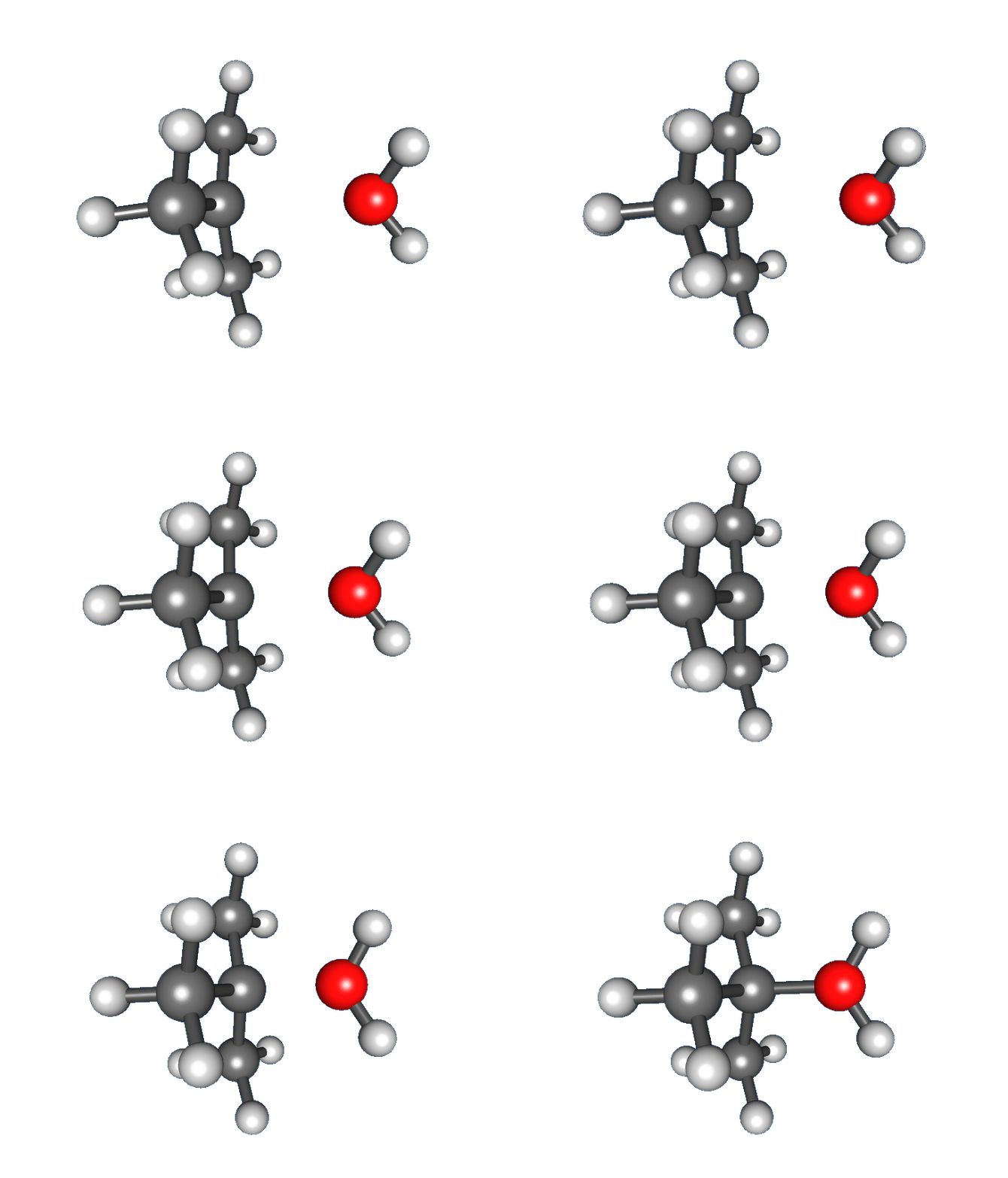
The SN1 pathway is stepwise. The first step is heterolytic cleavage of the bond between the reaction center and the leaving group, producing a carbocation and the anionic leaving group; this ionization is the rate-determining step and gives the characteristic rate law: rate = k[substrate]. Because only the substrate concentration appears in the rate law, SN1 reactions are described as first order in the substrate. After ionization the intermediate carbocation is intercepted by a nucleophile in a fast, usually diffusion-controlled step. For concise discussion of mechanism terminology see introductory material on reaction mechanisms and the rate-determining step.
Key factors that favor SN1
- Carbocation stability: More stable carbocations form more readily. Tertiary, allylic and benzylic carbocations are commonly involved.
- Leaving-group ability: Good leaving groups (weak bases) facilitate the ionization step.
- Solvent effects: Polar protic solvents stabilize ions through solvation and hydrogen bonding and thus favor SN1 pathways.
- Substrate structure: Substrates that can delocalize or stabilize positive charge by resonance or hyperconjugation are more likely to undergo SN1.
- Nucleophile strength: The strength of the nucleophile has less influence on the rate because attack occurs after the rate-determining ionization.
In inorganic contexts the step in which the ligand departs is often called a dissociative mechanism or unimolecular dissociation; the same kinetic and mechanistic labels apply.
Stereochemistry and rearrangements
Because a planar, sp2-hybridized carbocation intermediate is formed, the incoming nucleophile can attack from either face. For a stereocenter this often produces racemization or partial racemization rather than the stereospecific inversion typical of SN2. Carbocations can also undergo structural rearrangements (hydride or alkyl shifts) to give more stable ions before capture; these rearrangements are an important practical consideration because they change connectivity and product distribution.
Typical substrates and examples
Common SN1 substrates include tertiary alkyl halides and protonated secondary or tertiary alcohols under acidic conditions: protonation converts an alcohol into a better leaving group and facilitates ionization. Allylic and benzylic substrates, where positive charge is resonance-stabilized, also undergo SN1-type solvolysis relatively easily. Classic laboratory examples include solvolysis reactions in polar protic media; further experimental context is given in sources on reaction conditions and solvent effects.
Competition with other pathways
SN1 reactions often compete with other mechanisms. Elimination reactions (E1) share the same carbocation intermediate and can therefore be competitive under conditions that favor ionization. SN2 pathways compete when the substrate is less able to form a stable carbocation (for example primary substrates) or when strong nucleophiles and polar aprotic solvents are present; see comparative treatments of SN2 behaviour for contrasts. Experimentalists choose conditions to favor one route over another by changing solvent, nucleophile strength, temperature and leaving groups.
Experimental detection and applications
Kinetic measurements that show first-order rate dependence on substrate concentration indicate an SN1 process. Stereochemical outcomes (loss of optical purity), observation of rearranged products, and solvent effects are experimental signatures commonly used to assign mechanism. SN1 processes are exploited synthetically when carbocation rearrangements or formation of stabilized cationic intermediates lead to useful transformations; they are also important to anticipate as side reactions in complex syntheses.
History and terminology
The classification of substitution mechanisms into SN1 and SN2 and the stepwise proposal for unimolecular substitution were developed and formalized in the mid-20th century by workers including Christopher Ingold and collaborators, who contributed foundational studies and terminology; see historical accounts and the original proposal. For further reading and mechanistic surveys consult overview articles on nucleophilic substitution, introductory organic chemistry texts, and focused reviews of carbocation chemistry at advanced levels. Additional practical notes and experimental guidance can be found in resources that treat mechanism, rate-determining steps and the role of carbocations.
For compact comparisons of mechanistic labels and outcomes instructors and students often consult concise guides that link SN1 attributes to solvent polarity, substrate structure and leaving-group trends; see further discussions of mechanism, conditions and comparisons with SN2 and experimental conditions for practical decision-making in synthesis.
Related entries and educational materials are available in broader treatments of substitution chemistry and mechanistic organic chemistry; use the links above to navigate introductory and advanced coverage as appropriate.
Questions and answers
Q: What does "SN" stand for in SN1 reaction?
A: "SN" stands for nucleophilic substitution.
Q: What does "1" represent in SN1 reaction?
A: "1" represents the fact that the rate-determining step involves only one molecule (unimolecular).
Q: What type of reaction is SN1?
A: SN1 is a substitution reaction.
Q: What is the intermediate involved in SN1 reaction?
A: SN1 reaction involves a carbocation intermediate.
Q: Under what conditions do common SN1 reactions occur?
A: Common SN1 reactions occur with secondary or tertiary alkyl halides under strongly basic conditions, or with secondary or tertiary alcohols under strongly acidic conditions.
Q: What alternative reaction occurs with primary alkyl halides?
A: With primary alkyl halides, the alternative SN2 reaction occurs.
Q: Who first proposed the SN1 reaction mechanism and in which year?
A: Christopher Ingold et al. first proposed the SN1 reaction mechanism in 1940.
Related articles
Author
AlegsaOnline.com SN1 reaction — unimolecular nucleophilic substitution Leandro Alegsa
URL: https://en.alegsaonline.com/art/91288
Sources
- sciteclibrary.ru : SciTecLibrary