
Octet rule
A chemical guideline stating that many atoms attain stability with eight electrons in their valence shell; useful for predicting simple bonding but limited by many exceptions.
Overview
The octet rule is a simple guideline in chemistry that explains why many atoms form particular bonds. It asserts that atoms tend to gain, lose, or share electrons so that they possess eight electrons in their outermost shell, resembling the electron configuration of the noble gases. This idea helps explain common molecular formulas and bonding patterns for main-group elements. For a general introduction see related material.
Image gallery
3 Images
Characteristics and how it is used
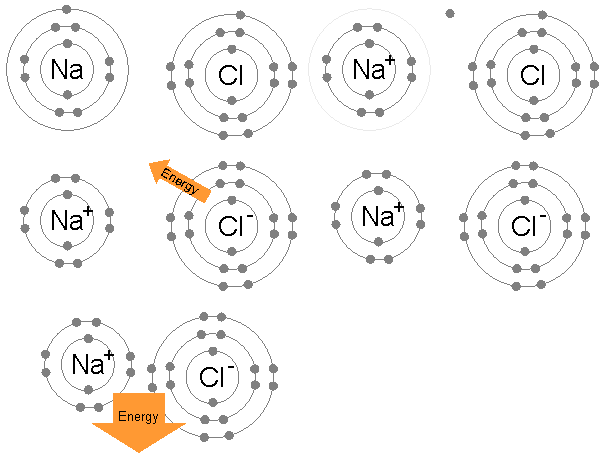
In practice the rule is applied using Lewis structures, which represent valence electrons as dots and bonds as lines. Elements in the second period (carbon, nitrogen, oxygen) most often obey the octet by forming covalent bonds: for example, carbon typically forms four bonds (as in methane), oxygen two (as in water), and nitrogen three (as in ammonia). Ionic compounds such as sodium chloride are also rationalized by octets when atoms transfer electrons to achieve noble-gas configurations. More on electron counting can be found at further resources.
Origin and historical context
The octet idea emerged from early 20th century attempts to explain chemical bonding. Gilbert N. Lewis and others proposed that shared pairs of electrons form covalent bonds and that filled valence shells confer extra stability. The octet rule became a cornerstone of introductory chemistry teaching because it provides an accessible way to predict structures and reactivity for many simple molecules.
Examples, applications and limitations
Typical examples that fit the rule include CH4, H2O, and CO2, while ionic salts reflect electron transfer toward octets. However, there are important exceptions: hydrogen follows a duet rule (two electrons), boron and beryllium commonly form electron-deficient compounds (e.g., BF3), some molecules have expanded octets (phosphorus, sulfur, and halogens in higher oxidation states like SF6), and many radicals and transition-metal complexes do not conform to eight valence electrons. Resonance and formal charge concepts are often invoked to refine Lewis-structure predictions. For more on modern perspectives and exceptions see additional discussion.
Overall, the octet rule remains a useful first approximation for understanding bonding in many main-group compounds but is complemented by molecular orbital theory and other models when greater accuracy is required.
Related articles
Author
AlegsaOnline.com Octet rule Leandro Alegsa
URL: https://en.alegsaonline.com/art/71894