
Atmospheric convection: processes, types, and role in weather and flying
Overview of atmospheric convection: causes, types (surface-driven and spontaneous), physical mechanisms, scales, weather impacts, examples such as thermals for gliding, and distinctions like dry vs. moist convection.
Overview
Atmospheric convection is the vertical movement of air driven by buoyancy arising from temperature and density differences. Warm, less dense air tends to rise through cooler, denser surroundings; cooler air sinks to replace it. This basic process redistributes heat, moisture and momentum in the troposphere and is a primary driver of cloud formation, turbulence, and many weather phenomena.
Image gallery
7 Images



Physical mechanism
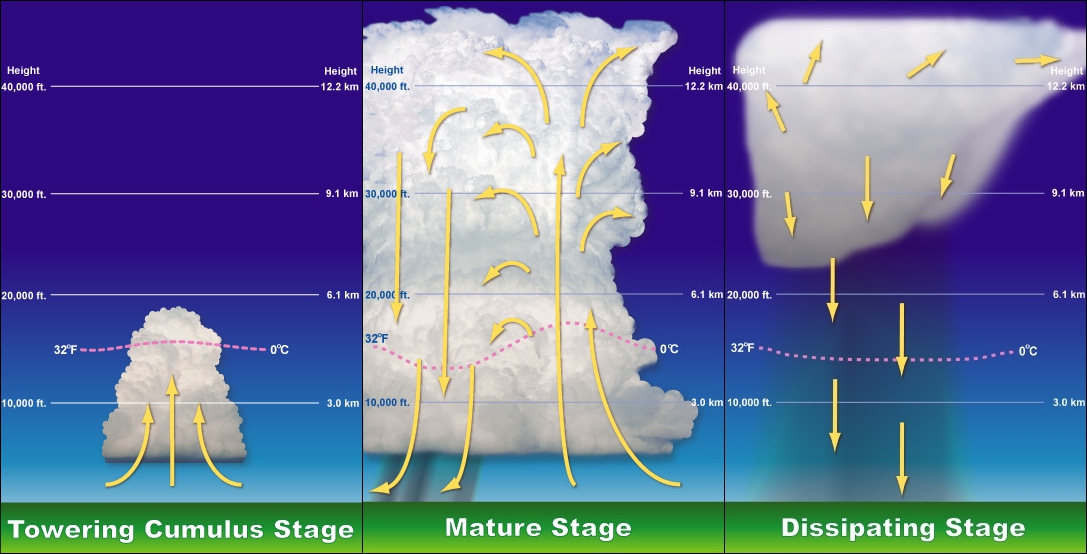
Convection begins when an air parcel becomes lighter than its environment, commonly because it is heated at the surface or has acquired moisture that releases latent heat during condensation. Rising parcels expand and cool at the adiabatic lapse rate; if the parcel remains warmer than the environment it continues to ascend. Friction and turbulent mixing reduce vertical motion, while inertia can carry a parcel beyond the point of neutral buoyancy. Important concepts that describe these processes include the environmental lapse rate, the dry and moist adiabatic lapse rates, and measures of instability such as convective available potential energy (CAPE).
Types and scales
- Surface-driven (contact) convection: initiated by differential heating of the ground, producing thermals and a convective boundary layer near the surface.
- Spontaneous or free convection: arises when the vertical temperature profile of the atmosphere is inherently unstable at some altitude, causing parcels to accelerate upward without a surface trigger.
- Forced convection: occurs when large-scale motions (fronts, orographic lifting, sea breezes) push air upward and can trigger or enhance convection.
- Moist vs. dry convection: moist convection involves condensation and latent heat release (clouds and storms), while dry convection does not reach the dew point (clear-air thermals).
Structure and common features
Typical convective elements include thermal plumes, rising columns of warm air, and convective cells that can organize into larger clusters. Entrainment of surrounding air, turbulent dissipation, and momentum transfer shape their evolution. Shallow convection mixes the boundary layer during daytime; deep convection can penetrate high into the troposphere and form cumulonimbus clouds, heavy precipitation, and sometimes severe storms.
History and study
Laboratory and theoretical work on convection—such as Rayleigh–Bénard experiments that illuminate pattern formation in heated fluids—has informed atmospheric studies. Observational meteorology, radiosondes and remote sensing have revealed how convective layers develop diurnally and respond to geography and large-scale weather patterns. Numerical weather and climate models include parameterizations of convective processes because they occur on scales smaller than typical grid spacing.
Importance and examples
Convection plays a central role in daily weather, the water cycle, and climate dynamics. It drives cloud formation, vertical transport of moisture and pollutants, and the release of latent heat that fuels storms. Practical examples include thermals used by glider pilots to gain altitude—exploiting rising warm air—and sea-breeze circulations that result from coastal temperature contrasts. For further reading, consult general resources on convection, the dynamics of vertical draft, the role of density differences, effects of friction and turbulence, concepts such as inertia in parcel motion, and recreational or practical applications like gliding.
Notable distinctions and facts
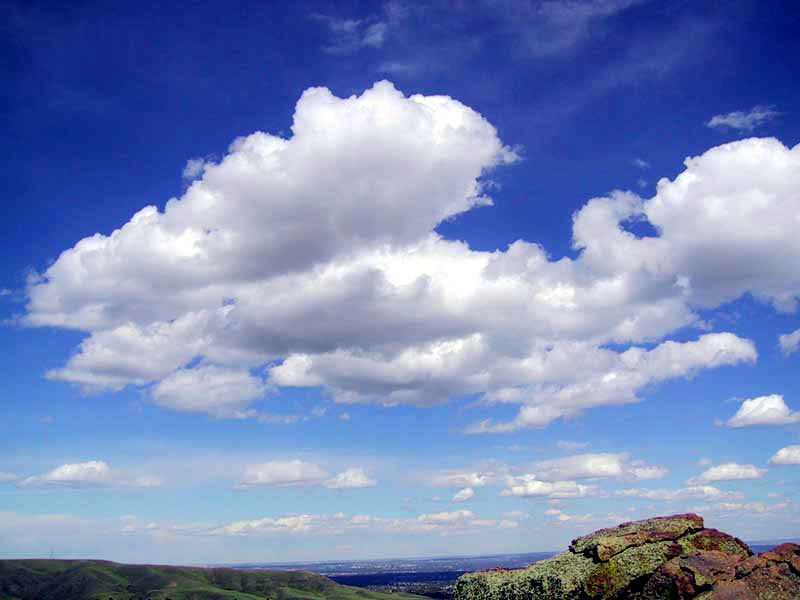
Distinguishing spontaneous (free) convection from contact (surface-driven) convection helps explain why storms sometimes develop away from surface heating or why daytime heating can produce isolated cumulus clouds. Convection occurs across a wide range of spatial scales—from meter-scale thermals to mesoscale convective systems hundreds of kilometers across—and is a key process linking local weather to larger atmospheric circulation. Convection also occurs on other planets, where different compositions and heating patterns produce analogous overturning motions.
Related articles
Author
AlegsaOnline.com Atmospheric convection: processes, types, and role in weather and flying Leandro Alegsa
URL: https://en.alegsaonline.com/art/7035