
Augite — a common dark pyroxene mineral
Augite is a dark, typically green to black member of the pyroxene mineral group, common in mafic igneous and some metamorphic rocks and useful in petrology for interpreting rock formation.
Overview
Augite is a dark, prismatic silicate mineral belonging to the pyroxene group. It is typically green, brown or black and is an important constituent of many mafic igneous rocks such as basalt and gabbro. The name comes from the Greek augites, meaning "brightness," a reference to its occasional vitreous luster.
Image gallery
3 Images

Characteristics
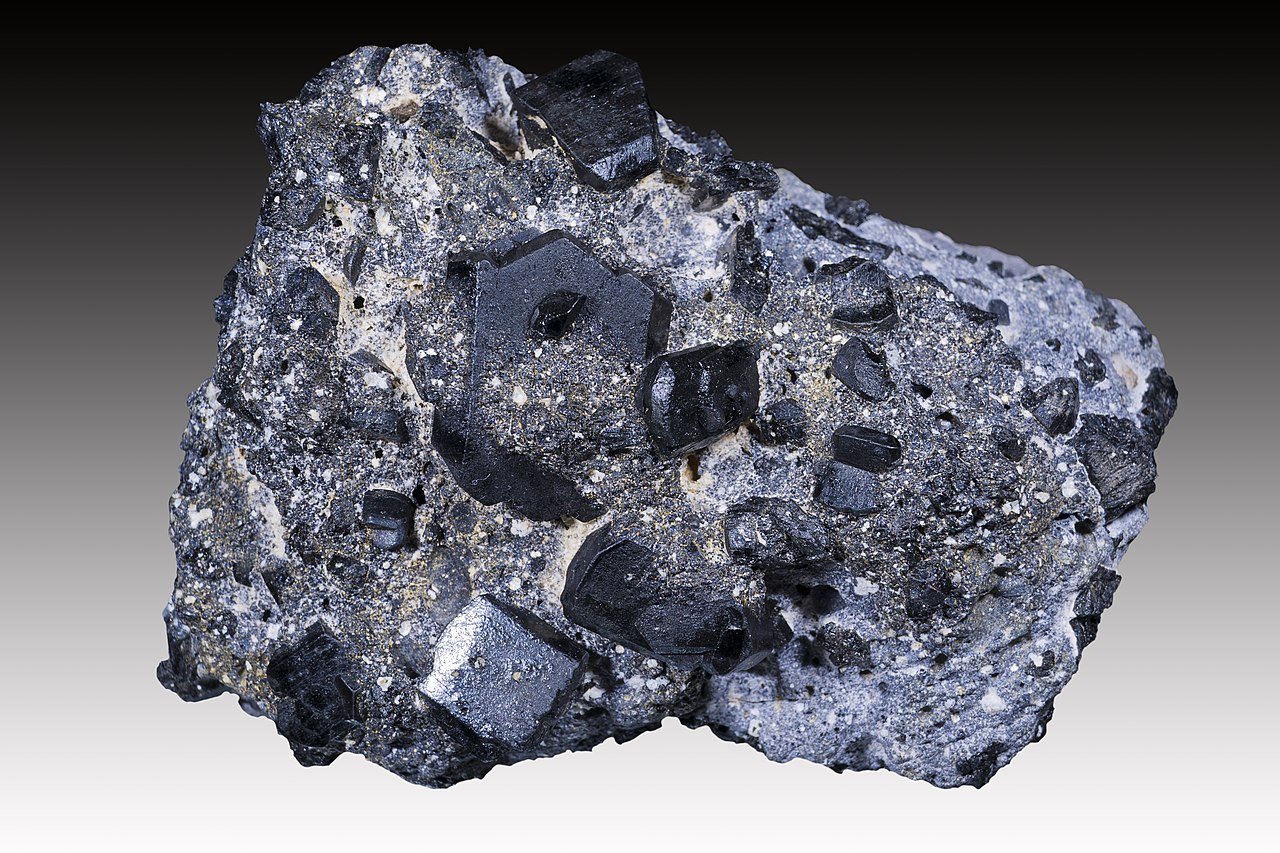
Augite crystals are monoclinic and commonly form stubby prisms. They show two good cleavage directions that intersect at nearly 90 degrees, a characteristic of pyroxenes. Typical physical properties include a vitreous to dull luster, Mohs hardness around 5–6, and a specific gravity generally in the range of 3.2–3.6. Chemically it is a complex calcium–magnesium–iron silicate in which sodium, aluminum and titanium may substitute to varying degrees.
Occurrence and formation
Augite forms in a range of geological settings. It is abundant in mafic and ultramafic igneous rocks, where it crystallizes from magnesium- and iron-rich magmas. It also appears in some metamorphic rocks that experienced high temperatures. Augite may occur as small grains in volcanic rocks or as larger crystals (phenocrysts) in porphyritic textures.
Uses and significance
Augite has little industrial use but is valuable to geologists. Its composition and crystal habits help reconstruct the temperature, pressure and chemical environment of rock formation. Variations within the pyroxene series provide clues to magmatic differentiation and metamorphic history.
Distinguishing features
- Dark color and prismatic habit.
- Two cleavages near right angles.
- Part of a compositional series with other pyroxenes (e.g., diopside, hedenbergite).
Related articles
Author
AlegsaOnline.com Augite — a common dark pyroxene mineral Leandro Alegsa
URL: https://en.alegsaonline.com/art/7282