
Banded iron formation (BIF): composition, origin, and significance
Banded iron formations are layered sedimentary rocks of the Precambrian made of alternating iron-rich and silica- or shale-rich bands. They record early ocean chemistry and are major iron ore sources.
Overview
Banded iron formations (BIFs) are layered sedimentary rocks composed of repeated thin beds of iron-rich minerals alternating with silica-rich or iron-poor layers. They are most characteristic of the Precambrian portion of Earth history and occur within ancient sedimentary rocks. BIFs are important both as archives of early environmental conditions and as the principal source of the world’s iron ore.
Image gallery
10 Images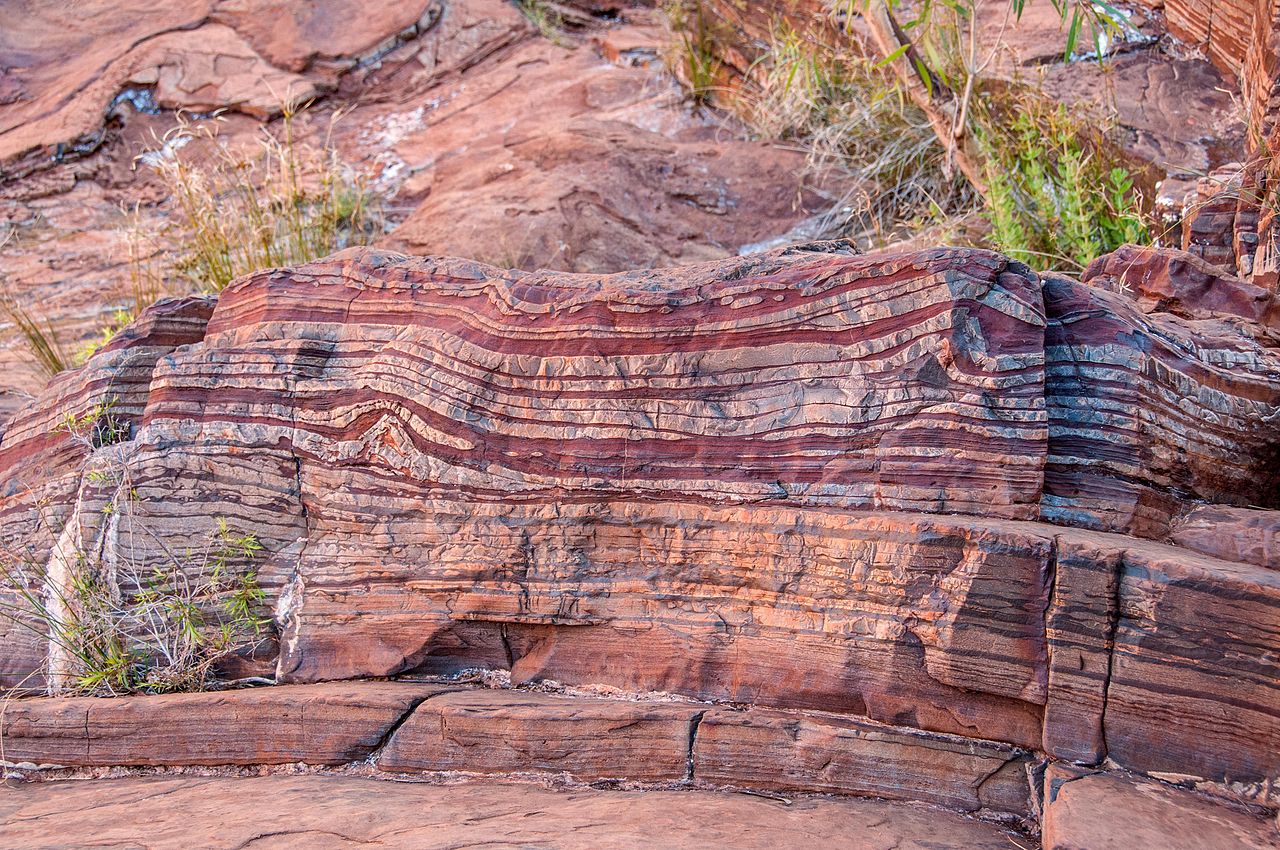



Composition and structure
Typical BIFs contain alternating layers of iron oxides and silica or fine clastic material. The iron-rich bands are commonly dominated by magnetite (Fe3O4) or hematite (Fe2O3) produced from dissolved iron in ancient oceans. Many BIFs also contain chert or microcrystalline quartz and thin beds of shale or other iron-poor sediment. Geologists describe the iron component generally as iron oxides, while the silica layers are often referred to as chert. Textures range from millimetre-scale laminae to thicker rhythmic bands formed over long intervals.
Origins and geological context
BIFs accumulated mainly during the Archean and Proterozoic eons when Earth’s oceans were largely anoxic and iron was soluble in seawater. The leading explanations invoke chemical precipitation of iron when it encountered oxidizing agents—either free oxygen produced by early photosynthetic organisms or alternative oxidants driven by microbial metabolism and sunlight. As oxygen concentrations rose during events such as the Great Oxidation Event, the character and frequency of iron deposition changed and large-scale BIF formation declined. Banded iron layers are therefore closely tied to the redox evolution of early sediments and seawater.
Uses, economic importance, and examples
Because they concentrate iron into mineable bodies, BIFs are economically crucial. Many of the world’s principal iron ore provinces are grounded in Precambrian BIF sequences. Mining targets the iron-rich oxide bands, which can be beneficiated into steelmaking feedstock. Beyond industry, BIFs are studied as geological indicators of ancient ocean chemistry and as indirect evidence for early microbial activity.
Notable features and distinctions
- BIFs are largely restricted to Precambrian strata and are much rarer in younger rocks.
- The alternating layers can record environmental rhythms and changes in ocean chemistry over time.
- Metamorphism and deformation can change original minerals—chert may recrystallize to quartz, and iron oxides may be altered—so careful study is needed to interpret original conditions, for example distinguishing magnetite versus hematite dominated bands.
Because they combine geological, chemical and biological information, banded iron formations remain a central subject in studies of Earth’s early surface environments and the rise of atmospheric oxygen.
Questions and answers
Q: What are banded iron formations?
A: Banded iron formations (BIFs) are a type of rock found in Precambrian sedimentary rocks. They consist of alternating thin layers of iron oxides, such as magnetite and hematite, with bands of shale and chert.
Q: How old are banded iron formations?
A: Some of the oldest known banded iron formations were formed over 3,700 million years ago (mya).
Q: What elements make up banded iron formations?
A: Banded iron formations consist of alternating thin layers of iron oxides such as magnetite and hematite, along with bands of shale and chert.
Q: Are banded iron formations common in Earth's early history?
A: Yes, they are a common feature in sediments for much of Earth's early history.
Q: What is the chemical formula for magnetite?
A: The chemical formula for magnetite is Fe3O4.
Q: What is the chemical formula for hematite?
A: The chemical formula for hematite is Fe2O3.
Q: Where can banded iron formations be found? A:Banded Iron Formations can be found in Precambrian sedimentary rocks.
Tags
Related articles
Author
AlegsaOnline.com Banded iron formation (BIF): composition, origin, and significance Leandro Alegsa
URL: https://en.alegsaonline.com/art/8687