
Nanometre: definition, scale, history, uses and examples
The nanometre (nm) equals 10⁻⁹ metres. This article explains its definition, relative scale, common applications in optics, biology and technology, historical names and practical examples.
Overview
The nanometre (international spelling: nanometre; US: nanometer) is the SI unit used to measure very small distances. It represents one billionth of a metre and is written in scientific notation as 1×10⁻⁹ m. In everyday language it is a compact way to describe scales that are invisible to the unaided eye but are large compared with subatomic particles. The term combines the SI prefix nano- (from the Greek word for "dwarf") with the parent unit metre.
Image gallery
1 Image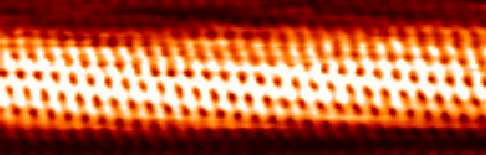
Scale and comparisons
Because the nanometre sits between atomic and macroscopic sizes it is useful for comparing structures across fields. The nanometre is equal to one thousandth of a micrometre and one millionth of a millimetre. Typical length scales often quoted in nanometres include:
- Atoms and small molecules: fractions of a nanometre to a few nanometres.
- Biological features such as the width of a DNA double helix (a few nanometres) and protein dimensions from nanometres to tens of nanometres.
- Wavelengths of visible light, which lie roughly in the 400–700 nm range within the electromagnetic spectrum.
Uses and examples
The nanometre is widely used across science and engineering because it conveniently describes ultrafine structure. In optics and photonics it identifies wavelengths and filter characteristics for different colors of light. In biology and medicine it helps specify sizes of viruses, cellular components and engineered nanoparticles. In materials science and semiconductor manufacturing the nanometre marks feature sizes and tolerances; modern fabrication processes often refer to component dimensions and process nodes measured in nanometres, although those node names can be partly marketing terms rather than strict physical measurements.
Concrete examples make the scale easier to grasp: a single water molecule is less than a nanometre across, the diameter of a DNA helix is measured in a few nanometres, and the thin films or surface coatings used in optics are often specified to nanometre thickness. The nanometre is therefore a practical unit for describing both physical dimensions and wavelengths of electromagnetic radiation.
History and terminology
The name derives from the SI prefix and the metre. Historically, the unit has also been called the millimicrometre or millimicron because it equals one thousandth of a micrometre; earlier symbols such as mµ or µµ were once used. Adoption of the standardized SI symbol nm and consistent use of scientific notation reduced ambiguity. The unit is part of the broader set of metric multiples and subdivisions used to express length within the SI system.
Notable distinctions and practical notes
When using the nanometre in technical contexts it is helpful to remember that marketed process sizes (for example in microelectronics) may not correspond exactly to a single physical dimension; they serve as a shorthand for technology generation. Also, while the nanometre is small by everyday standards, it is still much larger than atomic radii and smaller than most cellular structures, making it a bridge unit between atomic-scale and microscale descriptions. For further reading on measurement conventions and applications see related resources and technical references explaining the 10⁻⁹ relation and practical guides to nanoscale measurement methods.
For authoritative introductions to units and standards consult specialized metrology sources and educational materials; basic entries and overviews may be found through general science references and institutional pages about units or detailed treatment of SI prefixes and unit history in metric system references. For concise technical summaries, introductory texts in physics, chemistry and nanotechnology also cover the nanometre's role and common conversions to related units such as the micrometre and the ångström scale used for atomic dimensions.
Additional context and examples are available in specialized documentation on optics and spectroscopy wavelength references, electron microscopy and imaging methods for atomic-scale observation, and engineering standards that specify tolerances and feature sizes in nanometres for manufacturing. A practical primer can also include simple conversion aids and a table of everyday objects expressed in nanometres for classroom use explaining terminology and notation.
Related articles
Author
AlegsaOnline.com Nanometre: definition, scale, history, uses and examples Leandro Alegsa
URL: https://en.alegsaonline.com/art/68268
Sources
- researchgate.net : Plasmonic “ pump – probe ” method to study semi-transparent nanofluids
- doi.org : 10.1021/ja01665a016
- doi.org : 10.1021/ja01677a011