
Naked singularity
A naked singularity is a gravitational singularity without an event horizon, visible to distant observers. Its possible existence challenges predictability in general relativity and motivates research in quantum gravity.
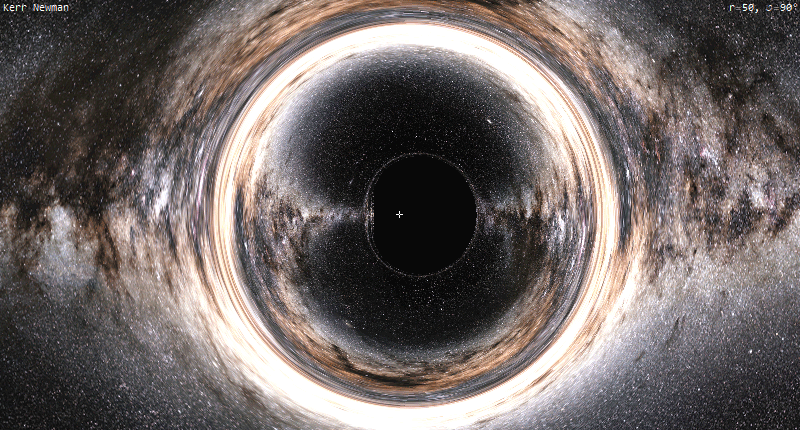
A naked singularity is a point or region in space-time where the gravitational field becomes singular and which is not concealed behind an event horizon. In the framework of general relativity, many solutions of the field equations contain singularities: locations where curvature, density, or tidal forces diverge. If such a singularity is shielded by an event horizon it is part of a black hole; if not, it is "naked" and, in principle, visible to outside observers. The concept raises questions about the limits of classical theory and about what observers might actually see in the vicinity of extreme gravity.
Image gallery
5 Images



Key characteristics
Naked singularities share some formal features with other singular solutions but differ crucially in their causal structure. Without an event horizon there is no one-way boundary preventing signals from the singular region reaching distant observers. Technically, their existence is associated with violations of conditions that guarantee global predictability in space-time, such as the formation of a Cauchy horizon. Important related ideas are the distinction between timelike, spacelike and null singularities, and whether the singular behavior is localized or extends along some surface.
Why they matter
The existence of a naked singularity would be of profound conceptual and observational importance. It would expose the extreme region where classical general relativity breaks down, making the breakdown directly accessible to outside measurements. That prospect tests the interface between gravity and quantum theory: ordinary quantum mechanics and quantum field theory on curved backgrounds are not equipped to predict the outcomes near a true singularity. Observationally, a naked singularity could produce unique high-energy signatures or lensing patterns that differ from those of black holes.
Formation, history and theoretical context
Interest in naked singularities dates to studies of gravitational collapse and exact solutions of Einstein's equations. Roger Penrose proposed the cosmic censorship conjecture to preserve determinism by positing that singularities produced by generic collapse are always hidden behind horizons. There are two related conjectures: a weak form preventing singularities from being visible to distant observers, and a strong form forbidding locally naked singularities that would break predictability even for nearby observers. Exact solutions such as over-extreme rotating or charged metrics (generalizations of the black hole solutions) can admit naked singularities when parameters exceed certain bounds, and numerical relativity has produced scenarios where collapse creates locally naked behavior under special conditions.
Observational prospects and theoretical research
- Signatures: Proposed observational effects include unusual gravitational lensing, distinct accretion behavior and bursts of high-energy radiation that would differ from typical black hole emission.
- Predictability: A visible singularity undermines the deterministic evolution of fields because initial data on a regular surface cannot uniquely determine later behavior beyond the Cauchy horizon.
- Quantum gravity: Various approaches, including loop quantum gravity and other quantum-gravity schemes, study whether quantum effects remove singularities or alter their visibility; some specific models suggest singularity resolution while others leave the question open.
Open problems and notable facts
There is currently no empirical evidence for naked singularities, and cosmic censorship remains unproven despite many partial results. Debate continues over whether nature has mechanisms (for example, fine-tuned initial conditions are unlikely, or classical instabilities will cloak a would-be naked singularity) that prevent their formation. Because a naked singularity would expose the deepest breakdown of classical gravity, it remains a focal point for studies aiming to unite gravitational theory with quantum principles and for proposals about observational tests in the strong-gravity regime. For further background see treatments of gravitational singularity, light propagation and horizons in light-related studies, and broader discussions in physics and on observable phenomena near extreme compact objects; the mathematics of space and time is surveyed under space-time geometry and singularity theorems.
Related articles
Author
AlegsaOnline.com Naked singularity Leandro Alegsa
URL: https://en.alegsaonline.com/art/68161
Sources
- scientificamerican.com : "Fast-spinning black holes might reveal all"
- scientificamerican.com : Naked Singularities"