
Space-time: the four-dimensional continuum of modern physics
Space-time is the unified, four-dimensional framework combining space and time used in relativity to describe motion, causality, gravity and cosmology.
Space-time is the unified arena in which physical events occur: a single mathematical framework that combines the three dimensions of space with the one dimension of time. As a mathematical model, it replaces the separate notions of absolute space and absolute time used in earlier physics and is most simply represented, for non‑gravitational situations, by Minkowski space. Thinking of events as points in this four‑dimensional continuum helps clarify how motion and causation operate under the rules of relativity.
Image gallery
10 Images



Key characteristics
Unlike ordinary three‑dimensional geometry, space‑time has a metric that mixes spatial and temporal distances into a single invariant called the space‑time interval. This interval determines causal relationships: events separated by intervals inside the light cone can influence one another, while those outside cannot. Worldlines trace the history of particles through space‑time, and quantities such as proper time (the time measured along a worldline) remain invariant even though observers in relative motion disagree about spatial distances and coordinate times.
Relation to classical and relativistic physics
In classical mechanics, a Newtonian description treats time as a universal parameter and uses Euclidean space for spatial geometry. That approach is adequate at everyday speeds and weak gravity. However, in a relativistic setting the separation between space and time depends on the observer: velocities alter the rate at which coordinate time passes and mix space and time coordinates. The relativistic dependence of measured time on an object's velocity leads directly to effects such as time dilation and length contraction.
Historical development
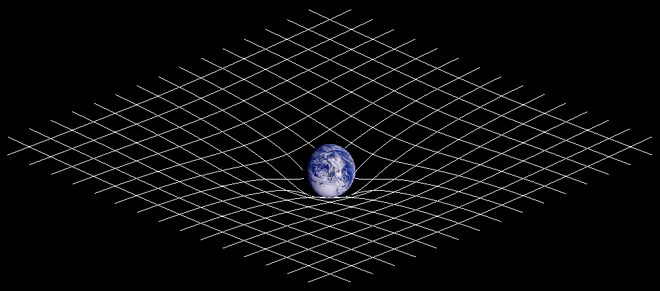
The modern concept of space‑time grew from the work on special relativity in the early 20th century, which showed that Maxwell's equations and the constancy of the speed of light require a combined space‑time structure. Hermann Minkowski formalized this idea geometrically, and later Einstein extended the concept in general relativity to allow curvature: mass–energy tells space‑time how to curve, and curved space‑time tells matter how to move. The curvature of the continuum is what we perceive as gravitational phenomena, rather than as a force acting at a distance.
Uses and examples
- Cosmology: Modeling the large‑scale evolution of the universe and the propagation of light and matter across cosmic history, a foundation for cosmology.
- Precision technology: Satellite navigation and atomic clocks must correct for relativistic timing shifts, including velocity‑related dilation and gravitational slowing by a gravitational field.
- Particle physics: The behavior and measured lifetimes of high‑speed particles and atoms are described naturally in space‑time terms; experiments probe these effects at high velocities and small scales, including systems built from atoms.
Distinctions and notable consequences
Space‑time is not merely a semantic merge of space and time but a different geometric structure with new symmetries and invariants. It distinguishes between different kinds of separations (timelike, spacelike, lightlike) and leads to counterintuitive but well‑tested predictions: clocks in relative motion or deeper in gravitational wells run at different rates. Those predictions reduce to the Newtonian picture in the appropriate low‑speed, weak‑gravity limit, but they become essential whenever precision or extreme conditions are involved.
For further reading, introductory presentations and mathematical formulations are available that explore the metric, light cones, and curvature in more detail; these resources range from conceptual overviews to technical expositions that treat space‑time as the central scaffold of both special and general relativity. See also discussions that contrast the Euclidean intuitions of everyday geometry with the Lorentzian geometry used in relativistic models.
Mathematical model • Space • Time • Minkowski space • Cosmology • Atoms • Classical mechanics • Euclidean space • Relativistic • Velocity • Gravitational field
Questions and answers
Q: What is space-time according to the text?
A: Space-time is a mathematical model that connects space and time, forming a four-dimensional continuum known as Minkowski space.
Q: How has combining space and time helped cosmology?
A: Combining space and time has allowed cosmology to better understand how the universe works on both the big level, such as galaxies, and the small level, such as atoms.
Q: Why is the use of Euclidean space instead of space-time good in non-relativistic classical mechanics?
A: In non-relativistic classical mechanics, the use of Euclidean space is good because time is treated as universal with a constant rate of passage that is independent of an observer's state of motion.
Q: Why is time inseparable from the three dimensions of space in a relativistic universe?
A: Time cannot be separated from the three dimensions of space in a relativistic universe because the observed rate at which time passes depends on an object's velocity relative to the observer.
Q: How does the strength of a gravitational field affect the passage of time for an object?
A: The strength of any gravitational field slows the passage of time for an object as seen by an observer outside the field.
Q: What is the name of the four-dimensional continuum that joins space and time?
A: The four-dimensional continuum that joins space and time is called Minkowski space.
Q: How has the combination of space and time helped cosmology understand the universe?
A: The combination of space and time has helped cosmology to better understand the workings of the universe, including on both the big level, such as galaxies, and the small level, such as atoms.
Related articles
Author
AlegsaOnline.com Space-time: the four-dimensional continuum of modern physics Leandro Alegsa
URL: https://en.alegsaonline.com/art/92427
Sources
- britannica.com : Space-Time,
- de.wikisource.org : "Raum und Zeit"