
Moons of Mars: Phobos and Deimos
An overview of Mars' two small moons, Phobos and Deimos, covering their features, orbits, origin theories, exploration history, and scientific importance.
Overview
Mars has two small natural satellites, Phobos and Deimos, which orbit the planet in close proximity. They were discovered in 1877 by American astronomer Asaph Hall and have been studied as accessible examples of small bodies in the inner Solar System. Both are much smaller and more irregular than Earth's Moon.
Image gallery
10 Images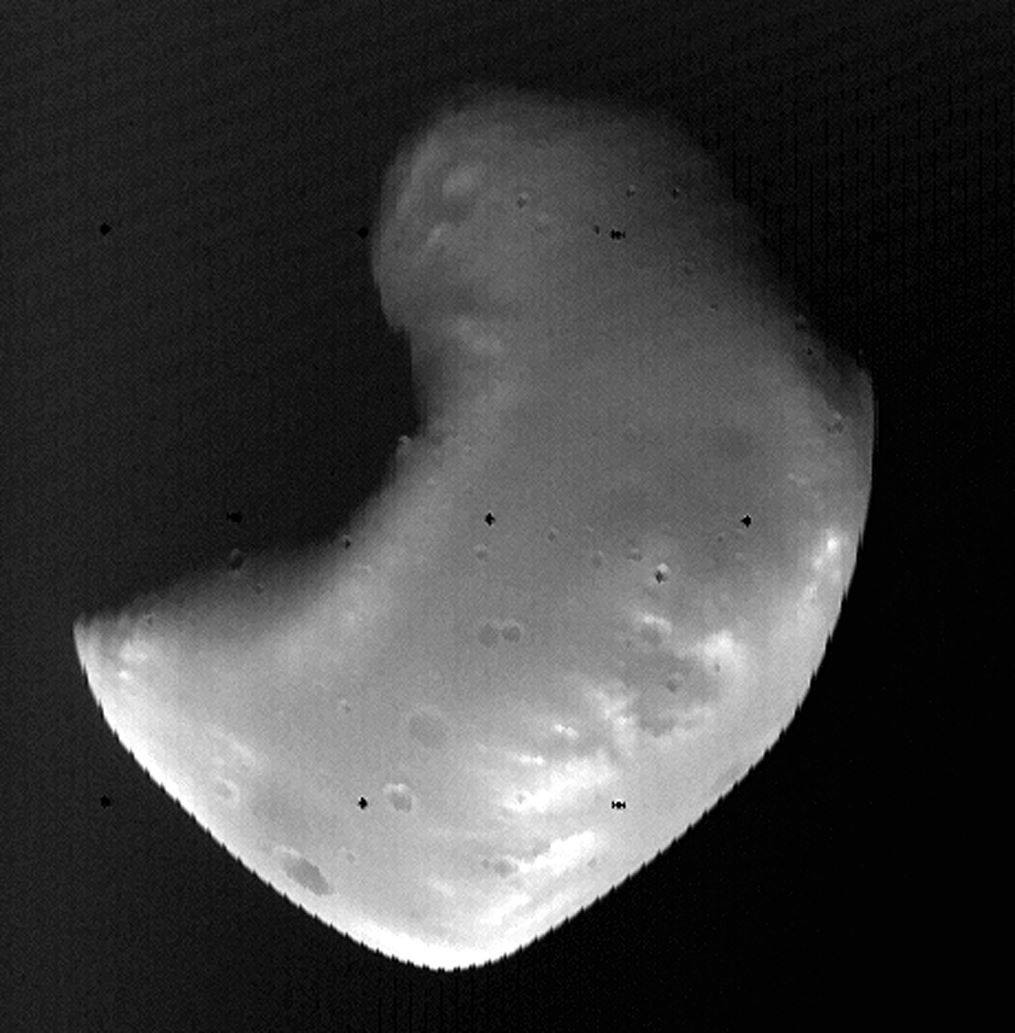





Physical characteristics
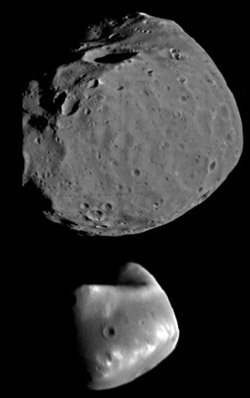
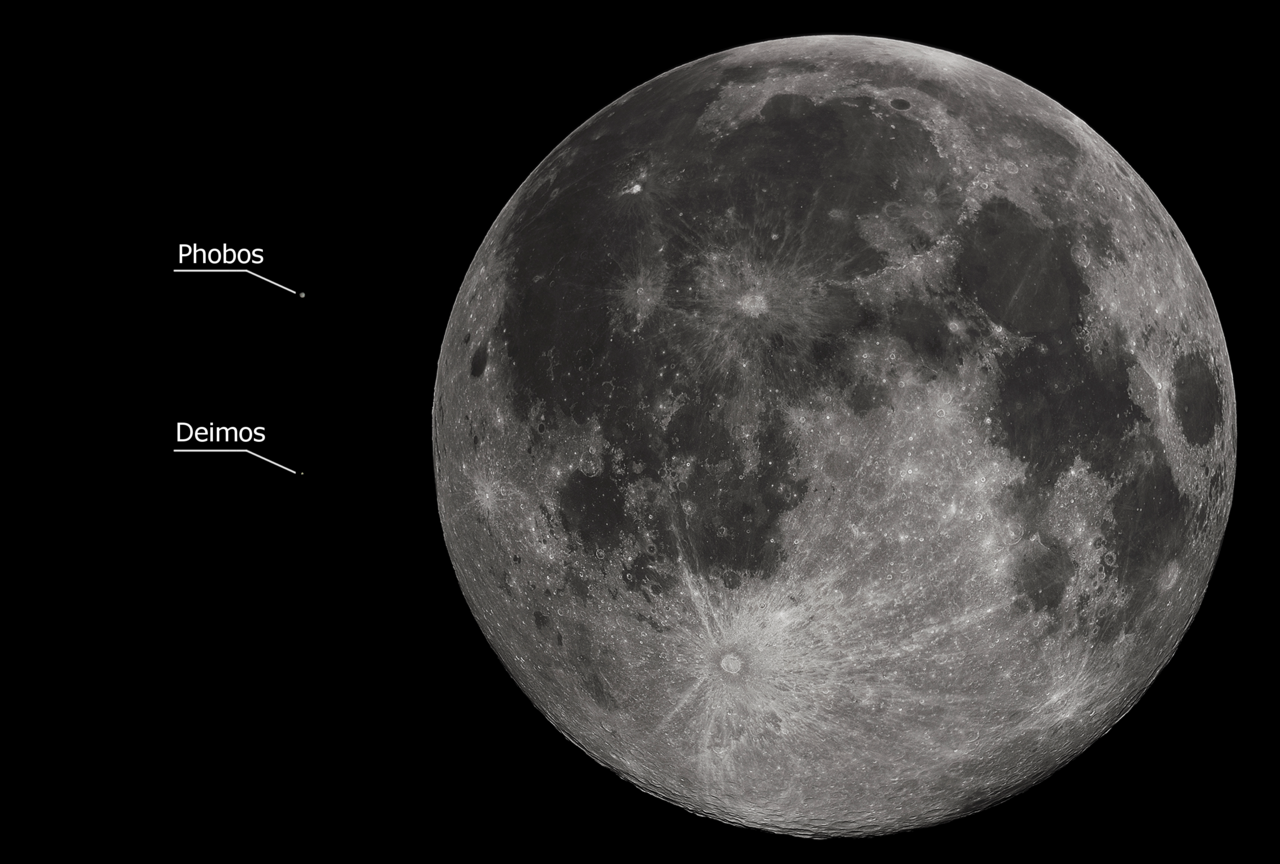
Phobos and Deimos are irregularly shaped, heavily cratered, and have low surface gravity. Phobos is larger (roughly a few tens of kilometers across) and shows prominent grooves and a large impact basin, while Deimos is smaller and smoother in appearance because of a thicker layer of loose surface material. Their low densities and composition suggest they are porous and rich in carbonaceous material.
Orbits and dynamics
The moons occupy very different orbits. Phobos orbits extremely close to Mars and travels faster than the planet rotates, so it appears to rise in the west and set in the east; its orbit is slowly decaying and it may eventually break up or impact Mars in tens of millions of years. Deimos orbits farther out and moves more slowly, appearing to rise in the east like most moons.
Origins and hypotheses
There are two leading ideas about their origin: capture of asteroid-like bodies from the nearby belt or co-formation/formation from debris produced by an ancient giant impact on Mars. Evidence for a captured origin includes spectral similarities to certain asteroids, while other observations and dynamical models allow for formation from impact ejecta. The question remains a subject of active research.
Exploration and future missions
Both moons have been observed by flyby and orbiting missions, including imaging and spectral studies from various Mars probes. Interest has grown in returning samples and conducting in situ science; for example, a planned sample-return effort led by JAXA aims to rendezvous with these moons and bring material back to Earth for detailed analysis. Continued study could clarify their composition and origin.
Scientific importance
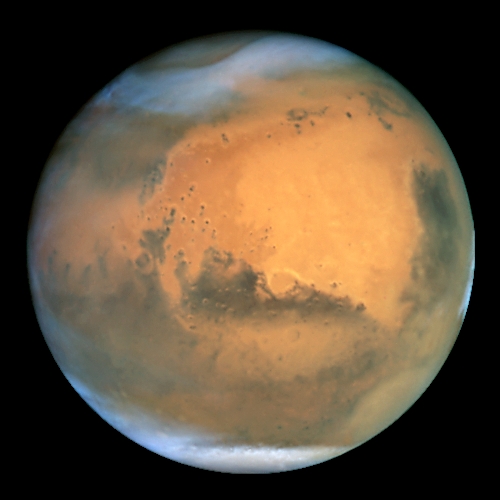
Phobos and Deimos are important for understanding small-body geology, capture processes, and the history of the Martian system. Their proximity makes them potential stepping stones for future robotic or crewed missions to Mars; they also offer relatively accessible locations to investigate primitive Solar System materials and the effects of Mars' environment on small satellites. For context on Mars itself, see Mars.
- Discovery: Asaph Hall, 1877
- Names: Phobos (fear/panic), Deimos (terror/dread), from Greek mythology
- Notable mission plans: sample-return concepts and dedicated explorers
Related articles
Author
AlegsaOnline.com Moons of Mars: Phobos and Deimos Leandro Alegsa
URL: https://en.alegsaonline.com/art/66547
Sources
- space.about.com : "Mars Moon Mystery"
- uapress.arizona.edu : "The Planet Mars: A History of Observation and Discovery. Chapter 5: 1877. University of Arizona Press"