
Messier 15 (M15): a dense, core-collapsed globular cluster in Pegasus
Messier 15 (M15) is a compact, core‑collapsed globular cluster in Pegasus about 33,600 light‑years away, notable for its dense core, many variable stars and pulsars, and the planetary nebula Pease 1.
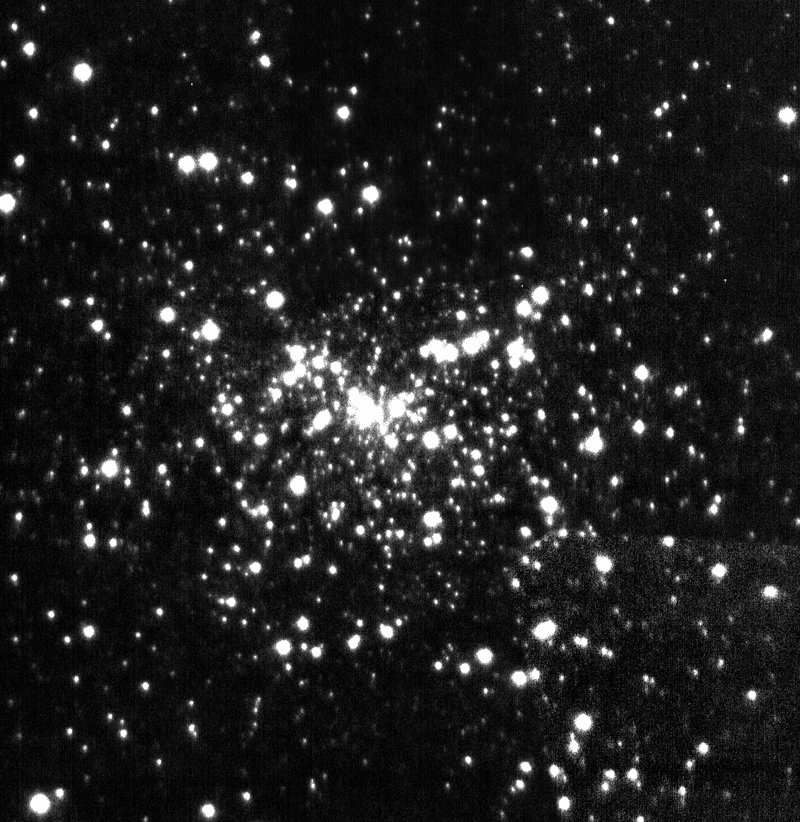
Messier 15, commonly abbreviated M15, is a well-known globular cluster located in the northern sky. It lies within the constellation Pegasus and was discovered by Jean‑Dominique Maraldi in 1746. At a distance of roughly 33,600 light‑years from Earth, M15 appears as a bright, compact object through small telescopes and resolves into individual stars in larger amateur and professional instruments.
Image gallery
8 Images




Structure and notable properties
M15 is classified as a core‑collapsed globular cluster: its central region is extremely dense compared with most other clusters. The cluster spans on the order of a few hundred light‑years across (commonly quoted diameters are near 175 light‑years) and contains well over 100,000 stars. The dense core has encouraged close stellar interactions, producing many stellar exotica and compact binaries. Observations have identified numerous variable stars and pulsars concentrated toward the center.
- Variable stars: about 112 known variables, including many RR Lyrae types used to probe the cluster’s distance and structure.
- Pulsars: at least eight pulsars have been detected; these millisecond pulsars are the remnants of binary evolution and dense stellar encounters.
- Planetary nebula: M15 hosts Pease 1, notable as the first planetary nebula found in a globular cluster.
History and scientific significance
M15 has been studied for centuries and remains important for multiple reasons. Its discovery in 1746 placed it among the early catalogued deep‑sky objects. Modern observations across optical, radio and X‑ray wavelengths have explored its dense core, populations of exotic objects and dynamics. Because globular clusters are ancient, M15 helps astronomers study stellar evolution, dynamics in high‑density systems, and the chemical history of the Galaxy. Some investigations propose a centrally concentrated mass of stellar remnants or an intermediate‑mass black hole to explain kinematic measurements; this interpretation remains under study and not definitively settled.
Appearance and observing tips
To amateur observers M15 appears as a bright, round glow through binoculars and a dense, grainy ball in small telescopes. Under good conditions and with apertures of 8 inches (200 mm) or larger, the core can be partially resolved and some of the brighter red giants become visible. Its compactness and rich stellar population make M15 a rewarding target for both visual observing and astrophotography.
Related articles
Author
AlegsaOnline.com Messier 15 (M15): a dense, core-collapsed globular cluster in Pegasus Leandro Alegsa
URL: https://en.alegsaonline.com/art/64117
Sources
- astropix.com : Messier 15 on astropix
- ui.adsabs.harvard.edu : 1989ApJ...346..803C
- doi.org : 10.1086/168061