
Messier 54 (M54) — A globular cluster linked to the Sagittarius dwarf galaxy
Messier 54 (M54, NGC 6715) is a bright, dense globular cluster discovered by Charles Messier. It lies toward Sagittarius and is physically associated with the Sagittarius dwarf elliptical galaxy, near its center.
Overview
Messier 54 (M54, NGC 6715) is a prominent globular cluster seen toward the constellation Sagittarius. First recorded by Charles Messier in 1778, it was included in his catalog of nebulous and comet-like objects (Messier catalogue entries). For many decades M54 was treated as a Milky Way halo cluster, but later work showed a physical association with a satellite galaxy, changing its role in studies of galactic structure and accretion.
Image gallery
6 Images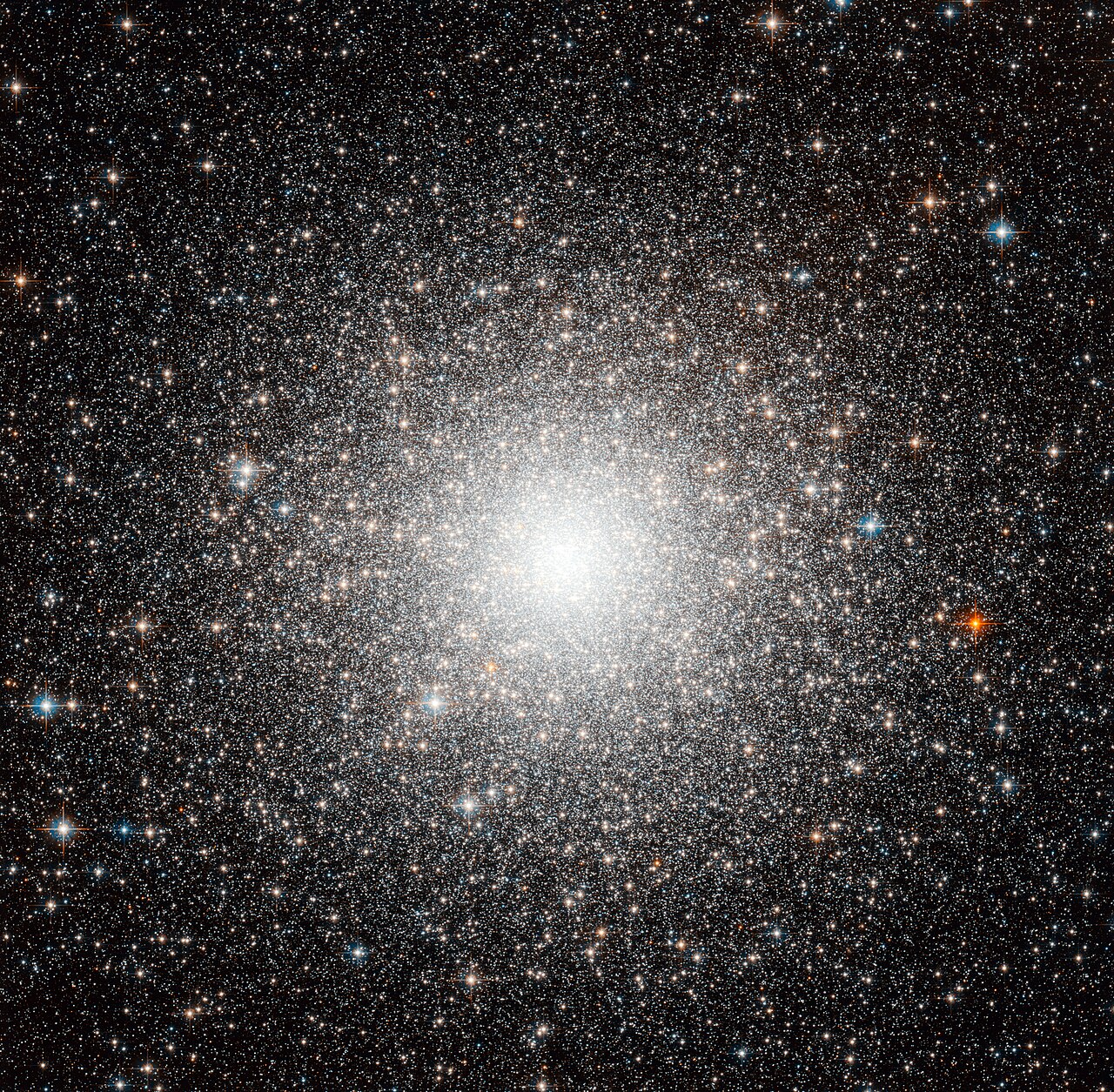




Physical characteristics
M54 is comparatively luminous and dense for a globular cluster. Published descriptions place its absolute magnitude near −10 and its integrated luminosity at roughly several 10^5 to 10^6 times that of the Sun, making it comparable to the most massive known clusters. Its distance from Earth is commonly quoted at about 87,000 light-years, which locates it near or within the central regions of the Sagittarius dwarf elliptical galaxy. The cluster's projected diameter is often expressed on the order of a few hundred light-years across; core and half-light radii are substantially smaller and are used in structural studies (structural parameters).
Stellar populations and chemistry
Like many massive clusters associated with dwarf galaxies, M54 shows evidence for more than a single simple stellar population. Spectroscopic and photometric studies reveal a spread in metallicity and multiple populations that indicate a complex formation and enrichment history. These characteristics contrast with simpler, single-population clusters and support interpretations that link M54 to an environment where prolonged or repeated star formation and chemical evolution took place.
Association with the Sagittarius dwarf galaxy
In the 1990s, studies of distance and radial velocity demonstrated that M54 is spatially coincident with the central regions of the Sagittarius dwarf elliptical galaxy (SagDEG), a small satellite currently being disrupted by the Milky Way. This association led to two alternative views: M54 might be a massive globular captured into the dwarf galaxy, or it could represent the dwarf's original nucleus, now seen as a dense stellar concentration. Both interpretations remain active subjects of research and are relevant to understanding how larger galaxies grow by accreting smaller systems.
Intermediate-mass black hole investigation
Observations of stellar motions and central density profiles in M54 prompted a 2009 report suggesting the presence of a possible intermediate-mass black hole at its core. The evidence—velocity dispersions and model fits—was suggestive but not definitive, and subsequent work has sought to confirm or refute the claim using deeper imaging and higher-resolution spectroscopy. The question of whether dense globular clusters can host such black holes remains an important open issue in dynamical astronomy.
Observing M54
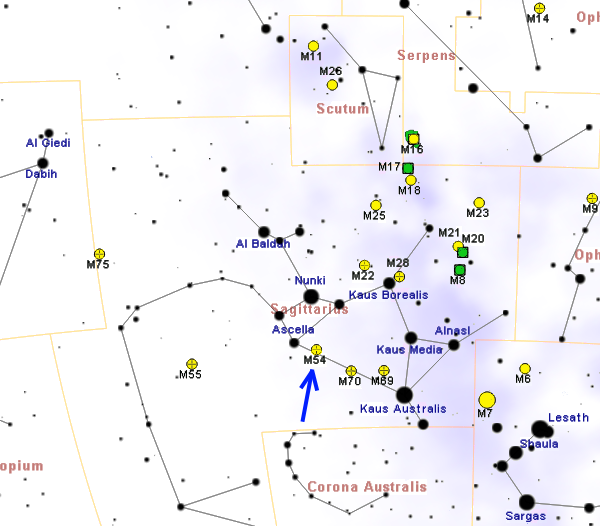
M54 lies in a rich star field toward the center of the Galaxy and is conveniently located near the bright star ζ Sagittarii, which serves as a useful pointer for amateur observers consulting nearby star charts. In binoculars it appears as a small, concentrated patch of light; in typical amateur telescopes it remains largely unresolved and looks like a fuzzy ball unless aperture and seeing permit partial resolution of the brightest members. Professional telescopes and space-based instruments can resolve many individual stars and measure their photometry and velocities for detailed study (photometry and luminosity studies).
Role in galactic archaeology
Because M54 is associated with a dwarf galaxy undergoing tidal disruption, it is an important object for studies of hierarchical galaxy formation. Its multiple populations, chemical signatures, and position near SagDEG's center make it a case study for how star clusters and nuclear star clusters relate to their host systems. Investigations of tidal streams from SagDEG and the dynamics of M54 contribute to broader efforts to map the assembly history of the Milky Way.
History and cataloguing
M54 appears in many modern catalogs under the identifiers Messier 54 and NGC 6715. Historical records show Messier noted it as a nebulous object, and subsequent observers used improving telescopes and photographic techniques to refine its position, brightness estimates, and structural parameters. Today it is a frequent target of surveys that examine globular clusters both in the Milky Way and in satellite galaxies.
Practical notes and resources
Amateur and professional observers can find summaries, structural data, and observing tips in specialized resources and catalog entries (globular cluster overview, Messier list, historical catalogs). For technical data and detailed studies consult survey papers and observatory archives that provide photometry, spectroscopy, and dynamical models (structural parameters, photometry, dynamical studies).
Notable facts
- M54 is one of the most luminous and dense globular clusters known and is catalogued as Messier 54 and NGC 6715.
- Its association with the Sagittarius dwarf elliptical galaxy changed its classification from a simple Milky Way halo cluster to a system linked to a dwarf galaxy's central region.
- Studies of M54 inform topics from stellar populations and chemical evolution to the possible presence of an intermediate-mass black hole and the processes of galactic accretion.
Further reading and up-to-date data can be found through observatory websites and astronomical databases that compile measurements of globular clusters and satellite galaxies (constellation maps, field star references, star charts).
Questions and answers
Q: What is Messier 54?
A: Messier 54 is a globular cluster located in the Sagittarius constellation.
Q: When was Messier 54 discovered?
A: Messier 54 was discovered in 1778 by Charles Messier.
Q: What did Charles Messier include Messier 54 in?
A: Charles Messier included Messier 54 in his catalog of comet-like objects.
Q: What was thought about Messier 54 belonging to the Milky Way galaxy?
A: It was thought that Messier 54 belonged to the Milky Way galaxy.
Q: When was it discovered that Messier 54 belongs to the Sagittarius dwarf elliptical galaxy?
A: It was discovered in 1994 that Messier 54 belongs to the Sagittarius dwarf elliptical galaxy.
Q: Is it easy to find Messier 54 in the sky?
A: Yes, Messier 54 is easily found in the sky and is close to the star ζ Sagittarii.
Q: Can individual stars be seen with amateur telescopes in Messier 54?
A: No, individual stars cannot be seen with amateur telescopes in Messier 54.
Related articles
Author
AlegsaOnline.com Messier 54 (M54) — A globular cluster linked to the Sagittarius dwarf galaxy Leandro Alegsa
URL: https://en.alegsaonline.com/art/64122
Sources
- arxiv.org : 0708.0027
- ui.adsabs.harvard.edu : 2007ApJ...667L..57S
- doi.org : 10.1086/522003
- arxiv.org : 1002.1963
- ui.adsabs.harvard.edu : 2010ApJ...714L...7C
- doi.org : 10.1088/2041-8205/714/1/L7
- arxiv.org : 0807.0105
- ui.adsabs.harvard.edu : 2008AJ....136.1147B
- doi.org : 10.1088/0004-6256/136/3/1147
- arxiv.org : 0906.4894
- ui.adsabs.harvard.edu : 2009ApJ...699L.169I
- doi.org : 10.1088/0004-637X/699/2/L169