
Pease 1 — a planetary nebula in the globular cluster Messier 15
Pease 1 is a faint planetary nebula located within the globular cluster Messier 15 in the constellation Pegasus. It is the first known planetary nebula found inside a globular cluster and is unusually rare.
Overview
Pease 1 is a small, faint planetary nebula located within a globular cluster. It lies in the dense star cluster Messier 15 (M15) and appears in the sky toward the constellation Pegasus. The nebula is notable because it was the first such object discovered inside a globular cluster; astronomers later identified three additional planetary nebulae in other clusters, making these occurrences quite uncommon.
Image gallery
2 Images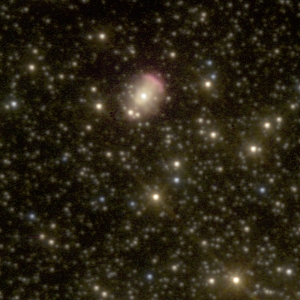

Physical characteristics
Like other planetary nebulae, Pease 1 consists of ionized gas expelled from a dying star, illuminated by a hot central remnant that will fade into a white dwarf. The nebula is very compact and faint against the dense stellar background of its host cluster, with an angular size much smaller than typical nebulae in the galactic field. Its spectrum shows emission lines typical of ionized hydrogen, helium and heavier elements, which are used to study the chemical makeup of the ejected envelope and the nebula's excitation.
Discovery and historical notes
The object is named for the astronomer who identified it; historically, its discovery was important because it demonstrated that late stages of stellar evolution can produce visible planetary nebulae even in old stellar populations such as those found in globular clusters. Discovering Pease 1 required careful observation and spectroscopy to distinguish the nebular emission from the light of nearby stars in M15 (Messier 15). Over time, only a handful of similar cluster nebulae have been confirmed, underscoring their rarity.
Observation and significance
Observing Pease 1 is challenging: the nebula is faint and embedded in a crowded field, so narrow-band imaging (for example through filters centered on strong emission lines) and high-resolution spectroscopy are the most effective methods for study. Professional telescopes and sensitive instruments reveal its emission-line spectrum and allow measurement of expansion velocities, chemical abundances, and the properties of the central star.
Why it matters
- It provides a direct example of post-asymptotic giant branch evolution within an old cluster environment.
- Studying the nebula helps test models of how low-mass, metal-poor stars shed material and form planetary nebulae.
- Its presence poses questions about cluster dynamics and binary interactions, which may influence whether a star produces a visible nebula.
Further context
Because planetary nebulae are rare in globular clusters, Pease 1 remains an object of interest for researchers studying stellar evolution in dense, ancient stellar systems. Advances in instrumentation and targeted searches continue to refine our understanding of how often such nebulae occur and what conditions are required for their formation.
Related articles
Author
AlegsaOnline.com Pease 1 — a planetary nebula in the globular cluster Messier 15 Leandro Alegsa
URL: https://en.alegsaonline.com/art/75368
Sources
- astropix.com : Pease 1 on astropix.com