
Messier 32 (M32): the compact dwarf elliptical companion of Andromeda
Messier 32 (M32) is a nearby compact dwarf elliptical galaxy orbiting the Andromeda system. It is notable for its dense stellar core, scarcity of gas and dust, and a central supermassive black hole.
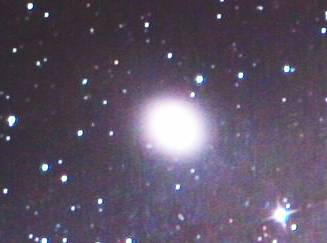
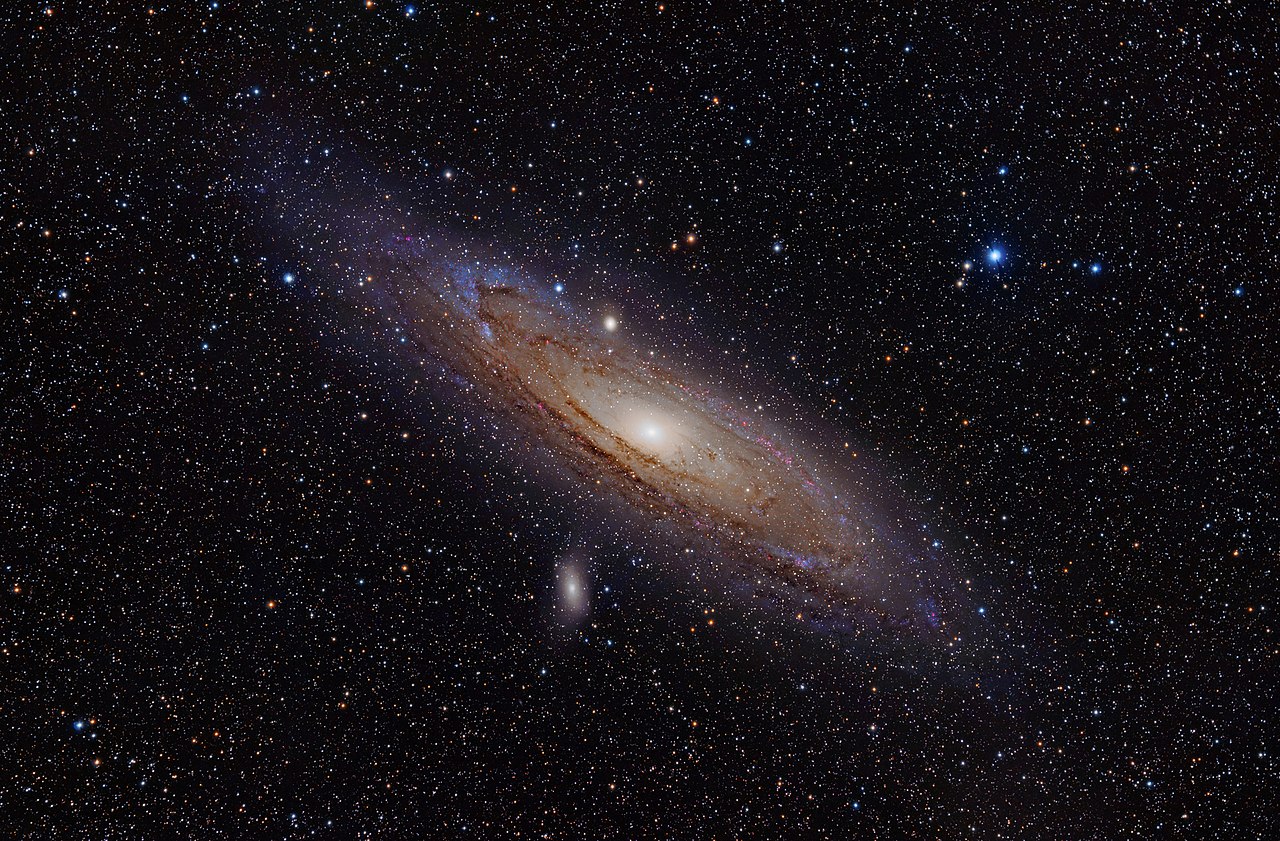
Overview. Messier 32, commonly abbreviated M32 and catalogued as NGC 221, is a small, compact elliptical galaxy that lies close to the Andromeda system at a distance of roughly 2.65 million light‑years. Seen against the same patch of sky as the large spiral Andromeda, M32 is visually associated with the constellation Andromeda. It is one of the best‑studied dwarf early‑type galaxies because of its proximity, which makes it an important laboratory for understanding the structure and evolution of compact ellipticals.
Image gallery
8 Images



Structure and physical properties
Messier 32 is classified as a compact elliptical (cE) galaxy, a rare subtype characterized by high surface brightness and small effective radii. As a compact elliptical, M32 concentrates a large fraction of its stars within a small central volume — roughly half the light comes from within an effective radius on the order of 100 parsecs (effective radius). The galaxy's full extent is only a few thousand light‑years across. High‑resolution imaging and spectroscopy, including observations with the Hubble Space Telescope, reveal a steep rise in stellar density toward the center and a very luminous nucleus.Stellar population and interstellar medium
Like many early‑type galaxies, M32 is dominated by older, red and yellow stars and shows little interstellar gas or dust. This scarcity of cold gas means almost no ongoing star formation, although studies indicate there were episodes of star formation in the relatively recent past, leaving a minority population of intermediate‑age stars (star formation). The lack of dust and active star‑forming regions contrasts with the nearby spiral arms of M31 and helps define M32’s classification as an early‑type system.Central black hole
Deep dynamical studies of stellar motions in the nucleus of M32 indicate the presence of a compact, central mass consistent with a supermassive black hole. Estimates place the mass in the range of a few million times the mass of the Sun, making M32 useful for calibrating relations between black hole masses and host galaxy properties (central black hole).Formation and evolutionary scenarios
The origin of M32’s compact form is debated. Several leading ideas are:- Tidal stripping: M32 may once have been a larger galaxy that lost outer stars and gas through gravitational interactions with the Andromeda galaxy, leaving a dense remnant.
- Intrinsic formation: it could have formed as a compact system early in the universe without experiencing major mergers.
- Harassment and mergers: repeated encounters and minor mergers within the Local Group might have altered its structure and triggered limited central star formation.
Discovery, observations and significance
Messier 32 was discovered in the eighteenth century and later catalogued as M32, becoming one of the nearest examples of its class. Its proximity makes it a key target for detailed imaging and spectroscopic work that informs broader questions about galaxy evolution, the growth of central black holes, and the effects of environment on small galaxies. Modern instruments continue to probe M32’s nucleus, its stellar content, and its relationship with the larger Andromeda system, building a clearer picture of how compact ellipticals form and evolve (compact ellipticals, Andromeda companion).Questions and answers
Q: What is Messier 32?
A: Messier 32 is a dwarf "early-type" galaxy located about 2.65 million light-years from Earth and seen in the constellation Andromeda.
Q: Who discovered Messier 32?
A: Messier 32 was discovered by Guillaume Le Gentil in 1749.
Q: What kind of galaxy is Messier 32?
A: Messier 32 is a compact elliptical galaxy type.
Q: How large is Messier 32?
A: Messier 32 measures 6.5 ± 0.2 thousand light-years in diameter at its widest point.
Q: Does Messier 32 have any current star formation?
A: Messier 32 contains mostly older faint red and yellow stars with practically no dust or gas, and consequently no current star formation. However, it does show hints of star formation in the relatively recent past.
Q: What is the half-light radius of the central star cluster in Messier 32?
A: The half-light radius of the central star cluster in Messier 32 is around 6 parsecs, emitting half the light of the central 100 parsecs.
Q: Does Messier 32 contain a supermassive black hole?
A: Yes, Messier 32 contains a supermassive black hole with a mass between 1.5 and 5 million solar masses.
Related articles
Author
AlegsaOnline.com Messier 32 (M32): the compact dwarf elliptical companion of Andromeda Leandro Alegsa
URL: https://en.alegsaonline.com/art/64118
Sources
- ui.adsabs.harvard.edu : 1987AJ.....94..306K
- doi.org : 10.1086/114472
- arxiv.org : astro-ph/9810070
- ui.adsabs.harvard.edu : 1998ARA&A..36..435M
- doi.org : 10.1146/annurev.astro.36.1.435
- ui.adsabs.harvard.edu : 1992AJ....104..552L
- doi.org : 10.1086/116254
- adsabs.harvard.edu : Quantifying the coexistence of massive black holes and dense nuclear star clusters
- ui.adsabs.harvard.edu : 2009AJ....138.1985R
- doi.org : 10.1088/0004-6256/138/6/1985
- arxiv.org : astro-ph/0606440
- ui.adsabs.harvard.edu : 2007ApJS..173..185G
- doi.org : 10.1086/516636
- ui.adsabs.harvard.edu : 1984ApJ...283L..27T
- doi.org : 10.1086/184326