
Messier 49 (NGC 4472): a giant elliptical galaxy in Virgo
Messier 49 (NGC 4472) is a luminous giant elliptical galaxy in Virgo, an early-discovered member of the Virgo Cluster notable for its rich globular cluster system, central X-ray source, and interactions with nearby dwarfs.
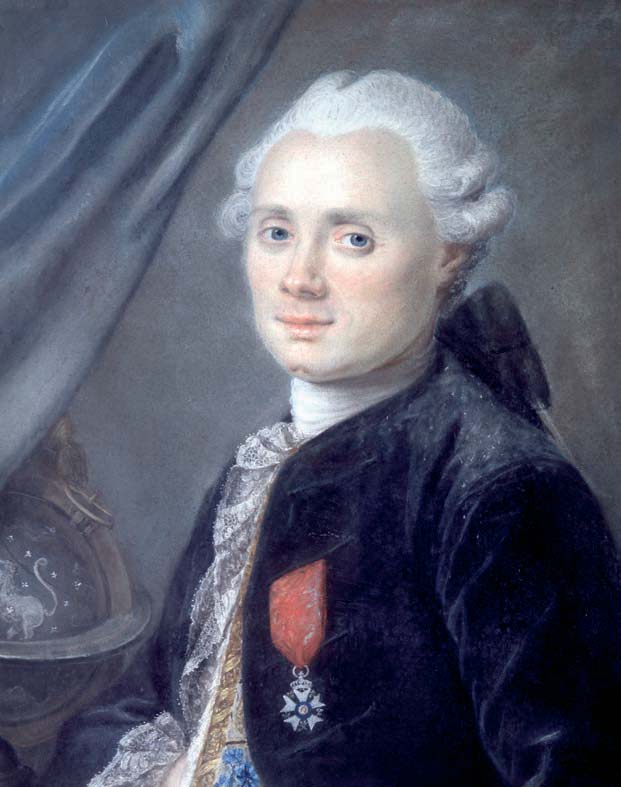
Messier 49, also cataloged as NGC 4472, is a giant elliptical galaxy located in the constellation Virgo at a distance of roughly 49 million light-years. It was cataloged by Charles Messier in 1771 and later recognized as the first identified member of the Virgo Cluster. M49 is among the most luminous galaxies in that cluster and serves as an important object for studies of galaxy structure, star clusters, and the environments of early-type systems.
Image gallery
5 Images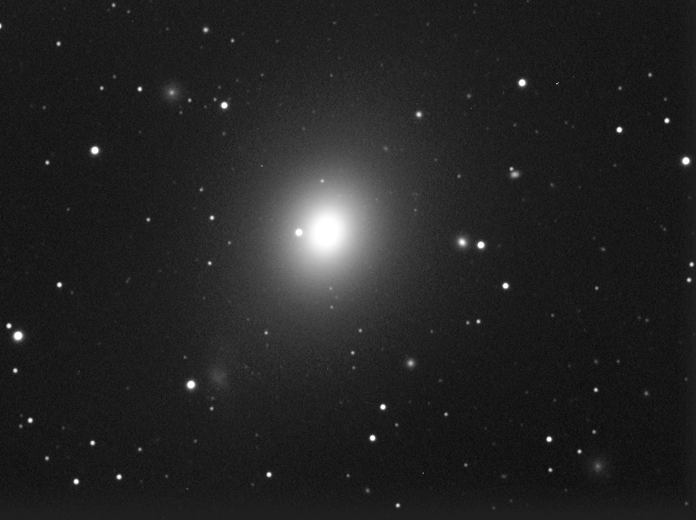


Physical characteristics
Classified generally as an elliptical galaxy, M49 has a smooth, extended stellar halo that can be traced far from its center. Observations in X-ray and optical bands reveal a bright nuclear region and a halo of hot gas; the X-ray emission from the core is interpreted as evidence for a central supermassive black hole with an estimated mass on the order of a few 108 solar masses. Deep imaging shows the luminous outline of the galaxy extending to very large radii—measurements have traced the stellar envelope to distances on the order of 260,000 parsecs in projection.
Environment and interactions
M49 lies within the Virgo Cluster but is associated with the Virgo B subcluster rather than the cluster's dynamic center around Messier 87. It sits several degrees from the central region and is currently interacting gravitationally with nearby dwarf galaxies. One well-known interacting companion is the irregular dwarf UGC 7636, where tidal forces have stripped gas and stars and produced observable disturbances in both systems. Radio observations indicate M49 displays typical radio emission for a normal galaxy, while its core is a comparatively strong X-ray source, consistent with accretion activity around a central massive object.
Globular clusters and compact objects
M49 hosts a very large population of globular clusters: estimates place the system at roughly 5,900 clusters, making it one of the richer globular systems known, though fewer than the extreme population around Messier 87. The globular clusters around M49 are predominantly old, with mean ages of order ten billion years, and they provide insight into the galaxy's formation history. Over the first decade of the 21st century observers reported strong evidence for stellar-mass black hole candidates embedded in at least one globular cluster in M49, with additional candidates proposed later, indicating that such clusters can retain compact-object populations.
History of observation and notable events
Discovered by Charles Messier in 1771, M49 has been observed across the electromagnetic spectrum. It was the first Virgo Cluster member to be identified, and because of its brightness it became a reference object for early extragalactic studies. The only recorded supernova in M49 to date is SN 1969Q, discovered in June 1969. Modern observations with space telescopes and large ground-based facilities continue to refine our understanding of its mass distribution, stellar populations, and central activity.
Significance and research uses
M49 is used as a laboratory for several astrophysical problems: the formation and evolution of massive elliptical galaxies, the dynamics and population statistics of globular cluster systems, the interaction between hot gas and galaxy potentials in cluster environments, and the demographics of central black holes in non-active galaxies. Its relative proximity, high luminosity, and rich cluster system make it attractive for both wide-field imaging and targeted spectroscopic surveys.
Quick reference links
- Elliptical galaxy
- Constellation Virgo
- Virgo
- Charles Messier
- Virgo Cluster
- Luminosity
- Galaxy
- Earth
- Messier 87
- Dwarf galaxy
- UGC 7636
- X-rays
- Supermassive black hole
- Black hole mass estimate
- Parsec
- Supernova
- Stellar-mass black hole
For observers, M49 lies about 4.1° west-southwest of the bright star Epsilon Virginis and is visible in most deep-sky atlases. Its dual role as a bright, nearby elliptical and as a host to a populous globular cluster system ensures it remains a frequent target for both professional study and advanced amateur imaging.
Questions and answers
Q: What is Messier 49?
A: Messier 49 (also known as NGC 4472) is an elliptical galaxy about 49 million light-years away in the constellation of Virgo. It was discovered by French astronomer Charles Messier in 1771 and is the most luminous member of the Virgo Cluster of galaxies.
Q: How far away from Earth is Messier 49?
A: Messier 49 is approximately 49 million light-years away from Earth.
Q: What type of galaxy is Messier 49?
A: Messier 49 is an elliptical galaxy.
Q: What star does it lie near to?
A: Messier 49 lies 4.1° west-southwest of the star Epsilon Virginis.
Q: Does it have any radio emission?
A: Yes, Messier 49 has the radio emission of a normal galaxy.
Q: Is there evidence for a supermassive black hole in this galaxy?
A: Yes, X-rays emitted from the core suggest that there may be a supermassive black hole with 565 million times the mass of our Sun present in this galaxy.
Q: How many globular clusters are estimated to orbit M49?
A: There are approximately 5,900 globular clusters orbiting M49.
Related articles
Author
AlegsaOnline.com Messier 49 (NGC 4472): a giant elliptical galaxy in Virgo Leandro Alegsa
URL: https://en.alegsaonline.com/art/64120
Sources
- books.google.com : Illustrated guide to astronomical wonders
- arxiv.org : astro-ph/0304333
- ui.adsabs.harvard.edu : 2003ApJ...592..866C
- doi.org : 10.1086/375865
- ui.adsabs.harvard.edu : 1996ApJ...471..683I
- doi.org : 10.1086/177998
- ui.adsabs.harvard.edu : 1978A&A....67...47E
- arxiv.org : astro-ph/0106326
- ui.adsabs.harvard.edu : 2001ApJ...555L..21L
- doi.org : 10.1086/323157
- nedwww.ipac.caltech.edu : "NASA/IPAC Extragalactic Database"
- ui.adsabs.harvard.edu : 1984A&AS...58..735B
- ui.adsabs.harvard.edu : 2011MNRAS.410.1655M
- doi.org : 10.1111/j.1365-2966.2010.17547.x