
Artificial life (Alife): study of life-like systems and emergent behavior
Artificial life (Alife) investigates how lifelike processes and organization arise in software, hardware, and chemistry, using simulations, robots, and laboratory systems to study emergence, adaptation, and evolution.
Overview
Artificial life, often written Alife, is an interdisciplinary pursuit that examines how systems can exhibit properties commonly associated with living organisms. Researchers construct and study models of life-like systems, exploring processes such as metabolism, development, and reproduction and the evolutionary dynamics that shape them. Rather than restricting study to natural organisms, Alife asks which behaviors and organizational principles can emerge in different substrates and under varying rules.
Image gallery
7 Images


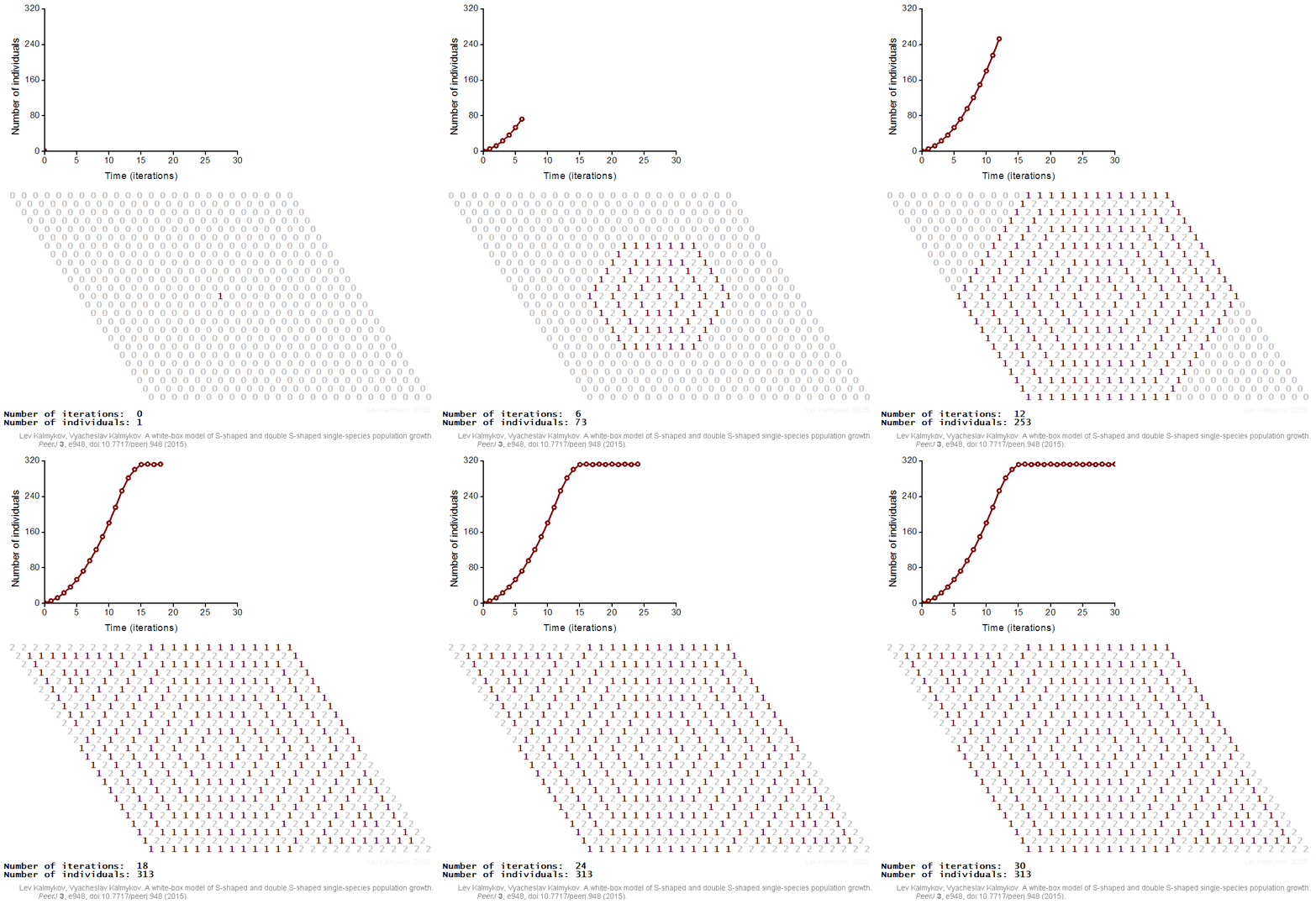


Approaches and components
Work in artificial life is usually organized around three practical approaches that emphasize different media and techniques:
- Soft Alife — models realized in computer programs and agent-based systems; practitioners build virtual ecologies, artificial genomes, and evolutionary simulations, often called software-based experiments.
- Hard Alife — physical embodiments that display lifelike behavior, for example robotic platforms and sensor-actuator networks; this approach draws on hardware and mechatronics to test ideas about embodiment and adaptation.
- Wet Alife — chemical and biochemical implementations that attempt to create minimal living systems or protocells using laboratory methods and synthetic chemistry, connecting directly to biochemical processes.
Soft projects commonly use large-scale simulations, while hard implementations are closely linked to robotics research and physical experimentation.
History and development
The modern idea of studying life through artificial systems arose as computer science and complexity theory matured in the late 20th century. Simple rule-based systems such as cellular automata (for example Conway's Game of Life) and later experiments in digital evolution helped shape the field’s questions and methods. Although Alife draws inspiration from and sometimes imitates themes in traditional biology, it treats life as a broader phenomenon that can be instantiated beyond carbon-based organisms.
Uses, examples, and importance
Artificial life provides conceptual tools and practical techniques. Examples include digital evolution platforms that study adaptation and open-ended evolution, robotic swarms that demonstrate decentralized coordination, and chemical systems used to test hypotheses about the origins of metabolism and membrane formation. Results inform research on complexity, adaptive design, resilient engineering, and education about emergent phenomena.
Distinctions and notable facts
Alife overlaps with but is not identical to artificial intelligence, synthetic biology, or evolutionary computation. Its central emphasis is on emergence, self-organization, and the ways lifelike properties arise in different substrates. The field remains inherently interdisciplinary, combining theory, simulation, engineering, and laboratory work to probe what it means for a system to be "alive" in functional and organizational terms.
Related articles
Author
AlegsaOnline.com Artificial life (Alife): study of life-like systems and emergent behavior Leandro Alegsa
URL: https://en.alegsaonline.com/art/6352
Sources
- dictionary.reference.com : "Dictionary.com definition"
- reed.edu : "Artificial life: organization, adaptation and complexity from the bottom up"
- springeronline.com : Artificial Life Models in Software
- zooland.alife.org : "What is Artificial Life?"