
Materpiscis: Devonian pyctodontid placoderm preserving an embryo
Materpiscis is a Late Devonian pyctodontid placoderm from the Gogo Formation whose fossil preserves an embryo and a cord-like structure, providing early direct evidence of internal development in vertebrates.
Overview
Materpiscis (Latin: "mother fish") is a genus of small, armored fishes placed among the pyctodontids, a subgroup of early jawed vertebrates known as placoderms. These fishes lived in reef environments during the Late Devonian, roughly 380 million years ago. Materpiscis is best known from exceptionally preserved material recovered from the Gogo Formation, where one specimen preserves an embryo within the adult's body cavity together with a short, cord-like structure that has been interpreted as an umbilical cord. This association has been widely cited as direct evidence that at least some early jawed vertebrates developed young internally, a form of viviparity.
Image gallery
6 Images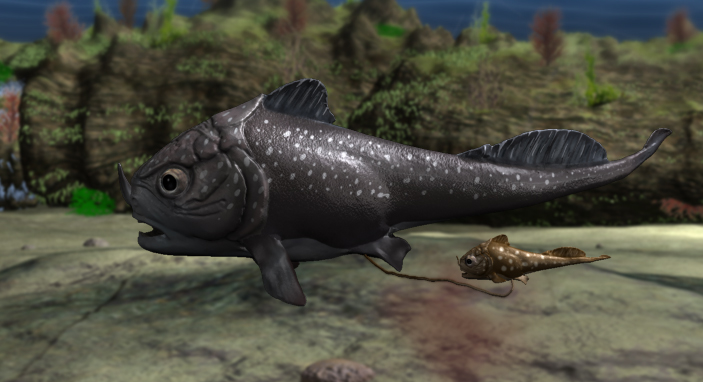


Discovery and preservation
The key fossil was collected from the Gogo reef deposits in the Kimberley region of Western Australia. Rocks of the Gogo Formation are notable for yielding three-dimensional skeletal remains preserved inside isolated nodules of limestone. Preparators extract delicate anatomical details by carefully dissolving the carbonate matrix with dilute acetic acid, a technique that reveals bone and cartilage surfaces while preserving spatial relationships between elements. Because of this mode of preservation, fossils from Gogo often retain fine internal details that are lost in more common flattened fossil deposits.
Anatomy and evidence for internal development
Materpiscis is interpreted as a pyctodontid on the basis of its overall body shape and jaw elements. Pyctodontids typically show a rounded body and robust tooth plates suited for crushing, traits associated with a durophagous diet. In the Materpiscis specimen, the embryonic skeleton is oriented within the adult's body cavity and exhibits articulated parts that indicate the young was relatively well developed at the time of preservation. The short cord-like structure interpreted as an umbilical connection suggests a physical link between parent and offspring during development. While this indicates internal development and supports a live-bearing interpretation, the fossil does not resolve whether nourishment was provided directly by the parent (true placenta-like viviparity) or primarily by yolk (ovoviviparity).
Classification and life history implications
Placoderms represent some of the earliest known jawed vertebrates, and discoveries such as Materpiscis have important implications for how early reproductive strategies evolved among gnathostomes. The evidence from Gogo indicates that internal fertilization and some form of retained development emerged early in the history of jawed fishes. Comparisons with reproductive modes in living fishes, such as many modern sharks that display internal fertilization and live birth, illustrate that viviparity has evolved repeatedly and in diverse anatomical contexts among fishes.
Importance, context and naming
The Materpiscis specimen is often described as the earliest direct fossil evidence of live birth in vertebrates and has been influential in discussions of vertebrate reproduction and development. The species was formally named Materpiscis attenboroughi in recognition of broadcaster and naturalist David Attenborough, who helped draw attention to the scientific value of the Gogo fish sites. Ongoing work on Gogo material continues to refine interpretations of anatomy, growth and behaviour in these ancient reef fishes and to place the reproductive biology of placoderms in a broader evolutionary context.
Key points
- Genus: Materpiscis, a Late Devonian pyctodontid.
- Group: part of the armored placoderms, early jawed vertebrates.
- Specimen: a fossil from the Gogo Formation preserving an embryo and cord-like structure interpreted as an umbilical cord.
- Preservation: three-dimensional fossils in limestone nodules prepared using dilute acetic acid.
- Location: Gogo reef deposits, Kimberley region.
- Significance: provides direct evidence of internal development and a form of viviparity among early jawed vertebrates.
- Nomenclature: specific name honors David Attenborough for his public advocacy of the site.
Research on Materpiscis exemplifies how exceptional fossil preservation can illuminate life history traits—such as reproduction—that are otherwise difficult to detect in deep time. While one fossil cannot answer all questions about placoderm reproductive biology, Materpiscis remains a cornerstone specimen for understanding the early evolution of internal development in vertebrates.
Related articles
Author
AlegsaOnline.com Materpiscis: Devonian pyctodontid placoderm preserving an embryo Leandro Alegsa
URL: https://en.alegsaonline.com/art/62799
Sources
- youtube.com : Dr John Long describes the discovery of the Materpiscis
- news.bbc.co.uk : BBC News: Fossil reveals oldest live birth