
Megalania: the giant Pleistocene monitor of Australia
Megalania (Varanus priscus) was a very large monitor lizard from Pleistocene Australia. This article summarizes its anatomy, ecology, fossil record, extinction and cultural significance.
Overview: Megalania, often given the scientific name Varanus priscus, was a very large member of the monitor lizard family. It lived in parts of what is now southern Australia during the Pleistocene and is classed among the continent's extinct megafauna. Megalania is commonly described as the largest known terrestrial land-based lizard discovered to date.
Image gallery
7 Images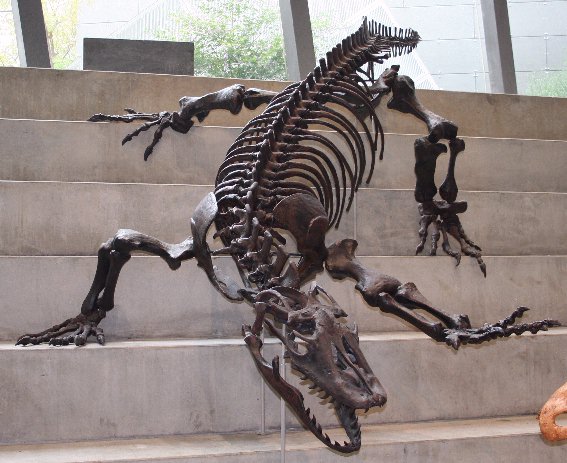


Description and size
Because the fossil record is fragmentary, estimates of Megalania's length and mass vary. Paleontologists usually infer size from vertebrae and limb elements and compare them to living monitors such as the Komodo dragon. Many published estimates place its maximum length at several metres and suggest a body mass of multiple hundreds of kilograms, but those figures remain approximate. Anatomical features include robust vertebrae, powerful jaws and limb proportions consistent with an active terrestrial predator.
Key characteristics
- Taxonomy: member of the genus Varanus, related to modern monitor lizards and goannas.
- Skeleton: known chiefly from isolated bones and fragments recovered from caves and sediment deposits.
- Physiology: ectothermic (cold-blooded) like other lizards; hunting behavior inferred from morphology and modern analogues.
Ecology and diet
Megalania was carnivorous and probably preyed upon medium to large mammals, reptiles and birds present in Pleistocene Australia. It has been proposed as a predator of giant marsupials such as Diprotodon or as an opportunistic scavenger. Modern monitors use a combination of strength, teeth and claws when subduing prey; some extant species also possess mild venom glands, so a degree of biochemical adaptation in Megalania is plausible but not proven.
Fossil record and discovery
Fossils attributed to Megalania have been found at a number of sites in southern Australia. The remains are typically fragmentary—vertebrae, jaw fragments and limb bones—so reconstructions depend on comparison with living relatives and biomechanical modelling. Ongoing reanalysis of existing specimens and new finds continue to refine understanding of its size and biology.
Extinction and human connections
Megalania appears to have disappeared roughly around the time that humans first occupied Australia. Some researchers link its decline to environmental change during the late Pleistocene, while others note possible interactions with early Aboriginal peoples, who may have encountered large goanna-like reptiles. Oral traditions and rock art occasionally cited in the literature have been interpreted by some scholars as cultural memories of large reptiles, though such connections remain debated.
Significance and notable facts
Megalania occupies an important place in studies of Australian megafauna because it represents a top reptilian predator of its ecosystems. Comparison to modern monitors helps scientists explore predator–prey dynamics, physiology and the effects of climate change and human arrival on large vertebrates. For broader context about monitor lizards and related research see resources on monitor lizards and continental megafauna summaries (megafauna overview). Additional paleontological databases and museum catalogues provide specimen details and ongoing updates to size estimates and interpretations (Pleistocene research, land-based reptile records, lizard comparative anatomy, Diprotodon studies).
Questions and answers
Q: What is Megalania?
A: Megalania is a giant monitor lizard that lived in southern Australia.
Q: When did Megalania live?
A: Megalania lived during the Pleistocene and seems to have disappeared around 40,000 years ago.
Q: What kind of species was Megalania part of?
A: Megalania was part of a species of megafauna that lived during the Pleistocene.
Q: Who may have encountered living Megalania?
A: The first Aboriginal settlers of Australia may have encountered living Megalania.
Q: Was Megalania a land-based or aquatic lizard?
A: Megalania was a land-based lizard.
Q: What did Megalania feed on?
A: Judging from its size, Megalania would have fed mostly upon medium- to large-sized animals, including any of the giant marsupials like Diprotodon.
Q: Are there any living relatives of Megalania?
A: The closest living relative of Megalania is the Komodo Dragon, which is also a monitor lizard.
Related articles
Author
AlegsaOnline.com Megalania: the giant Pleistocene monitor of Australia Leandro Alegsa
URL: https://en.alegsaonline.com/art/63503
Sources
- bbc.co.uk : "Megalania, giant ripper lizard"
- books.google.com.au : Dragons in the dust: the paleobiology of the giant monitor lizard Megalania