
Mass spectrometry: principles, history, techniques, and applications
Mass spectrometry is an analytical method that measures mass-to-charge ratios of ions to identify and quantify molecules. This article explains principles, steps, ionization and analyzers, history, and major uses.
Overview
Mass spectrometry is an analytical technique that characterizes ions by their mass-to-charge ratio. In practice it converts substances into charged particles and measures how those ions behave under electric and magnetic fields to infer composition and structure. A mass spectrometer can determine the molecular mass of unknowns, identify constituent chemicals in a complex sample, and reveal structural information about a molecule such as a peptide or other organic analyte.
Image gallery
10 Images






Basic steps and how it works
The process in most instruments proceeds in a series of linked stages. First the material is introduced and vaporized if necessary, then it is ionized, accelerated, separated according to how it responds to fields, and finally detected. The pattern of signals—called a mass spectrum—reports relative abundances of ions at different mass-to-charge ratios, which analysts interpret to identify components and estimate quantities.
- Introduction and vaporization. Solid or liquid samples are made compatible with the vacuum environment of the spectrometer. This can involve volatilization, thermal desorption, or transfer via a transfer line from a prior separation step.
- Ionization. Neutral molecules are converted into charged species. Ionization can be energetic and fragmenting or soft and preserving the intact molecular ion.
- Acceleration and focusing. Electric fields speed up ions and focus the beam so they enter the mass analyzer with controlled energy.
- Mass analysis (separation). Ions are separated by how strongly they are deflected or how long they take to travel—properties that depend on their m/z.
- Detection. When ions reach the detector they produce electrical signals proportional to abundance; a computer converts those signals into a spectrum for interpretation.
Ionization methods and mass analyzers
Different ion sources and analyzers make mass spectrometry adaptable to many targets. Common ionization techniques include electron ionization (suitable for small volatile molecules), electrospray ionization (ESI, widely used for polar biomolecules), and matrix-assisted laser desorption/ionization (MALDI, useful for large biomolecules). These vary in how much they fragment the molecule and whether they produce singly or multiply charged ions.
- Mass analyzers: Time-of-flight (TOF), quadrupole, ion trap, and high-resolution analyzers such as Orbitrap or Fourier transform instruments. Each offers trade-offs in resolving power, mass range, speed, and sensitivity.
- Tandem mass spectrometry (MS/MS): A sequence of mass selection and fragmentation steps allows structural elucidation by isolating one ion, fragmenting it, and recording the fragments.
History and development
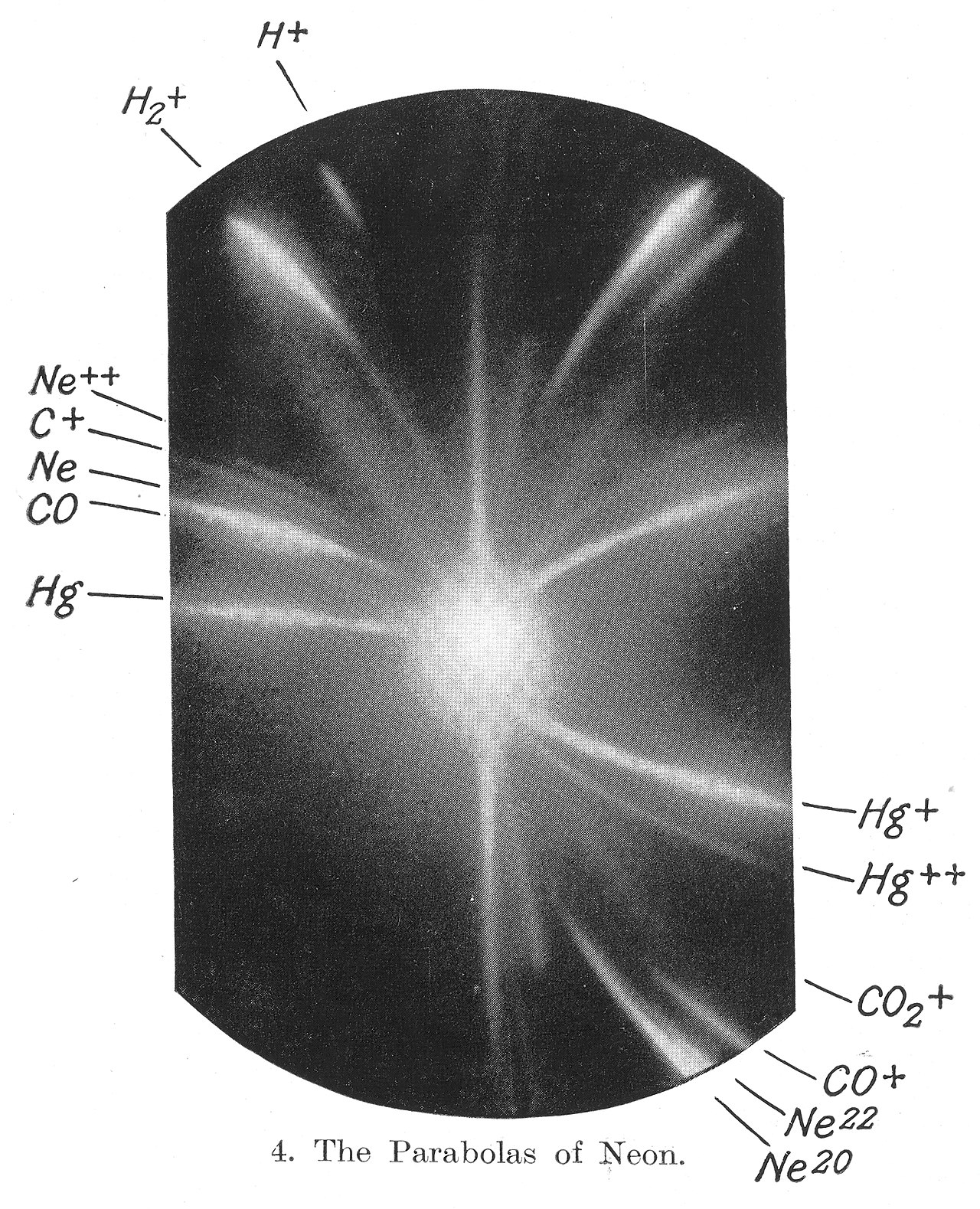
Foundational work on charged-particle analysis dates to the early 20th century. The first mass spectrograph was developed by J. J. Thomson, a physicist from the United Kingdom, who measured charged particle deflection and identified isotopes. His students and successors refined instrumentation and techniques; for example, Francis Aston improved practical mass spectrographs and isotope identification. Since then the field has evolved from bulky vacuum instruments to compact, highly sensitive devices capable of routine laboratory and field use.
Applications and examples
Mass spectrometry now underpins many scientific and industrial activities. In biochemical research it identifies and sequences peptides and proteins; in chemistry it characterizes organic and inorganic chemical compounds. In applied sectors it supports agriculture, brewing, food processing, geology, and petroleum exploration by detecting trace components, contaminants, and isotopic ratios. Mass spectrometers are routinely coupled with separation methods such as chromatography to analyze complex mixtures and improve quantitation and identification.
Strengths, limitations, and notable distinctions
Strengths of mass spectrometry include high sensitivity, specificity, and the ability to analyze complex mixtures when paired with separation techniques. Limitations arise from the need for ionizable material, potential fragmentation that complicates spectra, and instrument cost and maintenance. Distinctions among instruments—soft vs. hard ionization, single-stage vs. tandem systems, low- vs. high-resolution analyzers—determine suitability for a given problem. Careful choice of ion source, analyzer type, and sample preparation is essential to obtain meaningful and reproducible results.
Overall, mass spectrometry is a versatile analytical platform that links physical measurement of charged particles to chemical identity and structure. Its continual technical refinements keep expanding applications across science, medicine, industry, and space research.
Further reading and resources: basic m/z concepts, charged particle behavior, types of particles, molecular mass, chemical identification, sample preparation, molecular analysis, peptide mass fingerprinting, compound characterization, historical context, key figures, early instruments, industry uses: brewing, industry uses: food, industry uses: geology, industry uses: petroleum, chromatography coupling.
Related articles
Author
AlegsaOnline.com Mass spectrometry: principles, history, techniques, and applications Leandro Alegsa
URL: https://en.alegsaonline.com/art/62677
Sources
- chemguide.co.uk : "the mass spectrometer - how it works"
- youtube.com : Mass Spectrometry
- credoreference.com : "Mass Spectrometry"