
Marecchia (river in Emilia‑Romagna)
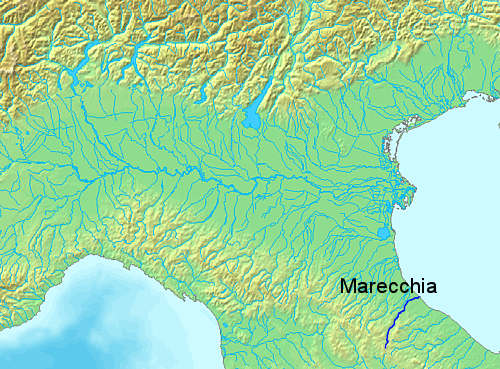
The Marecchia is a river in northeastern Italy that rises in the Apennines and flows northeast to the Adriatic at Rimini. Historically called Ariminus, its valley marks the southern edge of the Po Plain.
Overview
The Marecchia is a river in northeastern Italy, rising in the Apennine hills and running northeast to the Adriatic Sea at the city of Rimini. Its Latin name, Ariminus, is the root of the modern name of Rimini and of several historical references to the area. For basic locational data see coordinates and regional information on Emilia-Romagna.
Image gallery
6 Images


Course and characteristics
The Marecchia descends from upland springs in the Apennines and crosses a varied landscape of steep valleys, cultivated hills, and lowland plains before reaching the coast. In its lower reaches the river marks the southern margin of the Pianura Padana (Po Plain). Along its course it flows past or near several towns and communes; traditional river engineering and occasional flood-control works have shaped its modern channel.
Tributaries and basin
The river collects runoff from a compact mountain and hilly basin and receives several smaller streams and torrents. These tributaries are seasonal in character, with higher flows in late winter and spring and lower flows during summer. The basin supports agricultural land uses and local settlements and is managed through a mix of civil and regional authorities (region and provincial bodies).
History and name
The Marecchia valley has long been an important corridor between the interior Apennines and the Adriatic coast. In Roman times the waterway and nearby routes were associated with the name Ariminus, which gave rise to the name Rimini. Archaeological remains, road traces and medieval fortifications in towns and hilltops record centuries of human occupation and strategic use of the valley.
Uses, ecology and importance
Historically the river supplied water for agriculture, mills and small industries; today it remains significant for irrigation, local ecosystems and as a landscape element in tourism and recreation. Urban sections near the mouth traverse built-up areas where flood mitigation and water quality are active management concerns. Conservation efforts focus on preserving riparian habitats while accommodating human uses.
Notable facts
- The Marecchia’s mouth at Rimini has influenced the city’s development and identity; its Latin name is reflected in local toponymy.
- Its lowermost course serves as a geographic transition between the Apennine foothills and the river-fed plains of northern Italy.
- Local guides and maps frequently highlight historical sites along the valley; visitors can follow ancient roads and riverside paths to explore the region.
- For additional practical information and local resources, consult regional or municipal pages linked through official channels (map, city and regional sites).
Questions and answers
Q: What are the coordinates of the Marecchia river?
A: The coordinates of the Marecchia river are 44°04′N 12°34′E / 44.067°N 12.567°E / 44.067; 12.567.
Q: What region is the Marecchia river located in?
A: The Marecchia river is located in the Emilia-Romagna region.
Q: What is the Latin name of the Marecchia river?
A: The Latin name of the Marecchia river is Ariminus.
Q: How does the city of Rimini get its name?
A: The city of Rimini gets its name from the Latin name of the Marecchia river.
Q: What does the low course of the Marecchia river mark the end of?
A: The low course of the Marecchia river marks the end of the Padan Plain (Italian: Pianura Padana).
Q: Which city is located near the Marecchia river?
A: The city located near the Marecchia river is Rimini.
Q: In which geographical area can the Marecchia river be found?
A: The Marecchia river can be found in the Emilia-Romagna region of Italy.
Related articles
Author
AlegsaOnline.com Marecchia (river in Emilia‑Romagna) Leandro Alegsa
URL: https://en.alegsaonline.com/art/61703
Sources
- treccani.it : "Marecchia"