
Mariana Trench — Earth's Deepest Oceanic Trench
The Mariana Trench is the deepest known part of the world's oceans. This article explains its location, geology, dimensions, exploration history, biological significance and notable facts.
Overview
The Mariana Trench is the most profoundly deep submarine trench on Earth and contains the planet's deepest known point. It is a long, narrow trough in the western Pacific Ocean that marks a convergent plate boundary where one oceanic plate is forced beneath another. The trench and its deepest depression, the Challenger Deep, have drawn scientific attention for extreme-pressure environments, unique ecosystems, and milestone human explorations.
Image gallery
4 Images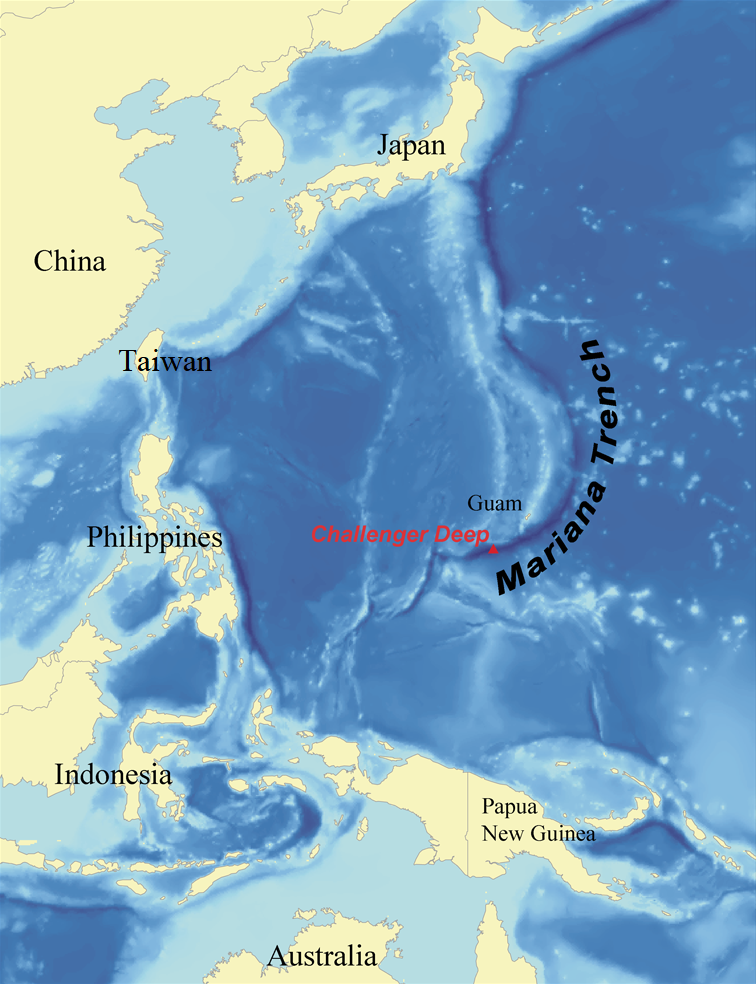


Location and dimensions
The trench lies to the south and east of the Mariana Islands and extends roughly 2,550 kilometres (about 1,580 miles) in length. Its width is relatively narrow compared with its length, averaging close to 69 kilometres (about 43 miles). The western end of the trench approaches the island of Guam. Measurements vary slightly by survey, but the greatest recorded depths are on the order of about 10,900–11,000 metres (commonly cited as approximately 10,971 m or about seven miles) at the Challenger Deep region.
Geology and formation
The trench formed where the Pacific Plate subducts beneath the much smaller Mariana Plate, creating a steep and deep seam on the seafloor. Subduction produces intense pressure, earthquakes, and volcanic activity; the volcanic arc formed by this process is visible as the chain of Mariana Islands. The same tectonic forces that create the trench also contribute to complex seafloor structures such as steep slopes, sediment-filled basins, and associated faulting.
Biology, exploration and importance
Despite extreme cold, darkness and crushing pressure, biological communities exist within and near the trench. Microbes, specialized invertebrates and amphipods have been sampled from great depths, often relying on chemosynthesis or scavenged organic material. The trench is also important for studies of life in extreme environments and for understanding global carbon cycles. Human exploration dates to 1875 surveys and modern deep-ocean work began with sonar mapping and sample collection. Notable descents include the 1960 bathyscaphe Trieste dive and later scientific and solo dives, including those by filmmakers and research teams. Remote operated vehicles (ROVs) and autonomous systems continue to map and sample the region, revealing new species and geological detail.
Notable facts and distinctions
- Deepest point: Challenger Deep is the trench's deepest surveyed pocket and is commonly cited among the deepest places on Earth.
- Length and width: About 2,550 km long and roughly 69 km wide on average.
- Tectonic setting: A classic example of an oceanic-oceanic subduction zone that produces a volcanic island arc.
- Scientific value: A natural laboratory for extreme ecology, geology and the limits of life; ongoing research uses manned and unmanned platforms to study the site.
- Further reading and maps are available for those seeking detailed bathymetry and expedition reports.
The Mariana Trench remains a focal point for oceanography and Earth science, combining geological extremes with unique biological communities and a history of deep-sea exploration that continues to expand our understanding of the deep ocean environment.
Questions and answers
Q: What is the Mariana Trench?
A: The Mariana Trench is the deepest known submarine trench and the deepest known location on Earth.
Q: Where is the Mariana Trench located?
A: The Mariana Trench lies south and east of the Mariana Islands.
Q: How deep is the Mariana Trench?
A: The Mariana Trench has a depth up to 10,971 m (7 miles).
Q: What is the width of the Mariana Trench?
A: The Mariana Trench is only an average of 69 kilometres (43 miles) wide.
Q: How long is the Mariana Trench?
A: The Mariana Trench is about 2,550 kilometres (1,580 miles) long.
Q: Where is the western end of the Mariana Trench located?
A: The western end of the Mariana Trench is near Guam.
Q: What are some interesting facts about the Mariana Trench?
A: The Mariana Trench is home to various unique and undiscovered species, and it has been explored by only a few expeditions due to its extreme depth and pressure.
Related articles
Author
AlegsaOnline.com Mariana Trench — Earth's Deepest Oceanic Trench Leandro Alegsa
URL: https://en.alegsaonline.com/art/61840
Sources
- newscientist.com : "Mission to Marianas"
- soest.hawaii.edu : "Daily Reports for R/V KILO MOANA June and July 2009"
- soest.hawaii.edu : "Inventory of scientific equipment aboard the R/V KILO MOANA"
- guardian.co.uk : "Mariana Trench: James Cameron completes record-breaking mission"
- worldcat.org : 0261-3077
- worldcat.org : 60623878
- 19thcenturyscience.org : 19thcenturyscience.org/HMSC/HMSC-Reports/1895-Summary/htm/doc878.html
- 19thcenturyscience.org : 19thcenturyscience.org/HMSC/HMSC-Reports/Zool-40/README.htm
- americanheritage.com : "To the bottom of the sea"
- time.com : "The last frontier"
- ns.gov.gu : Accessed Oct. 8, 2009
- doi.org : 10.1126/science.1105407
- pubmed.ncbi.nlm.nih.gov : 15692042
- news.nationalgeographic.com : "Life is found thriving at Ocean's deepest point"