
Marathi language: overview, history, script, and distribution
Marathi is an Indo-Aryan language spoken mainly in Maharashtra, India. This article explains its distribution, script and features, historical development, literature, dialects and official status.
Marathi is an Indo‑Aryan language primarily associated with the western Indian state of Maharashtra. It is one of the major languages of India and functions as the official language of Maharashtra. Marathi has a long written tradition and today uses the Devanagari script for most formal writing, education and media.
Image gallery
7 Images


Geographic distribution
While the core Marathi-speaking area is Maharashtra, communities and speakers live across adjoining states. Significant Marathi-speaking populations are found in parts of Gujarat, Madhya Pradesh, Goa, and Karnataka, and there are speakers in Andhra Pradesh. The language is also present in the union territories of Daman and Diu and Dadra and Nagar Haveli. Marathi communities in cities and abroad maintain cultural and linguistic ties with the region.
Linguistic features and script
Marathi belongs to the Southern branch of the Indo‑Aryan family. Its typical sentence order is subject–object–verb (SOV). The language has retained some conservative features from older Prakrits while also developing distinctive vocabulary and grammatical patterns. Marathi distinguishes gender and number in nouns and has a rich set of verbal endings. Standard Marathi uses the Devanagari script, which represents vowels and consonants clearly and accommodates the language's phonology.
History and literature
The recorded history of Marathi extends back many centuries through inscriptions, religious texts and devotional poetry. Over time Marathi evolved from Maharashtri Prakrit and absorbed influences from Sanskrit, Persian and neighboring languages. It developed a vibrant literary tradition that includes medieval bhakti poetry, classical prose, modern novels, plays, and a substantial body of journalism and scholarship. Renowned authors and poets contributed to the language's literary growth and to the development of a modern standard.
Contemporary use and education
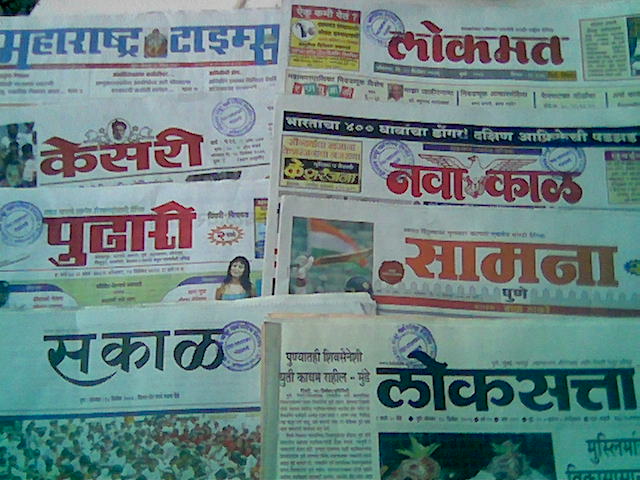
Marathi is used in government, education, print and broadcast media across Maharashtra. It is taught in schools as a primary or secondary language in its home state and appears in regional curricula elsewhere. The language figures in local administration, theatre, cinema and popular music, serving both everyday communication and formal functions.
Dialects and notable facts
- Marathi has several regional dialects and sociolects; coastal, urban and rural varieties differ in pronunciation and vocabulary.
- Standard forms coexist with dialectal speech used in folk literature and oral traditions.
- The script and literary norms have been standardized for education and publishing, while colloquial speech remains diverse.
Overall, Marathi is a major Indian language with deep historical roots, a broad geographic presence, a standardized written form, and a lively contemporary cultural life. It continues to adapt as speakers maintain traditions and produce new works in literature, media and public life.
Author
AlegsaOnline.com Marathi language: overview, history, script, and distribution Leandro Alegsa
URL: https://en.alegsaonline.com/art/61546
Sources
- nclm.nic.in : 42nd report: July 2003 - June 2004
- dnh.nic.in : Administration's profile