
Acanthaceae: the acanthus family of flowering plants
Acanthaceae is a mostly tropical family of about 230 genera and ~3,500 species of herbs, shrubs, vines and a few trees, noted for bilabiate flowers, showy bracts and explosive seed capsules.
Overview
Acanthaceae is a diverse family of flowering plants in the mint order (Lamiales) that includes roughly 230 genera and nearly 3,500 species. Members are commonly called the acanthus family and occur primarily in tropical and subtropical regions worldwide, with many species occupying forest understories, riverbanks and seasonally wet habitats. Plants range from small herbs to shrubs, climbers and a few trees.
Image gallery
10 Images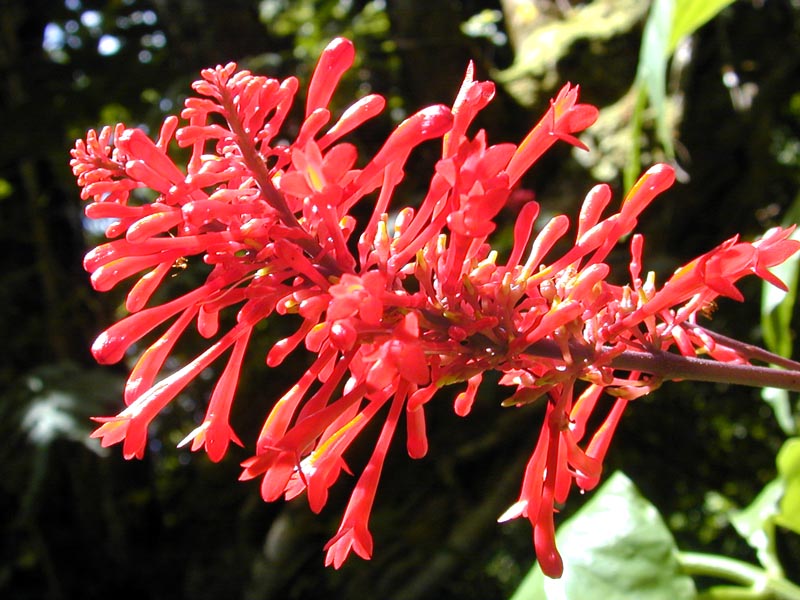


Key characteristics
Plants in this family share several morphological traits that are useful for identification. Typical features include opposite leaves, often simple and entire, and flowers that are zygomorphic (bilaterally symmetrical) with a two-lipped (bilabiate) corolla. Many species produce conspicuous bracts or inflorescences and bear fruit as dehiscent capsules that eject seeds. Seed dispersal frequently involves an elastic structure (retinaculum) that catapults seeds from the capsule.
Distribution and diversity
The greatest diversity of Acanthaceae occurs in tropical Asia, Africa and the Neotropics, although some temperate species exist. Most species favor humid, shaded environments but the family also includes taxa adapted to marshes, savannas and seasonally dry sites. Their evolutionary relationships place them within the broader assemblage of flowering plants often referred to as the mint order, alongside families with similar floral and chemical traits.
Uses, ecology and interactions
- Ornamental: Several genera are valued in horticulture for large, showy flowers and attractive foliage (examples include Acanthus, Thunbergia and Ruellia).
- Ecological roles: Flowers attract a range of pollinators—bees, butterflies, hummingbirds and other nectar feeders—so many species are important in tropical understory and edge habitats.
- Traditional uses: Some species have been used in folk medicine or as dye and fiber sources in local contexts; however, uses vary by region and species.
Notable genera and cultural notes
Well-known genera include Acanthus (famous for the leaf motif in classical architecture), Justicia (a large genus with many ornamental taxa, such as the shrimp plant), Thunbergia (vining ornamentals including the black-eyed Susan vine) and Ruellia (often called wild petunia). For general information about flowering plant orders and higher classification see flowering plants.
Identification tips and notable facts
When trying to identify a member of Acanthaceae look for opposite leaves, bilabiate flowers often with prominent bracts, and fruiting capsules that open explosively. While the family is primarily tropical, horticultural trade has spread several species widely beyond their native ranges, and a few have naturalized in new regions. The combination of distinctive floral structure and seed-ejection mechanism makes Acanthaceae an interesting group for both gardeners and ecologists.
Tags
Related articles
Author
AlegsaOnline.com Acanthaceae: the acanthus family of flowering plants Leandro Alegsa
URL: https://en.alegsaonline.com/art/611