
Celastraceae: the staff-tree family of woody flowering plants
Overview of Celastraceae, the staff-tree family of woody flowering plants: trees, shrubs and vines worldwide; key traits, genera like Euonymus and Celastrus, habitats and uses.
Celastraceae, commonly called the staff‑tree family, is a group of flowering plants placed in the order Celastrales. Members of the family are woody plants—trees, shrubs, and climbing vines—found across tropical and temperate regions worldwide. The number of recognized genera varies between treatments; many sources cite roughly several dozen genera, depending on how some groups are circumscribed.
Image gallery
1 Image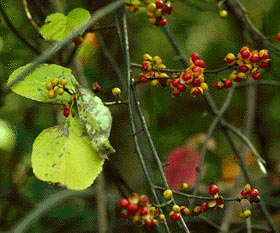
Growth habit and distribution
Species in this family occur in a wide range of habitats from warm lowland forests to temperate woodlands. They are primarily woody perennials and may be erect trees, multi‑stemmed shrubs, or lianas that climb on other vegetation.
Key characteristics
- Leaves: usually simple and often coriaceous (leathery), arranged alternately on the stems.
- Flowers: typically small and inconspicuous, with four or five sepals and a matching number of petals.
- Stamens: positioned alternately with the petals and commonly arise from a distinct nectar disk at the base of the flower.
- Fruit and seeds: fruiting structures are often brightly coloured and conspicuous; in many species the seeds bear fleshy arils or other attractive tissues that aid dispersal by birds and mammals.
Notable genera and uses
Some genera in the family are widely cultivated for their decorative foliage and colorful fruit. Well‑known examples include Euonymus and Celastrus (bittersweet). Beyond ornamental planting, various species have been studied for secondary compounds and have local uses, though details vary by species and region.
Tags
Related articles
Author
AlegsaOnline.com Celastraceae: the staff-tree family of woody flowering plants Leandro Alegsa
URL: https://en.alegsaonline.com/art/17849