
Magnetar
A magnetar is an unusual, highly magnetized neutron star whose decaying magnetic field powers persistent X-ray emission, short bursts and occasional giant flares.
Overview
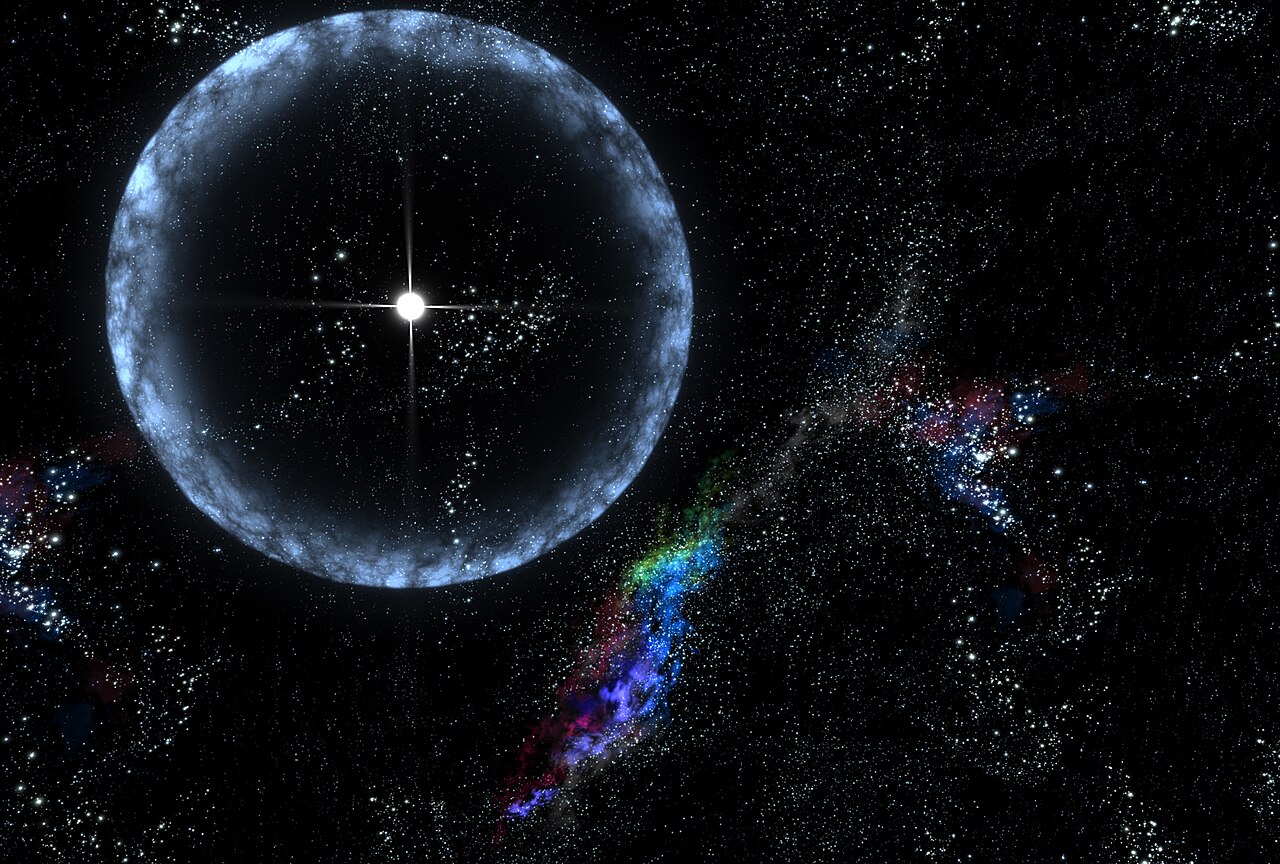
A magnetar is a kind of neutron star with an exceptionally strong magnetic field. These compact remnants are formed in the collapse of massive stars and are among the most magnetic objects known in the Universe. Unlike ordinary rotation-powered pulsars, magnetars derive much of their observable activity from the energy stored in their magnetic fields rather than from rotational energy alone.
Image gallery
9 Images





Magnetic strength and structure
Surface fields inferred for magnetars are typically in the range 10^14–10^15 gauss, orders of magnitude above those of normal pulsars and vastly stronger than any man-made magnet. The internal field may be still higher and the field geometry can be complex, with strong toroidal and poloidal components. Magnetic stresses influence the star's crust and outer layers, and slow decay of the field releases heat and high-energy radiation over time.
Observational behaviour
Magnetars are observed primarily through persistent X-ray emission, brief short bursts, and, on rare occasions, extremely energetic giant flares. Their spin periods are generally slow for neutron stars (typically a few seconds) and they often show rapid spin-down as magnetic torque removes rotational energy. Some sources switch between quiescent and active states, with outbursts that increase X-ray luminosity by orders of magnitude for weeks to months.
Classification and history
Historically, objects now recognized as magnetars were catalogued as Anomalous X-ray Pulsars (AXPs) and as soft gamma repeaters (SGRs). Early high-energy transients detected in the late 1970s and later powerful flares were important in establishing the magnetar interpretation. Theoretical work in the early 1990s proposed that magnetic field decay could power the observed emission and bursting behaviour.
Physical mechanisms and significance
Energy release in magnetars can occur through magnetic field decay, crustal fractures (starquakes), and magnetic reconnection in the magnetosphere. These processes heat the star, accelerate particles and produce X-ray and gamma-ray emission. Magnetars provide laboratories for physics under extreme conditions—ultra-strong fields, dense matter, and exotic plasma processes—and they influence their environments through injection of energetic particles and radiation.
Further notes
- Relation to other neutron stars: magnetars differ chiefly in the dominant role of magnetic energy, in contrast to rotation-powered pulsars and accreting neutron stars.
- Transient and multiwavelength behavior: some magnetars have exhibited radio pulses or variable optical/infrared counterparts during active phases.
For introductions and reviews, see materials on neutron-star types and high-energy transients; related terminology includes magnet-related concepts and catalogues of AXPs and SGRs.
Related articles
Author
AlegsaOnline.com Magnetar Leandro Alegsa
URL: https://en.alegsaonline.com/art/60622