
Luhman 16 — nearby binary brown dwarf system
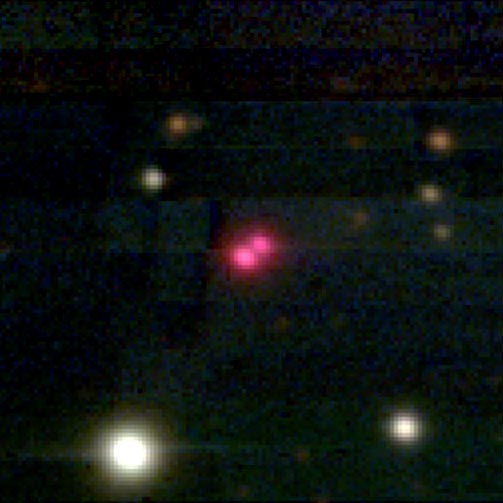
Luhman 16 (WISE 1049−5319) is a nearby binary brown dwarf system about 6.6 light-years away in Vela. It contains two substellar objects near the L/T spectral transition and shows notable atmospheric variability.
Overview
Luhman 16, also catalogued as WISE 1049−5319, is a pair of brown dwarfs in the southern constellation Vela. At roughly 6.6 light-years from the Sun it is among the nearest known systems outside the Solar neighborhood and represents one of the closest brown dwarf pairs to Earth. The system brought renewed attention to nearby substellar objects after its announcement and is often cited when discussing the population of objects that bridge the gap between stars and planets.
Image gallery
10 Images








Physical characteristics
Both components are brown dwarfs, objects too low in mass to sustain stable hydrogen fusion. The brighter component is classified around L8 ± 1, while the companion lies near the L/T spectral transition where atmospheres change from cloudy, dusty conditions to cooler, methane-bearing spectra. The pair orbit each other at a few astronomical units; their mutual separation projected on the sky is small but resolvable with moderate telescopes.
Discovery and distance
Discovered through analysis of data from the Wide-field Infrared Survey Explorer (WISE), the system is also known by its survey designation WISE 1049−5319. It is frequently mentioned in reviews of nearby neighbors to the Sun, alongside other close objects in discussions of the Solar System's immediate surroundings (nearby systems). The announcement underscored that this was the closest stellar or substellar system found since the early 20th century (a notable discovery).
Orbit and dynamics
The two brown dwarfs orbit one another with a semimajor axis of the order of a few astronomical units and a period of a few decades; published estimates place the orbital period at about 25 years. Their proximity and relative motion have allowed astronomers to measure dynamical masses and study how substellar objects evolve over time without internal hydrogen fusion.
Atmosphere, variability and scientific importance
Luhman 16 has been a prime target for studies of brown-dwarf weather. The cooler component displays rapid photometric variability attributed to patchy clouds and changing atmospheric patterns, making it a natural laboratory for testing models of cloud formation and circulation on objects between stars and planets. High-cadence monitoring and spectral time series have revealed rotation-driven changes and allowed mapping-like techniques to infer surface inhomogeneities.
Searches for companions and future study
Because of its proximity, the system has been searched for planets, faint companions, and circumstellar material using direct imaging and precision astrometry; no confirmed planetary companions have been reported so far. Continued observations aim to refine masses, orbital parameters and atmospheric models. For further technical details and observational resources see entries on binary brown dwarfs, the discovery survey WISE, and studies of nearby objects in the context of local stellar populations (classification, orbital period, separation). Additional reading and data releases are available through mission and survey archives referenced by the community (historical note, neighbors).
Related articles
Author
AlegsaOnline.com Luhman 16 — nearby binary brown dwarf system Leandro Alegsa
URL: https://en.alegsaonline.com/art/59824
Sources
- arxiv.org : arxiv.org/abs/1303.2401v2
- science.psu.edu : science.psu.edu