
Armenian Air Force
Air arm of the Republic of Armenia focused on airspace protection, ground support and integrated air defence; combines a small aviation component with missile and anti-aircraft units.
The Armenian Air Force is the aerial component of the Armed Forces of Armenia. Its primary missions are to protect national airspace, provide aviation support to ground forces and operate an integrated air-defence network. The service is compact compared with larger national air arms and places strong emphasis on surface-to-air capability and helicopter operations.
Image gallery
7 Images


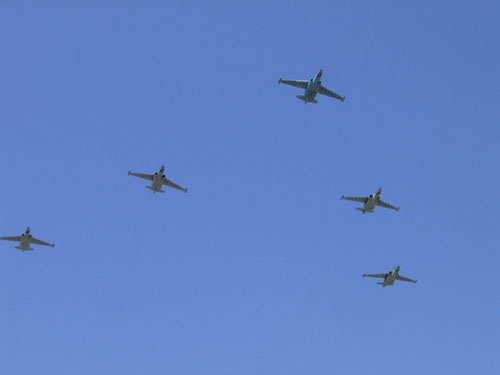
Organization and role
Formed from units and equipment carried over after the dissolution of the Soviet Union, the air arm has been shaped by successive restructuring and professionalisation efforts, including a military reform program. The force comprises aviation squadrons (principally helicopters and a limited number of fixed-wing types), as well as dedicated ground-based air-defence formations that coordinate closely with other branches.
Equipment and air-defence systems
The Armenian approach relies heavily on anti-aircraft and missile systems rather than a large combat-air fleet. Publicly available accounts describe anti-aircraft units and surface-to-air missile batteries mounted in brigades and regiments. Reported equipment types include short- and medium-range systems such as the M79 Osa and Krug, legacy Soviet designs like the S-75 and S-125, and longer-range S-300 systems. Older inventories have also been reported to include ballistic missiles.
- Anti-aircraft and radar elements that provide detection and early warning.
- Air defence brigades and regiments equipped with various launchers and interceptors.
- Reported missile types and assets are described under missile and air-defence categories.
Some sources have cited an aggregate of around one hundred missile launchers distributed among brigades and regiments, and references to tactical ballistic missiles in older inventories. These figures have varied over time due to retrofits, transfers and modernization.
History and development
Since independence, Armenia’s air component has evolved through acquisition, training exchanges and periodic modernisation. Cooperation with regional partners has influenced procurement and basing, while doctrine has prioritized layered air-defence coverage and support for ground operations. Reforms have sought to professionalise staffing, improve maintenance and adapt Soviet-era equipment to current requirements.
Operational context and challenges
Operating in a geopolitically sensitive region, the air force faces constraints common to small states: limited budgets, a small fleet of combat aircraft, and the need to maintain readiness across mountainous terrain. Its air-defence units—organized into a brigade and multiple regiments in various accounts—remain central to national deterrence and territorial defence planning.
Overall, the Armenian Air Force functions as a compact but integral element of national defence, emphasizing ground-based air-defence systems, rotary-wing mobility and integration with allied support networks.
Related articles
Author
AlegsaOnline.com Armenian Air Force Leandro Alegsa
URL: https://en.alegsaonline.com/art/5697