
Laurussia (Euramerica): the Old Red Sandstone continent
Laurussia, also called Euramerica or the Old Red Sandstone Continent, was a late Paleozoic landmass formed by the collision of Laurentia, Baltica and Avalonia, shaping early terrestrial ecosystems and mountain belts.
Overview
Laurussia was a Paleozoic landmass often described as a minor supercontinent. Commonly called the Old Red Sandstone Continent or Euramerica, it assembled during the Silurian–Devonian interval and played a central role in the geology and biogeography of the time.
Image gallery
10 Images



Formation and structure
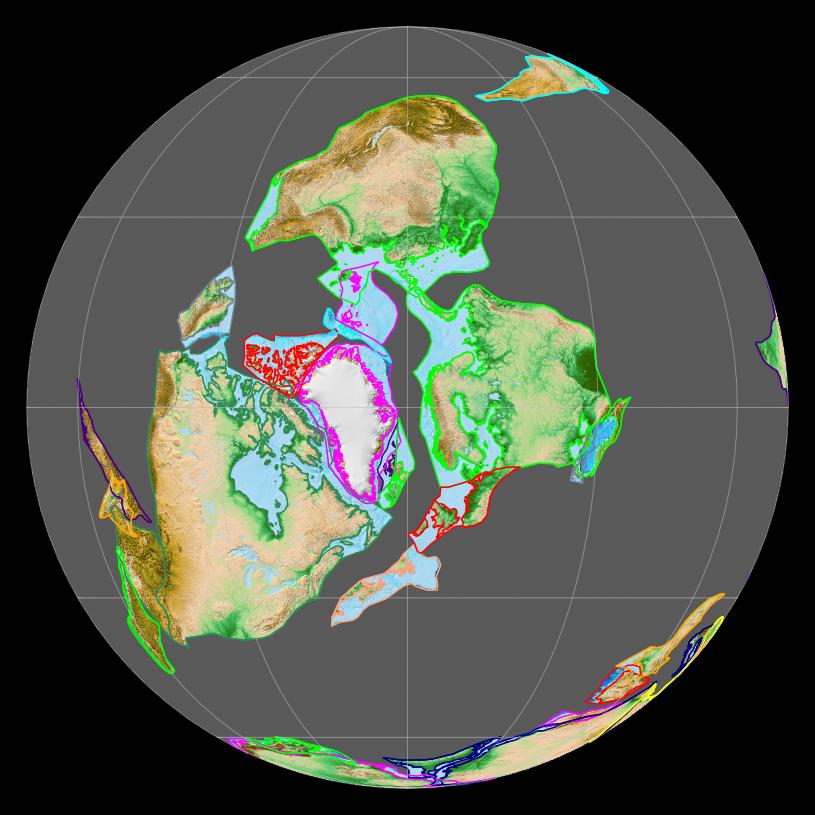
Laurussia resulted from the progressive collision of several continental blocks: Laurentia (roughly modern North America and Greenland), Baltica (northern Europe) and various smaller terranes collectively known as Avalonia. These collisions produced mountain belts and shaped sedimentary basins through orogenic episodes often grouped under the Caledonian and Acadian events.
Geographic distribution
The landmass included territories that correspond to parts of present-day North America, Greenland and northern Europe, plus smaller fragments now scattered along the Atlantic margins. Sea levels, climate and river systems of Laurussia influenced widespread deposition of red-bed continental sediments.
Significance and legacy
Laurussia is important for several reasons: it hosts characteristic sedimentary sequences such as the Old Red Sandstone, records key mountain-building events, and preserves fossils documenting the Devonian radiation of land plants and early terrestrial vertebrates. Its configuration affected ocean circulation and climate patterns in the late Paleozoic.
Later history and distinctions
By the late Carboniferous Laurussia collided with Gondwana to become part of the larger supercontinent Pangaea; subsequent rifting and plate motions in the Mesozoic and Cenozoic rearranged its fragments into the modern continents. Laurussia is therefore distinct from contemporaneous Gondwana and later Pangaea but is an essential chapter in the assembly and breakup of Earth’s continents.
- Major components: Laurentia, Baltica, Avalonia.
- Associated deposits: Old Red Sandstone facies.
- Key modern references: see regional studies of Devonian basins and orogenies.
- For maps and further reading consult sources linked at regional geology and compilations of Greenland and North American stratigraphy.
Related articles
Author
AlegsaOnline.com Laurussia (Euramerica): the Old Red Sandstone continent Leandro Alegsa
URL: https://en.alegsaonline.com/art/56334