
Length of day
The length of a day is the time Earth or another body takes to rotate once relative to the Sun or the stars. This article explains solar and sidereal days, planetary differences, and why day length changes.
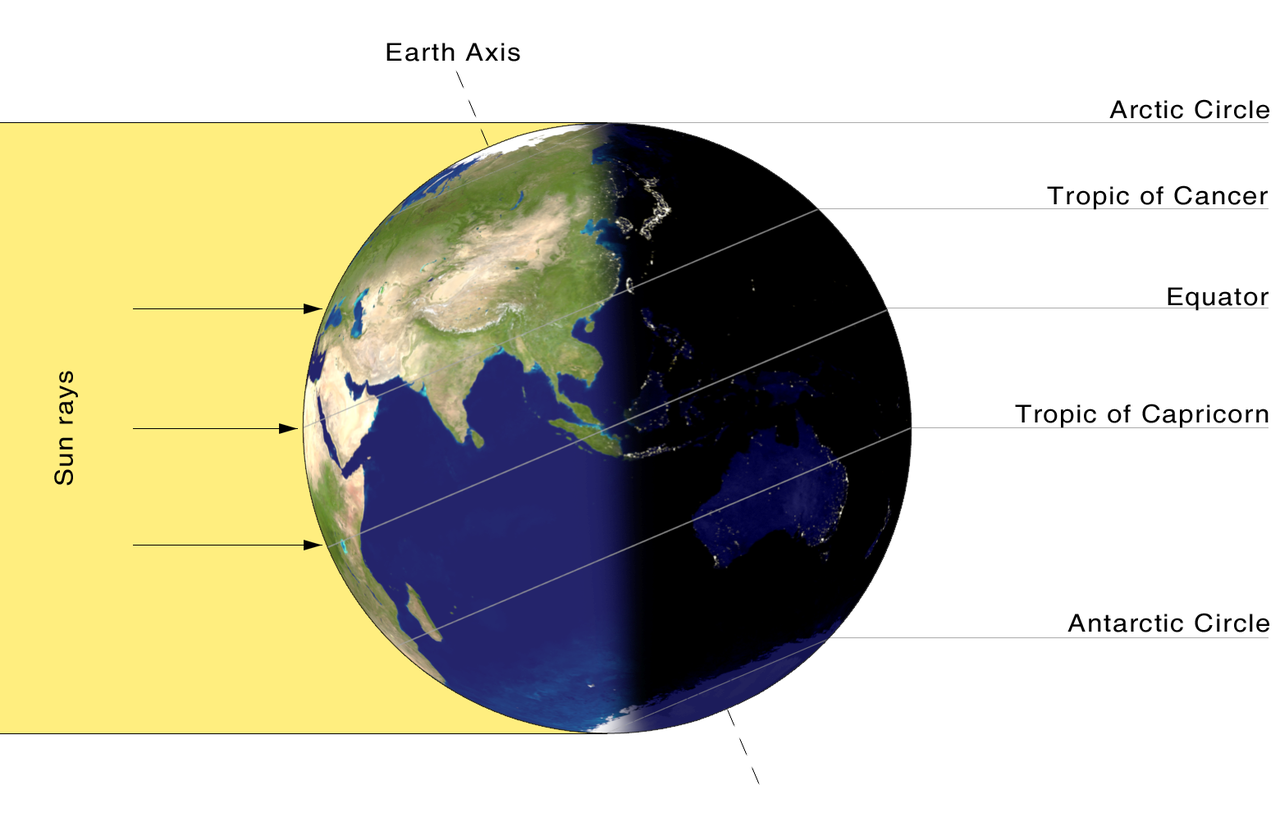
The "length of day" describes how long it takes a planet or other rotating body to complete a rotation that marks one daytime cycle. In everyday use on Earth a day is 24 hours by convention, but astronomers distinguish between different kinds of day depending on the reference point (the Sun or the distant stars).
Image gallery
10 Images







Definitions
Two widely used measures are:
- Solar day — the interval between successive solar noons, when the Sun returns to the same meridian in the sky. This is the basis of civil timekeeping and averages about 24 hours on Earth.
- Sidereal day — the time it takes a body to rotate once relative to distant stars rather than the Sun. On Earth a sidereal day is slightly shorter than a solar day because the planet advances along its orbit while rotating.
These definitions apply to any spinning world, and the numerical values vary with rotation rate and orbital motion.
Earth's day and small variations
For practical purposes people use the mean solar day of 24 hours. The actual length of each solar day varies by small amounts through the year due to orbital eccentricity and the tilt of Earth's axis. Over long timescales tidal interactions with the Moon and other effects slowly lengthen Earth's rotation, so days are becoming longer by fractions of a second per century. This gradual change has led to occasional adjustments such as leap seconds in coordinated universal time.
Day lengths on other worlds
Different planets show a wide range of day lengths. For example, Mars has a solar day close to Earth's, making its day-night cycle familiar to visitors; Jupiter rotates very rapidly, producing a day under ten hours; Venus rotates very slowly and in the opposite direction, giving it an extremely long solar day. Comparisons of rotation help astronomers understand planetary interiors, atmospheres and histories. See more about other planets for specifics.
History, measurement and importance
Humans have tracked day length since antiquity using sundials and later mechanical clocks. Modern timekeeping ties civil seconds to atomic standards while using astronomical observations to relate rotation-based time to clock time. Knowing the length of day is essential for navigation, calendar design, astronomy and studying planetary dynamics.
Notable distinctions include the difference between diurnal cycle (light and dark caused by rotation) and formal time definitions used for society. Understanding the length of day connects everyday experience with celestial mechanics and planetary science.
Related articles
Author
AlegsaOnline.com Length of day Leandro Alegsa
URL: https://en.alegsaonline.com/art/57133
Sources
- commons.wikimedia.org : Day length
- enchantedlearning.com : enchantedlearning.com/subjects/astronomy/planets/
- ui.adsabs.harvard.edu : 2000RvGeo..38...37W
- doi.org : 10.1029/1999RG900016