
Kura–Araxes culture (Early Transcaucasian): Bronze Age society of the South Caucasus
Bronze Age archaeological culture (c. 3500–2000 BCE) originating on the Ararat plain, noted for black‑and‑red burnished pottery, early metallurgy and wide distribution across the Armenian Highlands and South Caucasus.
The Kura–Araxes culture, often called the Early Transcaucasian culture, was a Bronze Age archaeological horizon that developed in the South Caucasus and adjacent highlands around the fourth millennium BCE and persisted in various forms until about 2000 BCE. It takes its common name from the Kura and Araxes river valleys where many characteristic sites were first identified. Archaeologists recognize it as a distinct cultural package defined by specific pottery, metalwork, settlement patterns and burial customs.
Image gallery
10 Images

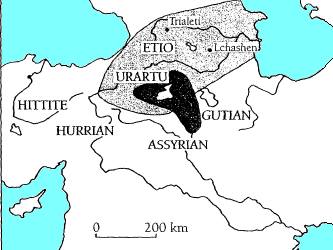


Geographic spread and chronology
The earliest traces appear on the Ararat plain and the Armenian Highlands; by the early third millennium BCE the material culture associated with Kura–Araxes occurs across a broad area that includes present‑day Armenia, parts of modern Georgia, Azerbaijan and regions of the wider Caucasus. From these cores the culture’s influence reached into eastern Anatolia, northwestern Iran and even parts of the Levant, indicating active networks of migration, exchange and imitation rather than a single homogeneous polity.
Distinctive characteristics
- Pottery: well‑burnished black and red wares, often with simple incised or impressed decoration and characteristic vessel shapes;
- Metallurgy: copper and early bronze objects including tools, ornaments and weaponry produced at local workshops;
- Architecture: settlements with stone foundations, rectangular mudbrick or timber buildings and occasional fortifications;
- Economy: mixed farming, herding and specialized craft production, combined with long‑distance trade.
Burial practices varied regionally and through time, ranging from inhumations in pits and stone cists to later burial mounds; this diversity suggests plural social traditions within the broader cultural horizon.
Debate continues over the culture’s origins and social organization: some scholars emphasize local development from preceding Neolithic and Chalcolithic communities in the highlands, while others point to interactions with neighboring groups. Its decline around 2000 BCE gave way to regional Middle Bronze Age traditions, but many technological and artistic traits persisted and influenced successor societies in the Caucasus and beyond.
The Kura–Araxes phenomenon is important for understanding the spread of Bronze Age technologies, early craft specialization and the formation of interregional networks across western Asia during the third millennium BCE.
Related articles
Author
AlegsaOnline.com Kura–Araxes culture (Early Transcaucasian): Bronze Age society of the South Caucasus Leandro Alegsa
URL: https://en.alegsaonline.com/art/54649