
Lake Mungo remains — Mungo Lady, Mungo Man and ancient Australian burials
Three well-known prehistoric human skeletons from the Willandra Lakes Region, Australia, notable for early burial practices, dating to around 40,000 years and their scientific and cultural importance.
Overview
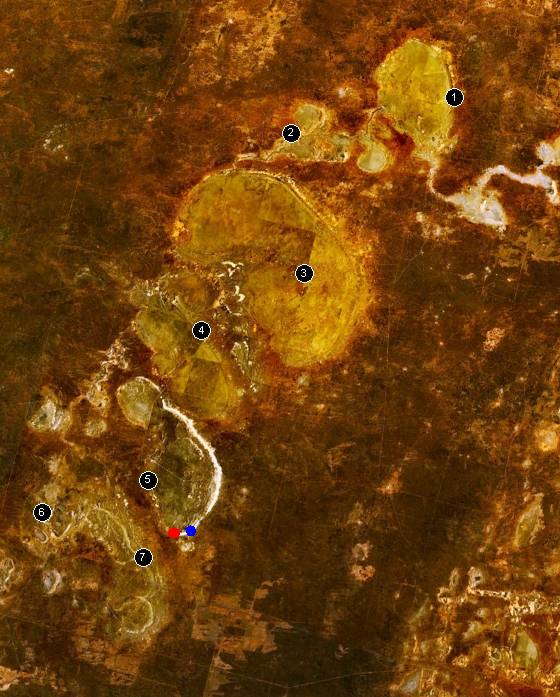
The Lake Mungo remains are a group of important prehistoric human skeletons recovered from the dry lake basins near Lake Mungo in New South Wales, Australia. Often discussed under the names Mungo Lady (LM1), LM2, and Mungo Man (LM3), these discoveries form part of the larger assemblage of more than forty people represented by fragmentary bones across the region. The site lies within the Willandra Lakes Region, which is recognised for its global heritage values (World Heritage).
Image gallery
3 Images

Characteristics of the remains
The best known individuals are Mungo Lady, a partially cremated adult whose remains show evidence of deliberate burning, and Mungo Man, an adult whose burial included the application of red ochre. Researchers have described skeletal preservation, burial positioning, and traces of funerary treatment in these and other fragments. Scientific reports and museum records refer to the material as fossils or skeletal material depending on context.
Dating and scientific methods
Multiple dating techniques, notably optically stimulated luminescence and radiocarbon methods applied to associated sediments and charcoal, have placed the principal burials in the Late Pleistocene—generally around tens of thousands of years before present. These ages make the Lake Mungo individuals among the oldest reliably dated human remains in Australia and important for understanding early human occupation of Sahul (the Australia–New Guinea landmass).
Archaeological and cultural significance
Besides establishing early human presence, the Lake Mungo burials provide some of the earliest direct evidence for complex funerary behaviour: deliberate burial, ochre use in mortuary contexts and possible cremation. This has influenced models of symbolic behaviour in ancient hunter-gatherer societies and shaped scientific debate about the timing and routes of migration into Australia.
Context, research and repatriation
The sites sit within a landscape that has yielded archaeological deposits, stone tools and further human remains attributed to dozens of individuals. Excavations were carried out by geologists and archaeologists in the late twentieth century and have since prompted ethical discussions about study, display and return of ancestral remains. Traditional owners and scientific institutions have engaged in repatriation and reburial processes, reflecting the cultural sensitivity of human remains and the need for collaboration.
Notable facts and continuing questions
- Lake Mungo finds are central to debates about the antiquity of ritual behaviour in Homo sapiens and about the timing of human dispersal into Australia.
- Ongoing research re‑examines preservation, dating techniques and the wider fossil record from the Willandra Lakes Region.
- The site illustrates the intersection of scientific inquiry and Indigenous rights, prompting new practices in archaeology and museum stewardship.
For further background and official site information see local heritage and scientific summaries associated with the Willandra Lakes Region and resources linked by regional authorities at Lake Mungo and related conservation pages (fossil records, skeletal catalogues, and jurisdictional pages for New South Wales, Australia, and the World Heritage listing).
Questions and answers
Q: What are the Lake Mungo remains?
A: The Lake Mungo remains are three sets of human fossils named Lake Mungo 1 (LM1), Lake Mungo 2 (LM2), and Lake Mungo 3 (LM3).
Q: Which one of the Lake Mungo remains is also known as Mungo Lady?
A: Lake Mungo 1 (LM1) is also known as Mungo Lady.
Q: Where are the Lake Mungo remains located?
A: The Lake Mungo remains are located near Lake Mungo, in New South Wales, Australia, in the World Heritage-listed Willandra Lakes Region.
Q: How many human skeletons have been found in the Willandra Lakes Region?
A: Over forty human skeletons have been found in the Willandra Lakes Region.
Q: Which of the human skeletons found in the Willandra Lakes Region is considered the most significant?
A: The Lake Mungo remains are considered the most significant of the human skeletons found in the Willandra Lakes Region.
Q: What is the significance of the Lake Mungo remains?
A: The Lake Mungo remains are significant because they are some of the oldest anatomically modern human remains found in Australia, dating back to around 40,000 years ago.
Q: What is the Willandra Lakes Region?
A: The Willandra Lakes Region is a World Heritage-listed area in New South Wales, Australia that contains a large number of archaeological sites and natural features, including Lake Mungo.
Related articles
Author
AlegsaOnline.com Lake Mungo remains — Mungo Lady, Mungo Man and ancient Australian burials Leandro Alegsa
URL: https://en.alegsaonline.com/art/55532
Sources
- doi.org : 10.1038/240046a0
- pubmed.ncbi.nlm.nih.gov : 4570638
- www-personal.une.edu.au : "Pleistocene homogeneity and Holocene size reduction: the Australian human skeletal evidence"
- www-personal.une.edu.au : "Lake Mungo 1"
- news.nationalgeographic.com : "First Humans in Australia Dated to 50,000 Years Ago"
- doi.org : 10.1038/nature01383
- pubmed.ncbi.nlm.nih.gov : 12594511
- doi.org : 10.1080/00438243.1970.9979463
- pubmed.ncbi.nlm.nih.gov : 16468208
- fnpw.org.au : Mungo Archaeological Digs
- oceania.metapress.com : "A new test of the sex of the Lake Mungo 3 skeleton"
- doi.org : 10.1006/jhev.2000.0442
- pubmed.ncbi.nlm.nih.gov : 11102270
- doi.org : 10.1006/jhev.1999.0400
- pubmed.ncbi.nlm.nih.gov : 10799264