
Kari (moon) — Saturn XLV, an irregular retrograde satellite
Kari (Saturn XLV, S/2006 S 2) is a small irregular, retrograde moon of Saturn discovered in 2006. It orbits far from Saturn and is named for Kári of Norse mythology.
Overview
Kari, also designated Saturn XLV and provisionally S/2006 S 2, is one of Saturn's small outer moons. Announced in June 2006, it is classified as an irregular satellite because of its distant, inclined, and eccentric orbit. Its small size and faintness place it among a population of outer satellites believed to be captured objects or fragments from past collisions.
Image gallery
4 Images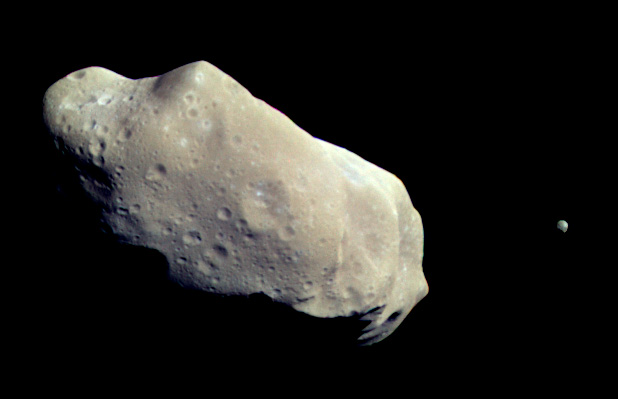


Physical characteristics
Kari is estimated to be about 7 kilometres across. Like most moons of this size, it is assumed to be irregularly shaped, lacks geological activity, and has a dark, heavily cratered surface typical of small outer satellites. Detailed information on composition, albedo, or surface geology is not available because the body is too small and faint for detailed remote study by current spacecraft instruments.
Orbit and dynamical properties
Kari follows a distant, retrograde orbit around Saturn. Key orbital parameters reported from observations are:
- Average orbital distance: about 22,305,100 km from Saturn
- Orbital period: roughly 1,243.71 days
- Inclination: ~148.4° to the ecliptic (about 151.5° to Saturn's equator) — indicating retrograde motion
- Eccentricity: approximately 0.3405 — a notably non-circular path
The combination of high inclination, substantial eccentricity, and large semi-major axis is characteristic of Saturn's irregular, retrograde satellites and suggests a history different from that of the large, regular moons that formed in a circumplanetary disk.
Discovery and name
The discovery was announced by a team including Scott S. Sheppard, David C. Jewitt, Jan Kleyna, and Brian G. Marsden on June 26, 2006, based on observations made between January and April 2006. The moon received its name in April 2007, after Kári (son of Fornjót), a figure in Norse mythology associated with wind. The naming follows the convention of using names from Norse myth for Saturn's retrograde irregular moons.
Context and significance
As one of many small irregular satellites, Kari contributes to astronomers' understanding of the outer satellite population around the giant planets. Studies of such moons help constrain models of capture, collisional fragmentation, and the dynamical evolution of satellite systems. Because Kari is small and faint it has not been visited directly by spacecraft, and most knowledge comes from ground-based telescopic surveys.
References and further reading
For discovery details and team information see the announcement pages for Scott S. Sheppard and David C. Jewitt. Orbital data and updates are summarized on resources such as satellite ephemeris listings and minor-planet circulars where provisional designations like S/2006 S 2 are tracked. The mythological name and background are discussed in sources on Norse mythology and naming conventions for planetary satellites (naming guidelines, Kári).
Related articles
Author
AlegsaOnline.com Kari (moon) — Saturn XLV, an irregular retrograde satellite Leandro Alegsa
URL: https://en.alegsaonline.com/art/52304
Sources
- ifa.hawaii.edu : Institute for Astronomy Saturn Satellite Data
- cfa-www.harvard.edu : IAUC 8727: Satellites of Saturn
- cfa-www.harvard.edu : MPEC 2006-M45: Eight New Satellites of Saturn
- cfa-www.harvard.edu : IAUC 8826: Satellites of Jupiter and Saturn