
Kepler-452b — an Earth-size exoplanet in the habitable zone of a Sun-like star
Kepler-452b is a transiting exoplanet discovered by the Kepler telescope in 2015. It is larger than Earth and orbits a Sun-like star within its habitable zone, though its composition and habitability remain uncertain.
Overview
Kepler-452b is an extrasolar planet discovered by the Kepler space telescope and publicly announced by NASA on 23 July 2015. It orbits a Sun-like star designated Kepler-452, located many light‑years from Earth, and was detected using the transit method when the planet crossed in front of its star as seen from the spacecraft. The planet attracted attention because it lies within the star's habitable zone, where temperatures could in principle allow liquid water at the surface.
Image gallery
10 Images
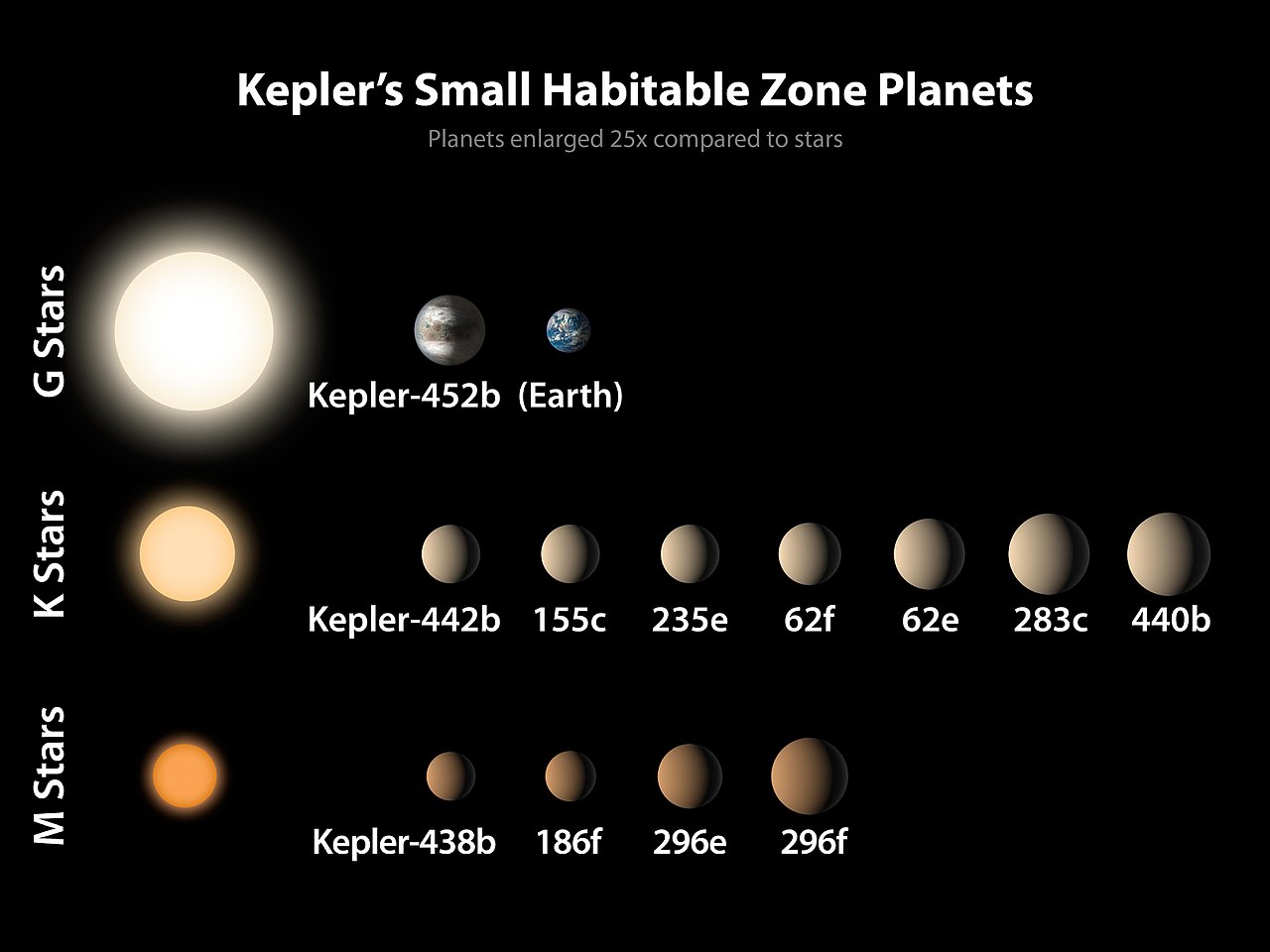





Characteristics
Kepler-452b is larger than Earth, with a radius commonly reported as roughly 1.6–1.7 times that of our planet. Its orbital period is similar to an Earth year, giving it an orbit at a distance from its star comparable to Earth's distance from the Sun. Because of its size, scientists consider two main possibilities: it could be a rocky super-Earth or a planet with a substantial volatile envelope more like a mini-Neptune. Direct measurements of mass and composition are not available due to the star's distance.
- Host star: Kepler-452, a G-type star broadly similar to the Sun
- Size: about 1.6–1.7 Earth radii
- Location: several hundred to over a thousand light‑years away in the Kepler field
- Detection: transit photometry by the Kepler telescope (Kepler mission)
Discovery and scientific context
The Kepler mission searched for planets by monitoring the brightness of more than a hundred thousand stars. Kepler-452b was identified as a periodic dip in brightness consistent with a planet crossing the stellar disk. Subsequent statistical validation and analysis led to its designation as a confirmed exoplanet in the Kepler candidate catalog. Its announcement was emphasized in public communications because it was one of the first Earth-size or slightly larger planets found in the habitable zone of a Sun-like star.
Importance and limitations
Kepler-452b is scientifically important as an example of a planet occupying a region where liquid water might exist under favorable conditions and as a target that illustrates the kinds of worlds Kepler could find. However, the great distance to the system limits detailed follow-up: current telescopes cannot readily measure its mass, atmosphere, or surface conditions. Those uncertainties mean that claims about habitability must remain cautious. The planet is often described in popular media as an "older, larger cousin" of Earth, but that phrase is shorthand rather than a definitive physical description.
Notable distinctions and open questions
Compared with other small exoplanets, Kepler-452b stands out for orbiting a star similar to the Sun at a roughly Earth-like orbital distance. Important open questions include whether the planet is predominantly rocky, whether it retains an atmosphere, and whether surface conditions could support liquid water. Future observations of similar, closer systems will provide better comparisons and help place Kepler-452b in context within the growing catalogue of exoplanets. For more technical summaries and mission details see the mission pages and catalogs maintained by the Kepler project (Kepler overview, NASA announcement) and planetary data repositories (habitable zone resources, stellar classification).
Related articles
Author
AlegsaOnline.com Kepler-452b — an Earth-size exoplanet in the habitable zone of a Sun-like star Leandro Alegsa
URL: https://en.alegsaonline.com/art/52994
Sources
- phl.upr.edu : "The Habitable Exoplanets Catalog – Planetary Habitability Laboratory @ UPR Arecibo"
- openexoplanetcatalogue.com : openexoplanetcatalogue.com