
W. M. Keck Observatory
A pair of 10‑meter optical/infrared telescopes on Mauna Kea, Hawaii, notable for their segmented mirrors, adaptive optics, and wide-ranging contributions to astronomy.
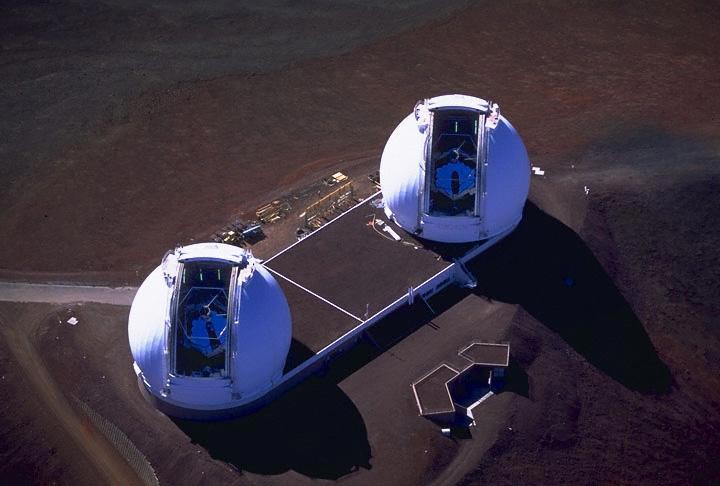
The W. M. Keck Observatory comprises two large, ground‑based telescopes sited near the summit of Mauna Kea on the island of Hawaii. Each telescope has a 10‑metre primary mirror assembled from hexagonal segments and operates at an altitude of roughly four kilometres above sea level to take advantage of thin, dry air for infrared and optical observations. Together the twin Keck telescopes are among the most powerful steerable optical/infrared facilities in the world.
Image gallery
7 Images


Design and technical characteristics
Keck’s primary mirrors are built from 36 hexagonal segments per telescope. The segments are actively controlled so the mirror behaves as a single, continuous optical surface. This segmented‑mirror approach allowed construction of much larger apertures than was practical with a single monolithic mirror at the time. The observatory also uses advanced adaptive optics systems — including laser guide stars — to correct for atmospheric turbulence and produce much sharper images than conventional ground‑based telescopes.
History and development
Funded by a major gift from the W. M. Keck Foundation, the facility was conceived in the late 20th century to push ground‑based astronomy to new angular resolution and sensitivity levels. The first telescope (Keck I) achieved first light in the early 1990s and the second (Keck II) followed within a few years. The segmented mirror technology and associated control systems pioneered at Keck influenced the design of later large telescopes.
Instruments and observing modes
- High‑resolution optical spectrographs for precise radial‑velocity measurements and chemical analysis.
- Near‑infrared cameras and spectrometers optimized for faint objects, star formation, and distant galaxies.
- Integral‑field spectrographs and multi‑object spectrographs for spatially resolved spectroscopy of complex sources.
Notable instrument names associated with Keck include HIRES, LRIS, NIRSPEC, NIRC2, OSIRIS, MOSFIRE and DEIMOS, among others; these provide a wide range of spectral resolution and imaging capabilities.
Scientific impact and notable results
Keck observations have contributed to many major areas of astronomy: precise measurements of stars orbiting the Galaxy’s central black hole, spectroscopic confirmation and study of distant galaxies, detailed characterizations of exoplanet atmospheres, and measurements critical for understanding galaxy formation and evolution. The combination of large aperture, adaptive optics, and powerful instrumentation has kept Keck at the forefront of observational research for decades.
Context and considerations
The observatory’s location on Mauna Kea provides exceptional observing conditions but also sits within a setting of cultural and environmental importance. That context has led to careful regulatory oversight and public discussions about land use and the future of astronomical facilities there. Scientifically, Keck remains a benchmark for large, steerable optical/infrared telescopes and an influential model for the design of next‑generation observatories.
Related articles
Author
AlegsaOnline.com W. M. Keck Observatory Leandro Alegsa
URL: https://en.alegsaonline.com/art/52678