
Kepler-62e — Super-Earth in the Habitable Zone of Kepler-62
Kepler-62e is a confirmed super-Earth exoplanet discovered by Kepler in 2013. It orbits in the habitable zone of the K-type star Kepler-62 about 1,200 light-years away toward Lyra.
Kepler-62e is a confirmed exoplanet classified as a super-Earth. It orbits the slightly cooler K-type star Kepler-62 and lies within the system's habitable zone, the region where stellar illumination allows for the possibility of liquid water on a planetary surface under suitable atmospheric conditions. The system is located roughly 1,200 light-years from Earth in the direction of the Lyra constellation. The candidate was validated by the transit method using data from the Kepler Space Observatory and announced in 2013.
Image gallery
10 Images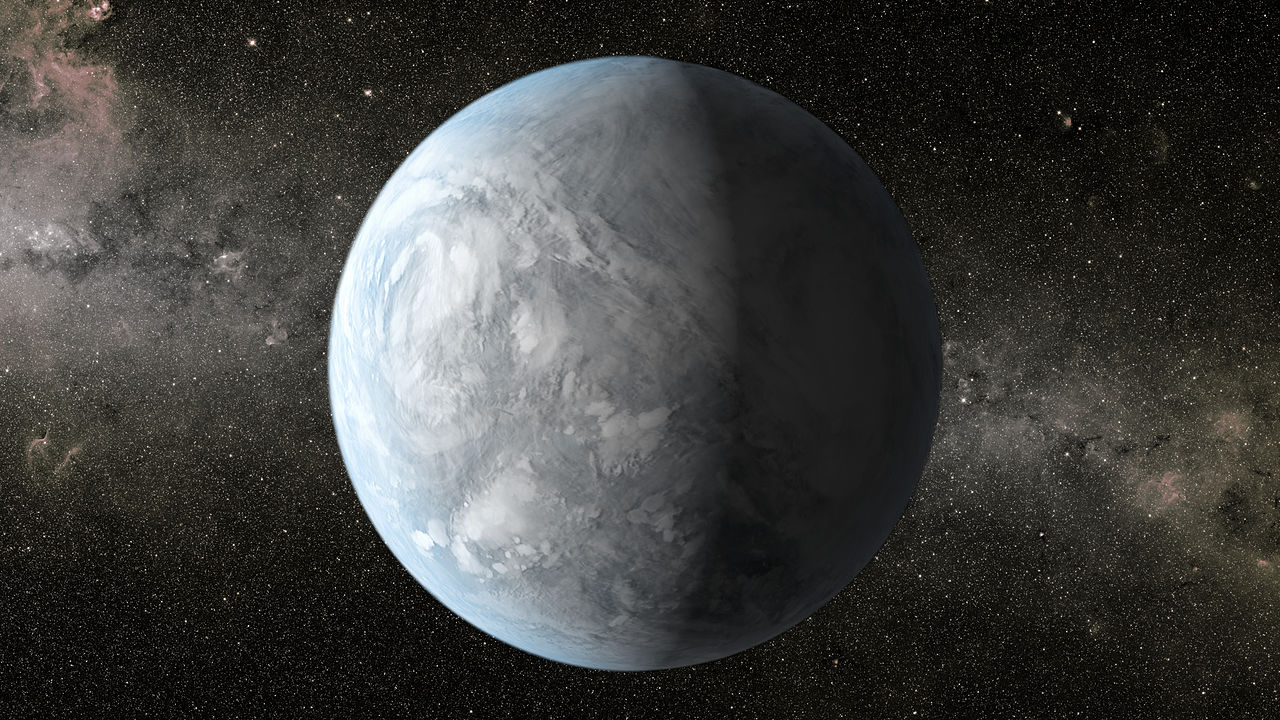





Physical characteristics
Kepler-62e has an estimated radius of about 1.6 times that of Earth, placing it in the class often called super-Earths. Its mass has not been directly measured by radial-velocity techniques; theoretical mass estimates that match the observed radius cover a range of compositions. Models consistent with the size include a predominantly rocky world with a higher mass than Earth or a planet with a substantial water layer and lower bulk density. The planet completes an orbit in roughly 122 days, receiving less total energy than Earth does from the Sun but, because its host star is cooler and less luminous, the orbital distance corresponds to temperate conditions by common definitions of the habitable zone.
Context and discovery
Kepler-62e is one of five known planets in the Kepler-62 system. The transit signals that revealed the planets were confirmed through analysis of multiple periodic dips in the star's light curve and statistical validation of the multi-planet configuration. Multi-planet systems provide additional confidence in the planetary interpretation and help researchers study the system architecture and potential dynamical interactions.
Habitability and composition
Interest in Kepler-62e largely stems from its location within the habitable zone and its size. Several modeling studies have explored scenarios in which the planet could be an "ocean world" with extensive surface or subsurface water and a thick, possibly cloudy atmosphere, producing warm and humid surface conditions. Alternative models place it as a rocky super-Earth with an atmosphere that may permit temperate climates. Because the planet's mass, atmospheric composition, and surface conditions are not yet measured directly, such scenarios remain speculative and are presented cautiously.
Scientific importance and limitations
Kepler-62e is valuable as an example of a temperate super-Earth in a multi-planet system, useful for comparative studies of planet formation, interior structure, and potential habitability. Its great distance and the relative faintness of the host star limit current opportunities for direct atmospheric characterization with present instruments. Future observatories and improved techniques may help place firmer constraints on its mass, atmosphere, and surface environment, improving assessments of its potential to host liquid water.
Notable facts
- Part of a five-planet system discovered by the Kepler Space Observatory.
- Orbits in the system's habitable zone, with an orbital period near 122 days.
- Estimated radius about 1.6 times that of Earth; mass is model-dependent and not yet directly measured.
- Located toward the Lyra constellation, roughly 1,200 light-years from Earth.
Questions and answers
Q: What is Kepler-62e?
A: Kepler-62e is a super-Earth exoplanet that is in the habitable zone around the star Kepler-62.
Q: How far away is Kepler-62e?
A: Kepler-62e is over 1,200 light years away in the direction of the Lyra constellation.
Q: Who discovered Kepler-62e?
A: Kepler-62e was discovered by the Kepler Space Observatory in 2013.
Q: What is the size of Kepler-62e compared to Earth?
A: Kepler-62e is about 160% as large as Earth.
Q: What is the weight of Kepler-62e compared to Earth?
A: Kepler-62e is almost 450% as heavy as Earth.
Q: What is the habitable zone?
A: The habitable zone is the zone around a star where the temperatures on a planet can support liquid water.
Q: What are some characteristics of Kepler-62e?
A: Kepler-62e is a possible ocean world, and may have cloudy skies and may be warm and humid.
Related articles
Author
AlegsaOnline.com Kepler-62e — Super-Earth in the Habitable Zone of Kepler-62 Leandro Alegsa
URL: https://en.alegsaonline.com/art/52995
Sources
- science.sciencemag.org : science.sciencemag.org/content/340/6132/587
- space.com : space.com/20723-earth-like-alien-planets-habitable-zone-infographic.html