
Kepler-22b: a transiting exoplanet in the habitable zone of a Sun-like star
Kepler-22b is an exoplanet orbiting a G‑type star in Cygnus about 600 light‑years away. Discovered by Kepler and confirmed in 2011, it lies in its star's habitable zone though its nature and habitability are uncertain.
Kepler-22b is an extrasolar planet discovered by NASA's Kepler Space Telescope that attracted attention because it transits a Sun‑like star and orbits within the star's habitable zone. The system lies in the constellation Cygnus at a distance of roughly 600 light‑years from Earth. Kepler‑22b was one of the earliest Kepler discoveries announced as a confirmed planet (December 5, 2011) and played a notable role in early discussions about potentially habitable worlds beyond the Solar System. For general reference about its classification see exoplanet and for details about its host see host star.
Image gallery
8 Images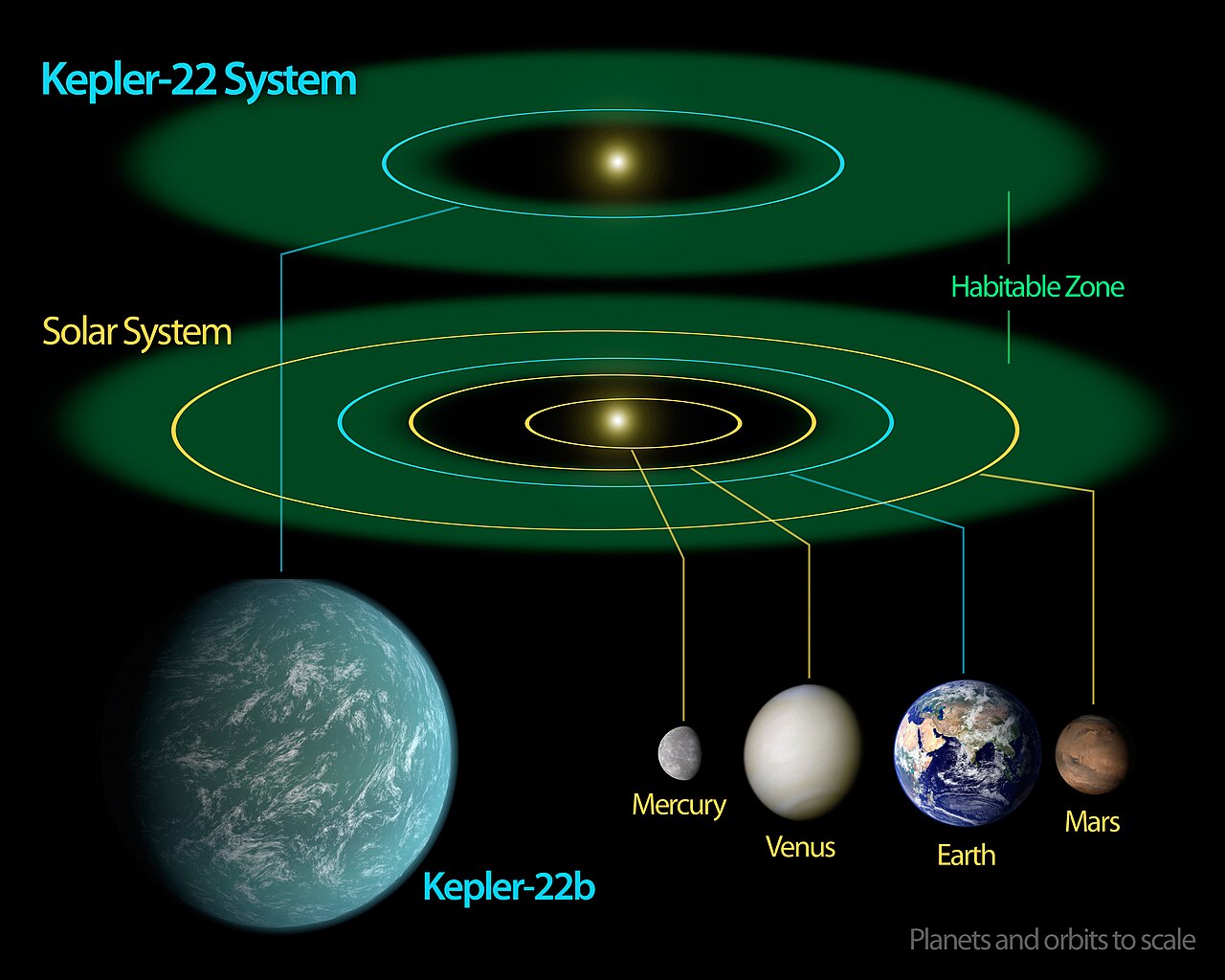






Basic characteristics
Kepler‑22b orbits a G‑type (Sun‑like) star designated Kepler‑22. The planet's orbital period is about 290 days, placing it within the region around the star where temperatures could permit liquid water on a rocky surface under suitable atmospheric conditions. Transit measurements indicate a radius larger than Earth's — roughly two to three times Earth’s radius — but its mass has not been precisely measured, so its bulk composition remains uncertain. The discovery relied on repeated dips in the star's brightness as the planet passed in front of it, a technique used throughout the Kepler mission; a general description of the mission is available via Kepler Space Telescope.
Discovery and observational history
The first transit attributed to Kepler‑22b was recorded in mid‑2009, early in Kepler's scientific operations. Additional transits were observed over the following months, and the target underwent follow‑up scrutiny with other facilities to rule out false positives. The Spitzer Space Telescope provided supplementary infrared observations that supported the transit interpretation. The planet's existence was publicly confirmed on December 5, 2011. For more about the supporting observations see Spitzer Space Telescope and for the mission organization see NASA.
What "in the habitable zone" means
Kepler‑22b is often described as lying in the habitable zone of its star, a term meaning the orbital range where surface temperatures could allow liquid water given a suitable atmosphere. This is a geometric and radiative concept rather than a guarantee of habitability. Whether a planet in that zone is actually habitable depends on many factors: composition, atmospheric pressure and chemistry, internal heat, and possible greenhouse effects. For background on the concept, see habitable zone.
Composition, climate scenarios, and uncertainties
Because only the planet’s size and orbital period are well constrained, scientists have proposed several plausible models for Kepler‑22b. It might be a dense water world with a deep global ocean; it could be a rocky super‑Earth with a thick atmosphere; or it could resemble a mini‑Neptune with a substantial gaseous envelope and no solid surface. Radial‑velocity follow‑up to measure mass was difficult because the host star is relatively faint and distant, limiting the precision of mass estimates. Those limitations mean that assessments of surface conditions and climate remain speculative rather than definitive.
Importance and legacy
Kepler‑22b's announcement was important because it showcased Kepler's ability to find transiting planets near Earth‑like orbital distances around Sun‑like stars and demonstrated the need for multi‑method follow‑up. It stimulated theoretical work on the potential climates of intermediate‑size planets and helped shape observational priorities for later missions aimed at characterizing atmospheres. The case of Kepler‑22b also illustrates a recurring theme in exoplanet science: a planet's presence in the habitable zone is a necessary but not sufficient condition for life.
Notable facts and references
- Host constellation and approximate distance: Cygnus, ~600 light‑years away (Cygnus, distance).
- Discovery and confirmation timeline: first Kepler transit mid‑2009, additional transits in 2010, confirmation announced in late 2011 (constellation note, Kepler Space Telescope).
- Follow‑up observations: space‑based infrared data from Spitzer aided vetting; professional observatories attempted radial‑velocity characterization with limited success.
- Why it matters: early example of a transiting planet within the habitable zone of a Sun‑like star and a case study for intermediate‑size planet composition and climate modeling (exoplanet studies).
For concise overviews and mission summaries, readers can consult general resources linked above. Kepler‑22b remains an instructive example of how detection, characterization, and habitability assessment are interrelated but distinct steps in the study of extrasolar worlds.
Questions and answers
Q: What is Kepler-22b?
A: Kepler-22b is an extrasolar planet that orbits a G-type star called Kepler-22.
Q: Where is it located?
A: It is located in the constellation Cygnus, about 600 light years away from Earth.
Q: How was it found?
A: It was found by NASA's Kepler Space Telescope.
Q: Is it the only planet orbiting the star?
A: The text does not mention if it is the only planet orbiting the star.
Q: What is significant about Kepler-22b?
A: Kepler-22b is notable for being the first known planet to orbit within the habitable zone of a Sun-like star.
Q: When were Kepler-22b's first and third transits observed?
A: Kepler-22b's first transit was observed on Kepler's third day of scientific operations in mid-2009, and its third transit was detected in late 2010.
Q: How was Kepler-22b's existence confirmed?
A: The Spitzer Space Telescope provided additional data that confirmed Kepler-22b's transits, and the confirmation of its existence was announced on December 5, 2011.
Related articles
Author
AlegsaOnline.com Kepler-22b: a transiting exoplanet in the habitable zone of a Sun-like star Leandro Alegsa
URL: https://en.alegsaonline.com/art/52992