
Antihydrogen — the antimatter counterpart of hydrogen
Antihydrogen is the antimatter form of hydrogen, made of an antiproton bound to a positron. Produced and trapped in labs, it is studied to test CPT symmetry, gravity on antimatter and annihilation processes.
Overview
Antihydrogen is the simplest neutral antimatter atom and the counterpart of ordinary hydrogen. As an atom of antimatter, it consists of an antiproton and a positron: the heavy antiparticle, the antiproton, plays the central role while the light antiparticle, the positron, is bound around it. When antihydrogen contacts ordinary matter, particle–antiparticle annihilation releases energetic photons and other particles, a clear experimental signature. Antihydrogen behaves chemically and quantum mechanically like hydrogen provided fundamental symmetries hold.
Image gallery
2 Images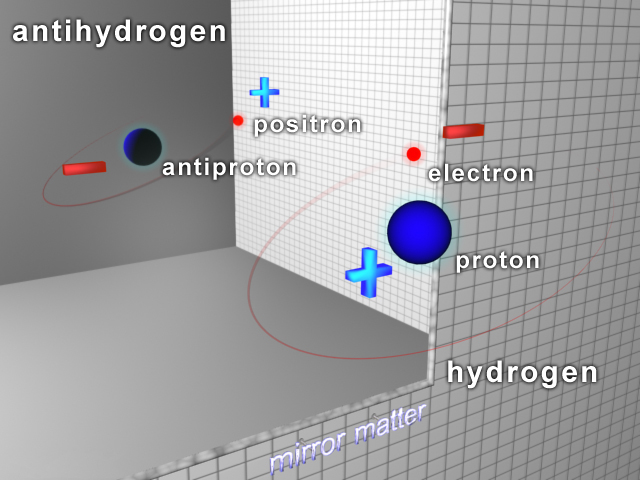

Composition and atomic properties
Structurally, antihydrogen parallels hydrogen: the antiproton corresponds to the ordinary proton and the positron corresponds to the electron. The positron carries positive electric charge (see positively charged) and is found orbiting the antiproton in bound quantum states. Predictions from quantum electrodynamics and CPT symmetry imply that spectral lines, energy levels and magnetic moments should match those of hydrogen; precise comparisons are an active experimental goal.
Production, trapping and detection
Antihydrogen is produced in particle physics laboratories where antiprotons and positrons are created separately and combined under controlled conditions. Typical methods slow charged antiparticles in electromagnetic traps and cool them so they can recombine into neutral antihydrogen. Because neutral anti-atoms cannot be confined by electric fields alone, experiments use magnetic minimum neutral-atom traps and related techniques to hold antihydrogen away from material walls long enough to measure properties.
- Antiprotons are supplied by accelerator facilities and stored in Penning-style traps.
- Positrons come from radioactive sources or pair-production systems and are accumulated before mixing.
- Detection relies on annihilation signals and spectroscopic observation of transitions.
Scientific importance
Antihydrogen offers a clean system for precision tests of fundamental physics. Experiments compare its spectral lines to hydrogen to probe CPT symmetry, investigate how gravity acts on antimatter, and study annihilation dynamics. Results constrain whether matter and antimatter are exact mirror images and inform cosmological questions about the matter–antimatter imbalance. Several international collaborations perform complementary measurements in dedicated facilities.
Molecular forms and terminology
Beyond single atoms, antimatter can form molecular analogues. A diatomic antimatter molecule analogous to H2 would contain two antiprotons bound with two positrons; in some contexts the word "Antihydrogen" may be used when discussing particular molecular or multi-particle bound states, but authors usually distinguish the single anti-atom from any molecular species (see molecule and general antimatter discussions).
Practical considerations and safety
Producing and keeping antihydrogen is technically demanding and expensive. Facilities follow strict procedures to prevent unintended annihilation and to record annihilation events for study. While large-scale energy production from annihilation remains impractical, controlled antihydrogen experiments yield valuable tests of fundamental laws and complement other precision measurements in particle physics.
For further background on constituent particles and basic concepts see entries on the antiproton, the positron, the ordinary electron and the proton.
Tags
Related articles
Author
AlegsaOnline.com Antihydrogen — the antimatter counterpart of hydrogen Leandro Alegsa
URL: https://en.alegsaonline.com/art/4651