
Hyperion (moon of Saturn)
Hyperion is an irregular, sponge-like moon of Saturn noted for its chaotic tumbling, low-density porous surface, heavy cratering, and detailed imaging by Voyager and Cassini spacecraft.
Overview
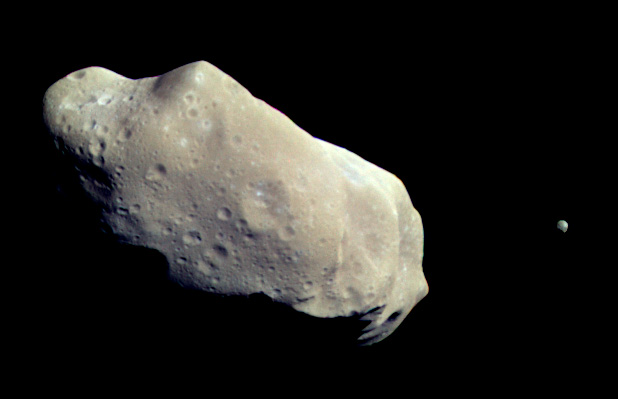
Hyperion is one of Saturn's more unusual satellites. First observed in 1848, it was discovered in 1848 by William Cranch Bond, George Phillips Bond and William Lassell. Unlike the rounded moons that dominate the outer Solar System, Hyperion is markedly irregular in shape and displays a distinctive, mottled, sponge-like surface that readily distinguishes it in spacecraft images; this texture has been widely discussed since high-resolution observations became available showing its sponge-like appearance.
Image gallery
10 Images






Physical characteristics
Hyperion is relatively small compared with Saturn’s major moons and is one of the largest bodies in the Solar System that is not in hydrostatic equilibrium (that is, it is not spherical). It has a low bulk density and a highly porous interior, implying a composition of water ice mixed with rock and a loosely consolidated structure. Its surface is heavily cratered with deep, sharp-edged pits that contribute to the overall sponge-like look.
Rotation and dynamics
A defining trait of Hyperion is that its rotation is chaotic. Instead of a steady spin with a fixed axis, Hyperion tumbles unpredictably over time. This behavior arises from its irregular shape and the complex gravitational torques it experiences from Saturn and other nearby bodies. The tumbling contrasts with the regular, stable spin of larger, tidally locked examples such as the Earth and the Moon, and makes Hyperion an important natural laboratory for studying celestial mechanics.
Discovery and exploration
Historically cataloged in the mid-19th century, Hyperion remained little studied until spacecraft visits. Voyager images provided the first close looks, and the Cassini mission later obtained much more detailed views and measurements. Those observations clarified the moon’s unusual topography and composition and helped scientists model its interior and rotational state.
Importance and comparisons
Hyperion is commonly cited as the second-largest irregular moon in the Solar System, a category that groups moons that have not become spherical under their own gravity; the largest of these irregular bodies is Proteus, according to standard listings of irregular moons. Because of its porosity, chaotic spin, and well-preserved craters, Hyperion provides insight into early Solar System processes, surface evolution on low-gravity bodies, and the dynamics of non-spherical satellites.
Notable facts
- Irregular, sponge-like surface with numerous deep craters.
- Low density and high porosity suggest a loosely bound interior.
- Exhibits chaotic rotational motion rather than steady axial spin.
- Studied in detail by Voyager and Cassini spacecraft.
Related articles
Author
AlegsaOnline.com Hyperion (moon of Saturn) Leandro Alegsa
URL: https://en.alegsaonline.com/art/46164