
Iapetus: Saturn's Two‑Faced Moon
Iapetus, a large moon of Saturn discovered by Cassini in 1671, is notable for its stark light‑and‑dark hemispheres, a surprising equatorial ridge, slow rotation, and puzzling origins explored by multiple spacecraft.
Overview
Iapetus is one of Saturn's most distinctive natural satellites. Discovered in 1671 by Giovanni Domenico Cassini, it stands out because one hemisphere is very bright and the other very dark. It is among the largest of Saturn's moons and follows an orbit that places it farther from the planet than many of the major inner satellites. Its name comes from a figure in Greek mythology, reflecting the convention of naming Saturnian moons after Titans.
Image gallery
10 Images





Physical characteristics
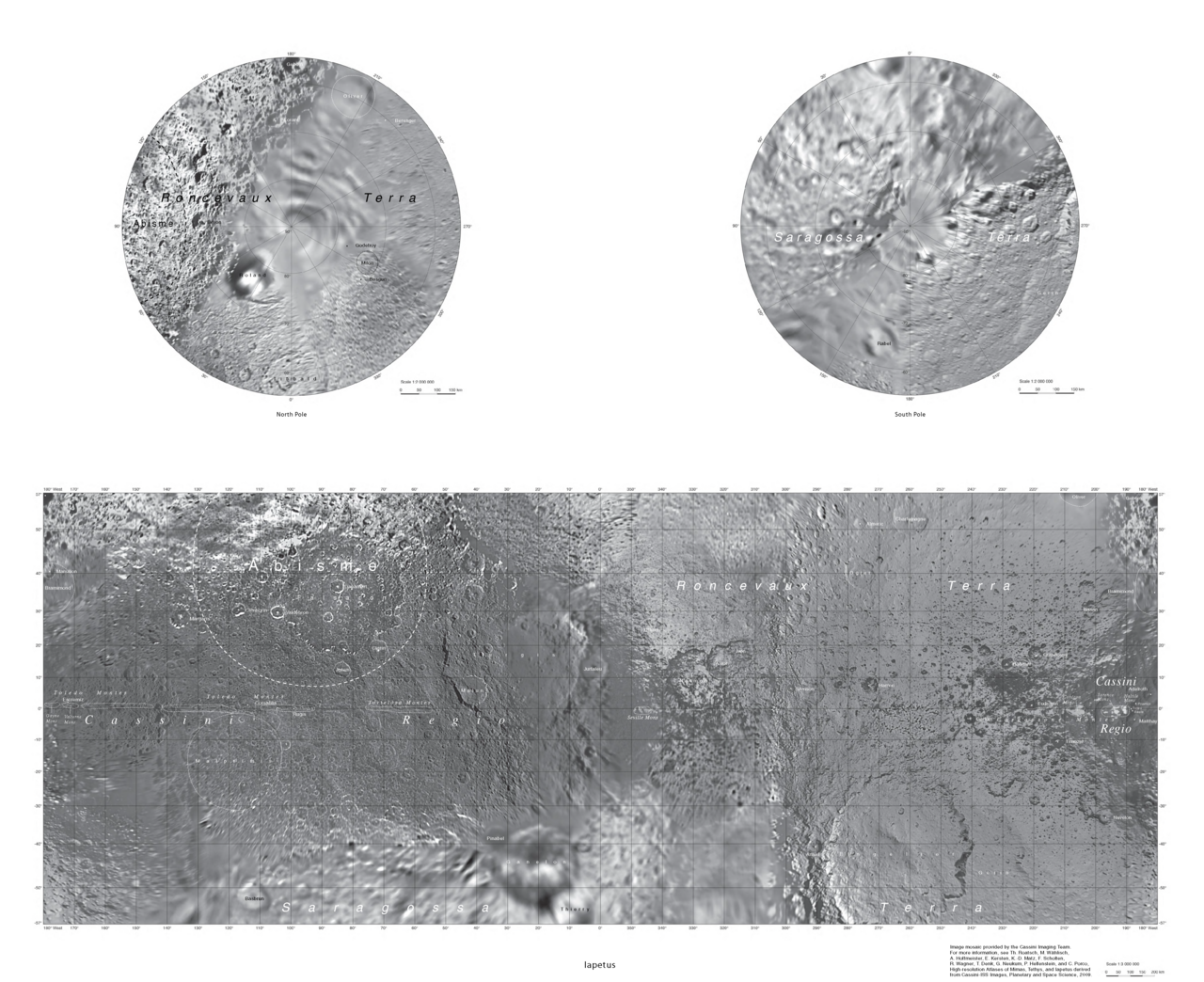
The most striking trait of Iapetus is its extreme albedo dichotomy: a dark region known as Cassini Regio covers much of the leading hemisphere, while the trailing hemisphere is bright and reflective, dominated by water ice. The surface is a mix of ice and rock, and the contrast in reflectivity produces strong temperature contrasts that affect surface processes. Iapetus rotates slowly, taking about 79 Earth days to complete one rotation, which is also its orbital period—so it always presents the same face to Saturn (synchronous rotation).
Discovery and exploration
Early telescopic observations led Cassini to note that Iapetus could sometimes be seen only on one side of Saturn, an observation later confirmed by space probes. Voyager 1 provided further evidence for the brightness difference, and detailed imaging by the Cassini–Huygens mission during multiple flybys beginning in 2004 revealed surprising new features, most notably a prominent equatorial ridge and diverse cratered plains.
Equatorial ridge and shape
One of Iapetus's most unusual landmarks is the long, narrow ridge that follows much of the moon's equator. The ridge gives Iapetus an irregular, almost walnut-shaped appearance and has been described in popular accounts as a continuous mountain range encircling the body. The ridge rises several kilometers above the surrounding terrain and extends for a very large distance along the equator; its origin remains debated.
Origin hypotheses
Scientists have proposed two broad types of explanations for Iapetus's features. The albedo dichotomy may result from exogenic deposition—dark material transported from outer, retrograde moons and distributed on Iapetus's leading side—or from thermal processes in which darker areas absorb more sunlight, driving sublimation of ice and migration of volatiles that accentuate brightness differences. The equatorial ridge has been attributed either to internal geologic uplift related to a past faster rotation and subsequent contraction, or to the collapse and accretion of a former ring or sub‑satellite onto the equator. Both lines of thought are supported by modeling and observational data but remain active areas of research.
Importance and notable facts
- Discoverer: Giovanni Domenico Cassini.
- Confirmed albedo contrast by Voyager 1 and studied in detail by Cassini missions.
- Distinct equatorial ridge documented by Cassini: often called a defining feature (equatorial ridge).
- Rotation and orbital synchronization: ~79 Earth days.
- Appearance described as walnut-shaped and featuring an encircling mountain range‑like ridge.
Iapetus remains a natural laboratory for studying surface alteration by external dust, the thermal behavior of volatile ices, and odd tectonic or accretionary events in the early Saturn system. Future observations and modeling may narrow the range of viable explanations for its dramatic contrast and unique ridge, offering insight into how moons evolve under combined internal and external influences.
Related articles
Author
AlegsaOnline.com Iapetus: Saturn's Two‑Faced Moon Leandro Alegsa
URL: https://en.alegsaonline.com/art/46349