
Hyrrokkin (Saturn moon)
Hyrrokkin is a small irregular retrograde moon of Saturn (~8 km across) discovered in 2006. It orbits at ~18.17 million km with high inclination and eccentricity and is named for a Norse giantess.
Overview
Hyrrokkin is one of Saturn's many irregular satellites: a small, distant moon that follows a highly inclined, eccentric, retrograde orbit. With a mean diameter of roughly 8 kilometres, Hyrrokkin is far too small to be spherical and is best understood as a capture or collisional fragment rather than a body formed in place around the planet. Its orbit and physical properties place it among the so-called Norse group of Saturnian satellites, a population that shares similar orbital directions and distances.
Image gallery
4 Images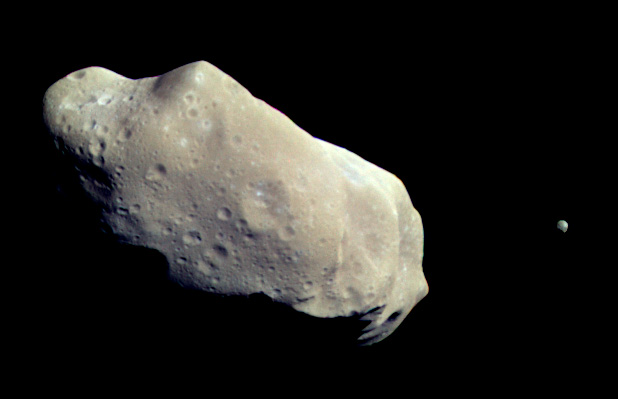


Physical and orbital characteristics
The moon orbits Saturn at an average distance of about 18,168,300 kilometres and completes one revolution in approximately 914.3 days. Its orbit is markedly eccentric (e ≈ 0.3604) and inclined at about 153.3° to the ecliptic (roughly 154.3° to Saturn's equator), which means it moves in the opposite sense of Saturn's rotation (a retrograde orbit). Because Hyrrokkin is small and remote, its surface is presumed to be dark and heavily cratered, with low reflectivity typical of irregular satellites; detailed composition and topography are unknown due to its faintness and limited observations.
Discovery and naming
Observations that led to the identification of Hyrrokkin were taken between December 2004 and April 2006. The discovery was announced on 26 June 2006 by a team including Scott S. Sheppard (discovery announcement), David C. Jewitt (report), Jan Kleyna and Brian G. Marsden. Orbital details and measurements have been catalogued by groups that track outer satellites (orbital data) and updated as further observations refined its path (element summary).
In April 2007 the moon received its official name, Hyrrokkin, after a giantess of Norse mythology who helped launch the funeral ship Hringhorni for the god Baldr. The spelling was briefly published in error as "Hyrokkin" before being corrected in the formal naming citation (naming citation).
Context and significance
Hyrrokkin and other irregular satellites are valuable to planetary scientists because their orbits, sizes, and compositions preserve evidence about the dynamical environment of the outer Solar System. Groups like the Norse cluster hint at past collisional events or common capture origins: similarities in orbital direction and semi-major axis suggest that some members may be fragments of a larger progenitor that broke apart. Studying these small moons helps constrain models of satellite capture, migration, and collisional history around the giant planets.
Key facts and notable points
- Designation: Saturn XLIV, provisional S/2004 S 19.
- Approximate diameter: ~8 km.
- Average orbital distance: ~18,168,300 km from Saturn; orbital period ~914.3 days.
- Inclination and motion: ~153.3° to the ecliptic; retrograde orbit, eccentricity ≈ 0.3604.
- Group: Part of the Norse irregular satellites — characterized by retrograde, distant orbits.
- Naming: After the Norse giantess Hyrrokkin; initial published spelling later corrected.
Because Hyrrokkin is faint and small, many detailed properties — such as precise mass, composition, rotation rate and surface geology — remain uncertain. Future observations with larger telescopes or targeted missions would be required to improve knowledge beyond the basic orbital and size estimates gathered since its discovery.
Related articles
Author
AlegsaOnline.com Hyrrokkin (Saturn moon) Leandro Alegsa
URL: https://en.alegsaonline.com/art/46222
Sources
- ifa.hawaii.edu : Institute for Astronomy Saturn Satellite Data
- cfa-www.harvard.edu : IAUC 8727: Satellites of Saturn
- cfa-www.harvard.edu : MPEC 2006-M44: S/2004 S 19
- cfa-www.harvard.edu : IAUC 8826: Satellites of Jupiter and Saturn
- cfa-www.harvard.edu : IAUC 8860: Saturn XLIV (Hyrrokkin)