
Sponge (Porifera): structure, ecology, and evolutionary significance
Sponge (phylum Porifera) — simple, mostly marine animals with porous bodies, filter-feeding habits, long fossil record, and important ecological roles in aquatic ecosystems.
Overview
Sponges are sedentary aquatic animals in the phylum Porifera. They lack organs such as a mouth, digestive tract, heart or brain, yet are composed of many specialized cell types. Most species live attached to substrates in marine environments, although some freshwater forms exist. Sponges feed by moving water through a system of pores and chambers, extracting microscopic food particles as a group of cells makes up much of their physiology.
Image gallery
6 Images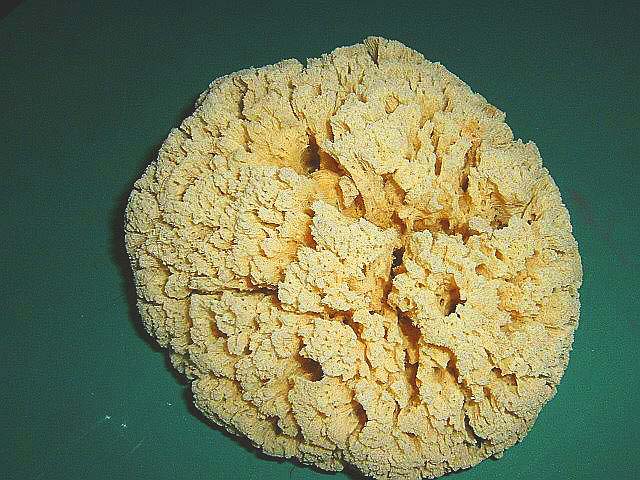



Structure and function
At the basic level a sponge's body is built from two cell layers separated by a gelatinous matrix called the mesohyl. The external layer is formed by epithelial-like cells, while internal choanocyte cells — flagellated collar cells — generate water flow and capture food. Water enters through numerous small pores, passes through canals and choanocyte-lined chambers, and exits by a larger opening or multiple oscula. Structural support is provided by spicules (made of silica or calcium carbonate) and/or spongin fibers.
- Pores and canals: permit continuous water circulation for feeding and gas exchange.
- Choanocytes: drive filtration and trap bacteria and planktonic particles.
- Mesohyl: a connective matrix where amoeboid cells move, digest, and differentiate.
- Spicules and spongin: provide rigidity and defense.
Evolutionary history and classification
Sponges are among the oldest animal lineages with a fossil record extending into the late Precambrian. Their simple organization has made them central to studies of early animal evolution and the origins of multicellularity. Taxonomically, Porifera is divided into classes such as Demospongiae, Calcarea and Hexactinellida, distinguished by skeletal composition and body plan. See general resources for taxonomy and classification: overview, morphology.
Ecological role and human uses
Sponges play several ecological roles: they are efficient filter feeders that help clarify water, form habitat for small animals, and participate in nutrient cycling by converting dissolved organic matter into forms accessible to other organisms. Some sponges host diverse microbial communities that can perform photosynthesis or nitrogen fixation. In human contexts, natural sponges were harvested for bathing and cleaning, and sponges or sponge-derived compounds continue to be investigated for pharmaceutical applications and biotechnology.
Diversity, reproduction, and notable facts
There are thousands of described sponge species, the majority marine but with important freshwater representatives. Sponges reproduce both sexually — producing free-swimming larvae — and asexually through budding or fragmentation. Many species can regenerate from small pieces. Some noteworthy points: glass sponges can form deep-sea reefs; certain tropical sponges contain chemical defenses that deter predators or fouling; and sponge-associated microbes produce bioactive molecules of interest to medicine and industry. For distribution and species lists consult databases and conservation sources: marine, freshwater.
Importance and distinctions
Sponges differ from plants and most other animals by their sessile lifestyle and lack of true tissues in the conventional sense, yet they are unequivocally animals, exhibiting unique cell-to-cell interactions and developmental processes. Their simple anatomy masks complex ecological interactions and biochemical diversity. For accessible general introductions and further reading, see introductory materials, specialist reviews at research summaries, conservation notes at policy pages, and educational resources at teaching portals.
Questions and answers
Q: What is a sponge?
A: A sponge is a member of the phylum Porifera, which is a simple animal with many cells, but no mouth, muscles, heart or brain.
Q: How does a sponge move?
A: A sponge is sessile, which means it cannot move from place to place the way most animals can.
Q: How does a sponge feed?
A: Most sponges feed on bacteria and other microorganisms, while a few of them eat tiny crustaceans. They filter (take out) little bits of food from the water going through their bodies.
Q: Where do most sponges live?
A: Most sponges live in the ocean, while a few live in fresh water.
Q: How does water circulate through a sponge's body?
A: A sponge's body is full of pores and channels allowing water to circulate through them.
Q: How many species of sponge are there?
A: There are more than 10,000 species of sponge.
Q: What makes sponges unique in the animal kingdom?
A: Sponges are the oldest animals with fossil evidence, dating back to ~635 million years ago.
Related articles
Author
AlegsaOnline.com Sponge (Porifera): structure, ecology, and evolutionary significance Leandro Alegsa
URL: https://en.alegsaonline.com/art/92764
Sources
- ncbi.nlm.nih.gov : "The Amphimedon queenslandica genome and the evolution of animal complexity"
- ui.adsabs.harvard.edu : 2010Natur.466..720S
- doi.org : 10.1038/nature09201
- pubmed.ncbi.nlm.nih.gov : 20686567
- cejsh.icm.edu.pl : "Animals die more shallowly: they aren't deceased, they're dead. Animals in the polish linguistic worldview and in contemporary life sciences"
- doi.org : 10.17951/et.2017.29.135
- livescience.com : "Traces of Earth's oldest animals possibly found"
- doi.org : 10.1002/ar.10162
- books.google.com : Systema Porifera: A Guide to the Classification of Sponges
- doi.org : 10.1017/S0025315407058237
- mapress.com : "A new genus of carnivorous sponges (Porifera: Poecilosclerida, Cladorhizidae) from the deep N-E Pacific, and remarks on the genus Neocladia"
- doi.org : 10.1017/S0025315407058560
- doi.org : 10.1038/373333a0
- precedings.nature.com : "New species from the deep Pacific suggest that carnivorous sponges date back to the Early Jurassic"