
IC 10 — irregular starburst galaxy in Cassiopeia
IC 10 is a nearby irregular starburst galaxy in Cassiopeia, a member of the Local Group notable for its high density of Wolf–Rayet stars, large hydrogen envelope, and heavy obscuration by the Milky Way.
IC 10 is a small irregular galaxy located in the northern constellation Cassiopeia. It is catalogued as IC 10 in the Index Catalogue (IC) and lies close enough to be a member of the Local Group of galaxies. IC 10 is unusual among Local Group members because it is undergoing a mild but sustained episode of enhanced star formation and is commonly described as the only known starburst galaxy in the group. The galaxy is seen through a dense region of the Milky Way and so is heavily reddened by foreground dust and gas, which makes optical study challenging.
Image gallery
3 Images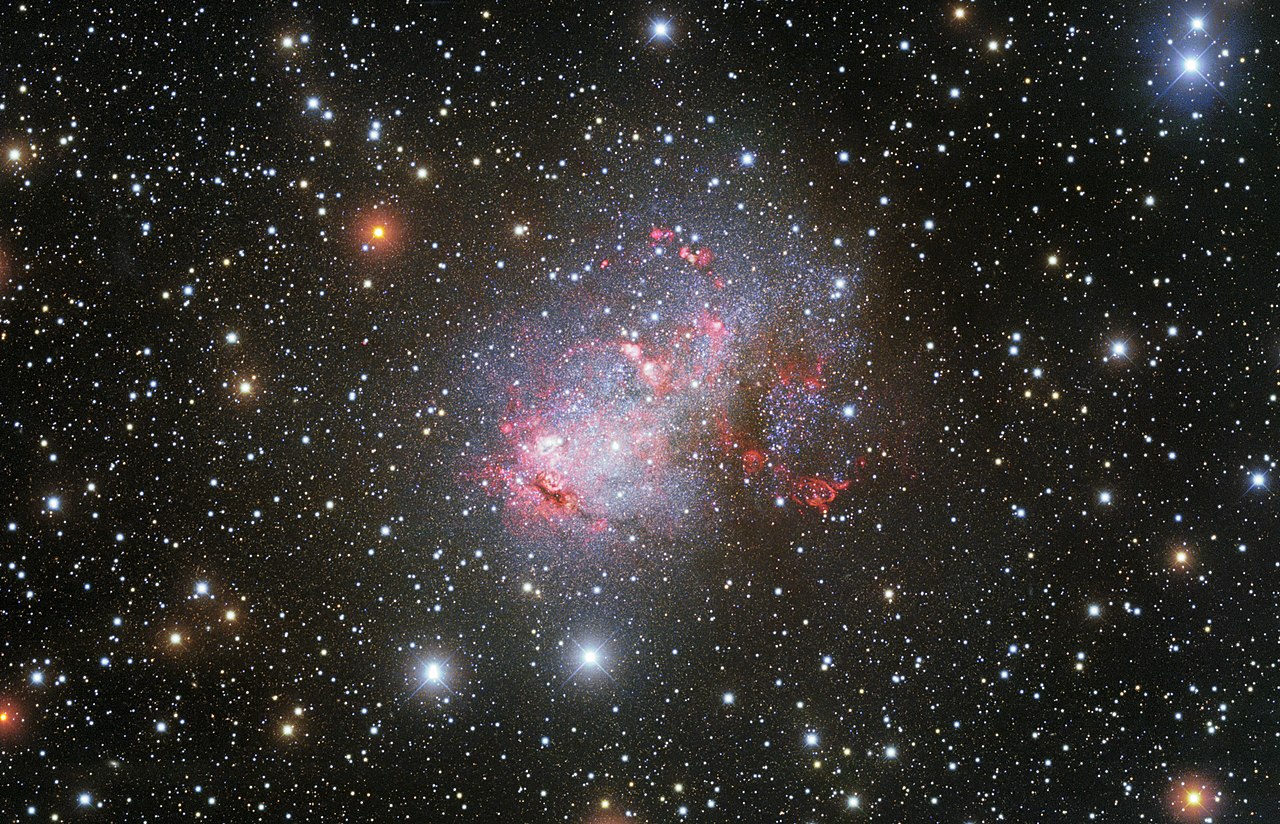


Physical characteristics
IC 10 is classified as an irregular system without a clear spiral structure. In visible light its main body subtends only a few arcminutes — about 5.5′ × 7.0′ — but it is embedded in a vastly larger envelope of neutral hydrogen whose apparent extent has been measured as roughly 68′ × 80′. The galaxy contains an H II nucleus indicating centers of ionized gas and ongoing star formation. Its measured radial velocity shows it is moving toward our Galaxy at roughly 350 km/s, supporting its proximity to the Local Group.
Key properties and notable measurements include:
- Membership: confirmed Local Group galaxy by distance measurements using Cepheid variables.
- Star formation: a star formation rate estimated at about 0.04–0.08 solar masses per year, sufficient to continue forming stars for a few billion years at current rates.
- Wolf–Rayet content: an unusually high surface density of Wolf–Rayet stars (roughly 5.1 stars per kpc²), implying a recent burst of massive-star formation.
- Gas reservoir: a large hydrogen envelope that extends well beyond the optical disk.
Discovery and confirmation of distance
IC 10 was first recorded in the late 19th century and identified as a nebulous object in Cassiopeia. The galaxy’s status as a nearby system was suggested early on by astronomers including Edwin Hubble, though its membership in the Local Group was debated for decades because accurate distances were hard to obtain. The galaxy’s radial motion and later detection of classical pulsating stars solved the question: radial-velocity measurements made in the 1960s showed IC 10 is approaching the Milky Way, and precise distance estimates based on variable stars (Cepheids) in the 1990s confirmed it lies at a distance consistent with Local Group membership.
Interstellar environment and observational challenges
Because IC 10 is observed through a low Galactic latitude region, interstellar extinction by Galactic interstellar matter and dust significantly dims and reddens its light. Far-infrared observations reveal that the internal dust composition of IC 10 appears deficient in the smallest grain sizes, perhaps because harsh ultraviolet radiation from hot young stars destroys or modifies those grains. The combination of foreground obscuration and intrinsic dust properties means that multiwavelength observations — radio, infrared and optical spectroscopy — are necessary to form a complete picture of the galaxy.
Structure, dynamics and subgroup associations
Radio mapping of neutral hydrogen has shown both the enormous gaseous halo and a curious kinematic decoupling: the inner, optically bright region and the outer H I envelope can appear to rotate in different directions. This may reflect past interactions, accretion of gas, or dynamical evolution distinct from isolated dwarf galaxies. On the sky the separation between IC 10 and the Andromeda Galaxy (M31) is comparable to the separation between Andromeda and the Triangulum Galaxy (M33), which has led to suggestions that IC 10 belongs to the M31 subgroup inside the Local Group, influencing models of local galaxy grouping and dynamics.
Scientific importance and ongoing study
IC 10 provides a nearby laboratory for studying massive star formation, the lifecycle of Wolf–Rayet stars, and the interplay between intense radiation fields and interstellar dust. Its relative proximity makes it valuable for resolving individual stellar populations and for calibrating star-formation diagnostics that are applied to more distant starburst systems. Current and planned observations at radio, infrared and optical wavelengths aim to refine its star-formation history, map molecular clouds, and understand the origin of its extended hydrogen envelope. For further reading on related topics see studies of irregular galaxies, Local Group dynamics and the impact of stellar feedback on galactic dust (constellations, galactic plane, stellar evolution, far-infrared, dust).
Because IC 10 is a compact, actively star-forming system obscured by foreground material, astronomers rely on a mix of observational techniques to study it: radio H I and molecular line mapping to reveal gas structure and dynamics, near- and mid-infrared imaging to penetrate dust, and optical spectroscopy to identify massive stars and ionized regions. These complementary approaches continue to improve our understanding of how small galaxies form stars and evolve within the Local Group environment (IC catalog, Local Group, galaxies, Milky Way, Cepheids).
Questions and answers
Q: What constellation is IC 10 located in?
A: IC 10 is located in the constellation Cassiopeia.
Q: When was IC 10 discovered?
A: IC 10 was discovered in 1887.
Q: How fast is IC 10 approaching the Milky Way?
A: IC 10 is approaching the Milky Way at about 350 km/s.
Q: How did astronomers confirm that it belonged to the Local Group of galaxies?
A: Astronomers confirmed that it belonged to the Local Group of galaxies by measuring its distance using observations of Cepheids in 1996.
Q: What makes studying this galaxy difficult?
A: Studying this galaxy is difficult because it lies near the galactic plane of the Milky Way and is heavily obscured by interstellar matter.
Q: How many Wolf-Rayet stars are there per square kiloparsec compared to other galaxies in the Local Group?
A: There are 5.1 Wolf-Rayet stars per square kiloparsec, which is more than double those found in either the Large Magellanic Cloud (2.0 stars/kpc²) or Small Magellanic Cloud (0.9 stars/kpc²).
Related articles
Author
AlegsaOnline.com IC 10 — irregular starburst galaxy in Cassiopeia Leandro Alegsa
URL: https://en.alegsaonline.com/art/46395
Sources
- messier.seds.org : "IC 1"
- arxiv.org : astro-ph/9910564
- ui.adsabs.harvard.edu : 2000ApJ...532..909B
- doi.org : 10.1086/308590
- arxiv.org : astro-ph/0001040
- ui.adsabs.harvard.edu : 2000PASP..112..529V
- doi.org : 10.1086/316548
- adsabs.harvard.edu : "A search for 'dwarf' Seyfert nuclei. III: Spectroscopic parameters and properties of the host galaxies"
- doi.org : 10.1086/313041