
IC 418 — the Spirograph Nebula
IC 418 is a compact planetary nebula in Lepus, about 1,100 light-years away. Noted for concentric shells and fine filamentary structure, it is a common target for detailed imaging and spectroscopic study.
IC 418 is a compact planetary nebula in the southern sky, located in the constellation Lepus (Lepus). At an estimated distance of roughly 1,100 light-years from Earth, it is relatively nearby by nebular standards and therefore has a comparatively high surface brightness for its apparent size. It is often called the "Spirograph Nebula" because high-resolution images reveal concentric shells and delicate filamentary detail reminiscent of a spirograph pattern.
Image gallery
1 Image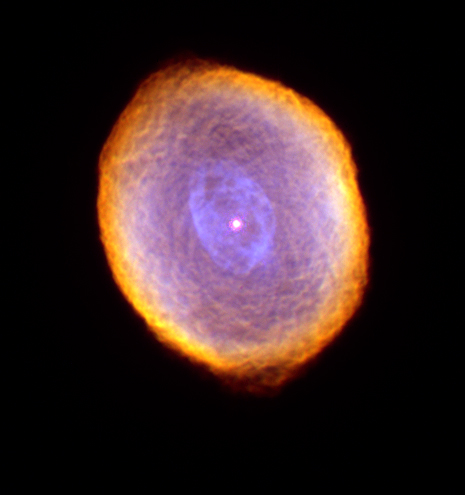
Appearance and spectrum
Through small or medium telescopes IC 418 typically appears as a small, bright oval or disc; long-exposure and space-based images resolve multiple shells and small-scale structure. Its visible glow is produced by gas ionized by the hot central star, with prominent emission lines from hydrogen and common nebular ions such as oxygen and nitrogen. Spectra show the familiar emission-line pattern of planetary nebulae, and detailed spectroscopy is used to measure chemical abundances, electron temperatures and densities.
Central star and formation
The central object is the exposed core of a star that has shed its outer layers during the asymptotic giant branch phase. Ultraviolet radiation from the hot central star ionizes the ejected material. The concentric shells and nested structures are interpreted as signatures of episodic mass loss and the interaction between a fast stellar wind and previously expelled, slower material.
Scientific value and observations
IC 418 is a useful target for studies of late-stage stellar evolution, wind interactions, and nebular chemistry. Because it is compact and bright it serves as a test case for photoionization models and for comparing imaging techniques. Observations with ground-based telescopes and instruments such as the Hubble Space Telescope have revealed fine morphological details that inform models of shell formation and shaping mechanisms.
Viewing tips
- Best seen from mid- to southern latitudes where Lepus is well placed in the evening sky.
- Appears compact; moderate to large amateur telescopes with high magnification render the disc, while long-exposure imaging shows concentric shells.
- Narrowband filters centered on hydrogen and oxygen emission lines improve contrast against the background sky.
Related articles
Author
AlegsaOnline.com IC 418 — the Spirograph Nebula Leandro Alegsa
URL: https://en.alegsaonline.com/art/46398