
White-lipped tree frog (Litoria infrafrenata)
A large Australasian tree frog species, the white-lipped tree frog is notable for its size, broad distribution in New Guinea and northern Australia, diet of insects, and use in the pet trade.
Overview
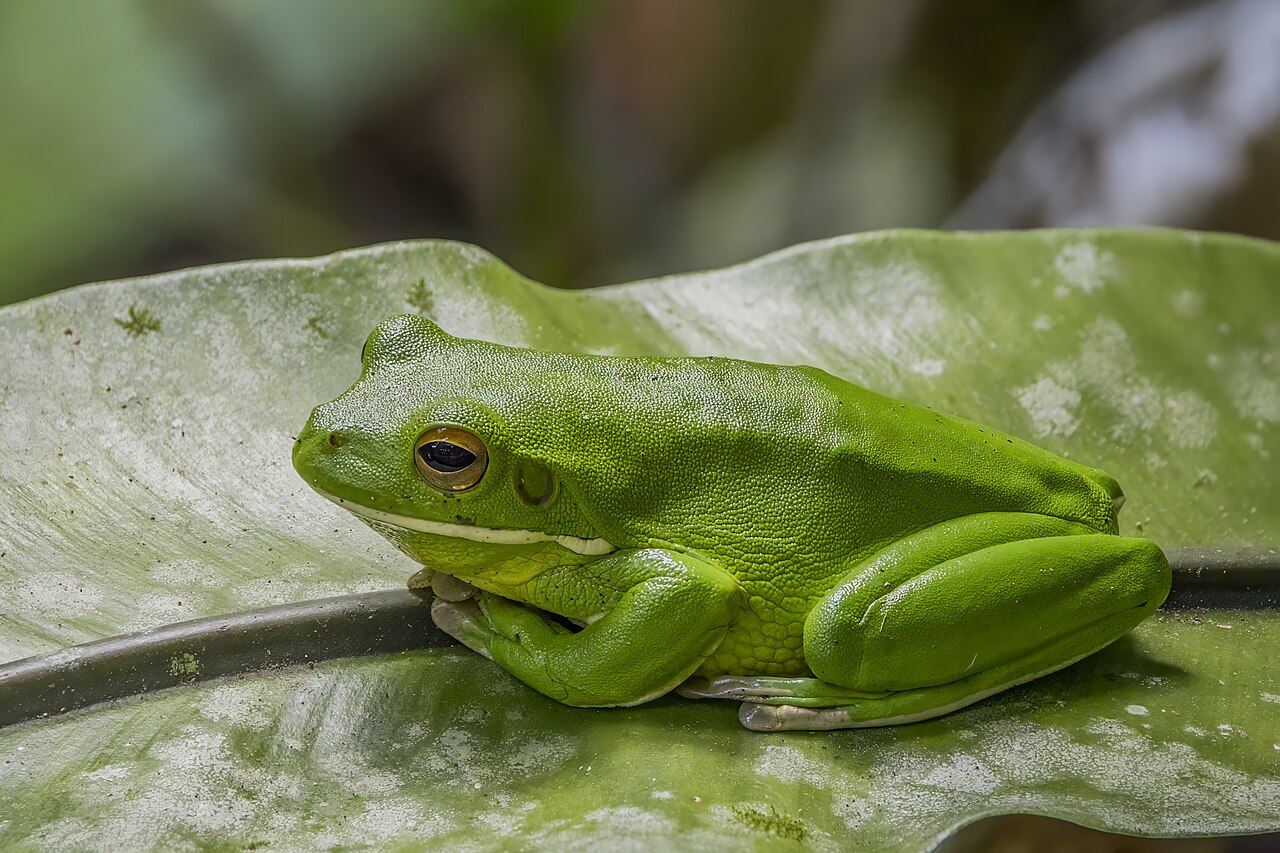
The white-lipped tree frog (Litoria infrafrenata), often called the giant tree frog, is a large arboreal frog native to parts of northern Australia, New Guinea and nearby island groups. It belongs to the Australasian tree frog assemblage and is one of the largest species of tree frog worldwide. The common name refers to a pale line that may border the upper lip in many individuals.
Image gallery
4 Images


Physical characteristics
This species is robust and relatively heavy-bodied compared with many other tree frogs. Adults commonly grow substantially larger than most hylids, with body lengths often exceeding 10 cm in mature individuals; females are usually larger than males. The skin is smooth and can vary from pale green to olive or brownish tones, sometimes with mottling or a yellowish belly. The toe pads are expanded for climbing, and the species has strong limbs suited to a largely arboreal life.
Distribution and habitat
The white-lipped tree frog occurs across a broad region of northern Australia, including parts of Queensland, and on the island of New Guinea as well as the Bismarck and Admiralty Islands. It occupies rainforest, woodland and human-modified habitats such as gardens and farms, typically close to standing water where breeding can occur. For general background on the group, see species overview and broader treatment of tree frogs.
Behavior, diet and reproduction
White-lipped tree frogs are primarily nocturnal. They are good climbers, spending much time in vegetation but often descending to breed in ponds and still water after rain. Their call is a loud, resonant note used by males to attract females. Their diet consists mainly of insects and other arthropods, captured with a sticky tongue from foliage or the ground; larger individuals may take bigger prey on occasion. For general information about the region, see New Guinea and its fauna.
Captive care and human interactions
These frogs are sometimes kept in captivity because of their striking appearance and relatively calm nature. In parts of Australia they are regulated and ownership may require a license; local rules differ, so prospective keepers should consult authorities. Basic captive care includes a tall terrarium with branches for climbing, a shallow water area for breeding and hydration, and a diet of suitable live invertebrates. For feeding guidance see resources on insect diets at dietary references and on Australian regulations at national or state sites. Pet care references and licensing information can be found via keepers' guides.
Conservation and notable facts
Overall the white-lipped tree frog is not currently regarded as one of the most threatened frog species across its range, and it adapts to disturbed habitats in many areas. Still, like many amphibians it faces risks from habitat loss, disease and environmental change. Notable points are its status as one of the largest tree frogs, its adaptability to a range of wetland and forest-edge habitats, and its presence in the pet trade where regulation varies by jurisdiction.
Key identification and care tips
- Identification: pale upper lip margin, large size, smooth green to olive skin.
- Habitat: rainforests, woodlands and garden areas near still water.
- Diet: primarily insects and arthropods.
- Care: provide vertical climbing space, humidity, water for breeding, and appropriate live food.
Related articles
Author
AlegsaOnline.com White-lipped tree frog (Litoria infrafrenata) Leandro Alegsa
URL: https://en.alegsaonline.com/art/38717
Sources
- eol.org : EOL.org
- iucnredlist.org : Litoria infrafrenata